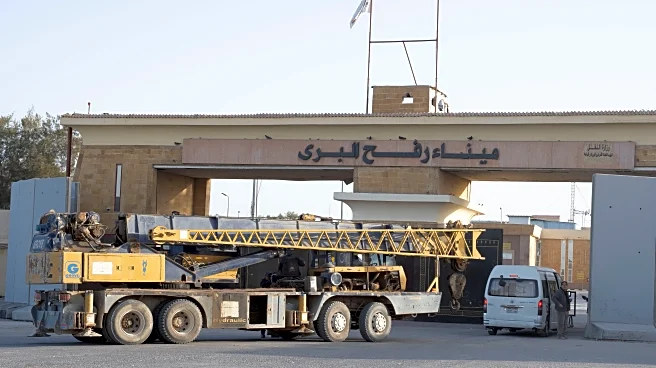




CAIRO (AP) — Before the war, the Rafah border crossing was Gaza's only gateway to the outside world not controlled by Israel. When Israeli troops seized it in May 2024, that gateway was shuttered. It has now reopened, Egyptian and Israeli officials said Monday — but with tight restrictions.
Only a trickle of Gaza's tens of thousands of wounded and sick Palestinians will be allowed out each day, Israel says.
Still, the reopening shows that the ceasefire
in the two-year war between Israel and Hamas is moving forward and provides a glimmer of hope for Palestinians seeking to leave the strip — and those wishing to return home.
Rafah;s reopening will make it easier for Gazans to seek medical treatment, travel internationally or visit family in Egypt, which is home to tens of thousands of Palestinians. It could also help Gaza’s devastated economy, as Palestinian-made olive oil and other products are widely sold in Egypt and throughout the Arab world.
“We hope this will close off Israel’s pretexts and open the crossing,” said Abdel-Rahman Radwan, a Gaza City resident whose mother is a cancer patient and requires treatment outside Gaza.
Israel also has said Palestinians wanting to leave Gaza will have to get Israeli and Egyptian security approval. Egypt has been opposed to Palestinian refugees permanently resettling in that country.
With much of Gaza turned to rubble, the United Nations has said the Palestinian territory’s population of over 2 million people needs a massive influx of fuel, food, medicine and tents. While some aid has entered via the crossing, trucks have been lined up outside it for months while waiting for the chance to enter.
Before the war, the Rafah crossing bustled with goods and people. Although Gaza has four other border crossings, they are shared with Israel and only Rafah links the territory with another neighboring country.
After Hamas-led militants sparked the war by attacking southern Israel on Oct. 7, 2023, Egypt tightened its restrictions on traffic through the Rafah crossing. Israel took control of the Gaza side in May 2024 as part of its offensive and closed the crossing except to the occasional medical evacuation.
The Gaza side of the Rafah crossing was heavily damaged during the war.
With the current ceasefire deal calling for Hamas to have no role in running Gaza, it’s unclear who will operate the territory’s side of the Rafah crossing once the war ends. Currently an EU mission is running the crossing with assistance from Palestinian workers. Israel says it is subjecting Palestinians to security checks once inside Gaza.
The crossing also will be central to Gaza's reconstruction. Last week, U.S. President Donald Trump’s son-in-law and Middle East adviser Jared Kushner said postwar construction would first focus on building “workforce housing” in Rafah, the nearby southern city currently controlled by Israeli troops.
But Netanyahu on Monday told Israel's parliament, the Knesset: “We are at the start of the next (ceasefire) phase. What is the next phase? The next phase is disarming Hamas and demilitarizing the Gaza Strip. The next phase is not reconstruction.”
___
Associated Press reporters Samy Magdy in Cairo, Farnoush Amiri at the United Nations and Melanie Lidman in Tel Aviv, Israel, contributed to this report.
___
Find more of AP’s coverage at https://apnews.com/hub/israel-hamas-war