








NEW DELHI (AP) — Indian authorities are seeking to recover the body of a climber known as “Green Boots” from the upper slopes of Mount Everest, nearly three decades after the mountaineer died on the world’s highest peak.
The Indo-Tibetan Border Police, an Indian paramilitary force, has begun the process of hiring high-altitude recovery specialists to retrieve what it believes is the body of Dorje Morup from Everest’s northern route in Tibet.
Morup was
part of a six-member Indo-Tibetan Border Police expedition on Everest in May 1996. As weather conditions deteriorated near the summit, three climbers turned back, while Morup and two colleagues continued their ascent. All three died in the storm that claimed eight lives across multiple expeditions in what was one of Everest's deadliest disasters at the time.
Morup’s remains, widely known as “Green Boots” because of the bright-green mountaineering boots he wore, lie in Everest’s so-called death zone above 8,000 meters (26,247 feet). His body has long served as a landmark for climbers on the mountain’s northeast route.
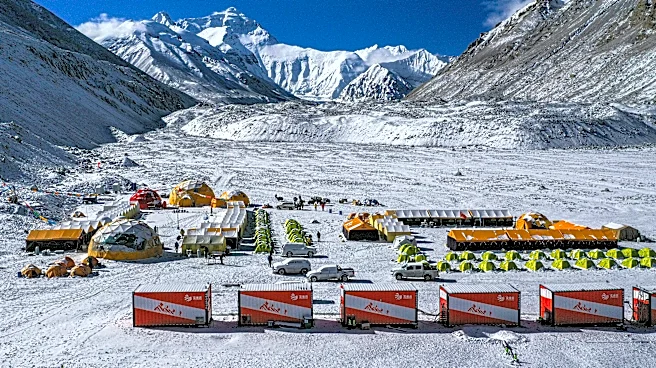
The remains are on Everest’s Tibetan side, where access is controlled by Chinese authorities and climbing permits are tightly regulated. China closed the mountain to foreign climbers during the 2026 spring climbing season without publicly explaining the decision.
The hiring of the specialists is the first step toward recovering the body, though the operation would still depend on Chinese approval and favorable weather.
It was not immediately clear whether the recovery would be carried out by an Indian, Nepali or Chinese team. Chinese authorities have not publicly commented on the plan.
“It is not impossible to retrieve the body from Everest, but the first challenge is getting permission from the Chinese officials and then only can they proceed to bring the body down,” said Pemba Sherpa, founder of the Kathmandu-based Xtreme Climbers Treks and Expedition.
Nearly 350 people have died while climbing Mount Everest since it was first conquered in 1953. Many bodies are left on its icy slopes because recovery attempts are risky and expensive.
Retrieving bodies from the “death zone” is particularly dangerous. Helicopters cannot land at that altitude, forcing teams of experienced Sherpa guides and high-altitude climbers to move bodies down steep slopes on foot while facing avalanche risks, severe weather and the effects of extreme altitude and low oxygen.
——
Gurubacharya reported from Kathmandu, Nepal.