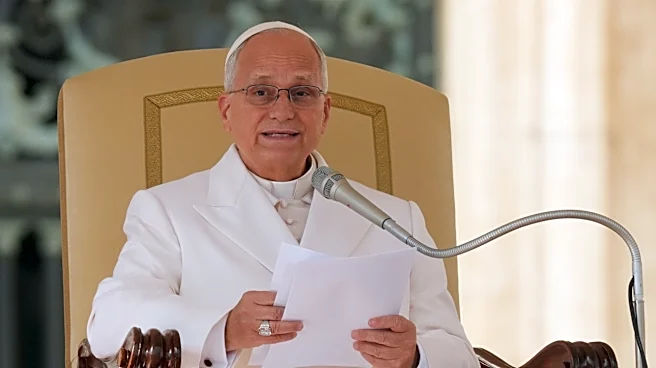


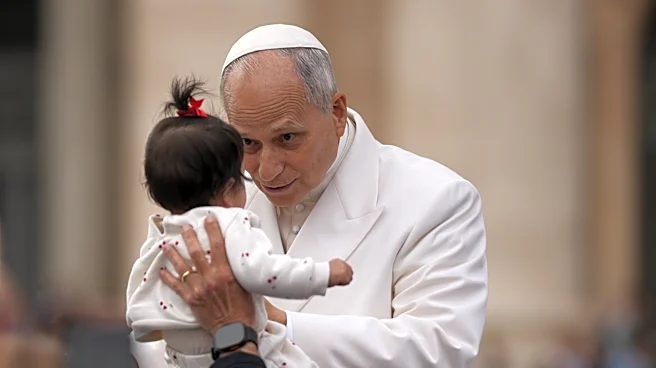

VATICAN CITY (AP) — Pope Leo XIV is returning home to the continent where he spent two decades as a missionary priest and learned to be a pastor, visiting Uruguay, Argentina and his second homeland of Peru.
The Nov. 6-17 trip marks the longest and farthest of his papacy and is coming just three weeks after Leo underwent surgery Oct. 13 to remove a cancerous tumor from his right lung. Doctors nevertheless gave him the green light to make the trip.
Latin
America still is home to around 40% of the world’s 1.4 billion Catholics, but the Catholic proportion of the region’s population has shrunk in recent year s and the decreases are especially notable in the countries Leo will visit.
The trip begins in Uruguay, whose secular identity and separation of church and state are so deeply entrenched that Christmas is officially “Family Day” and Holy Week is “Tourism Week.”
According to Vatican statistics, nearly 77% of Uruguay’s 3.5 million people are baptized Catholics. But more than half of all Uruguayans identify as religiously unaffiliated — the highest portion in Latin America – and only a fraction of those who identify as Catholic actually go to Mass regularly.
Leo’s itinerary includes a stop at a parish in Casavalle, a poor neighborhood on the outskirts of Montevideo plagued by drug trafficking and gang violence. The church works with national and municipal authorities on support initiatives, including housing construction and addiction recovery programs.
Leo will also celebrate Mass in Paysandú, some 375 kilometers (230 miles) from the capital and chosen because of its accessibility to those living north of the Río Negro, a river that crosses the country, and proximity to the Argentine city of Colón.
The visit begins with a welcome ceremony at the Plaza Independencia in the center of Montevideo, a symbol of Uruguay’s national identity and history. The plaza features a monument to independence hero José Gervasio Artigas.
But most significantly, Leo will mark an important Catholic feast day Nov. 8, which commemorates the Virgin of the Thirty-three, the patron of Uruguay and an icon deeply rooted in the country’s history and patriotism.
According to tradition, 33 independence patriots acquired the small, wooden Guaraní statue and had it with them when independence was declared from the Brazilian empire in the Uruguayan city of Florida on Aug. 25, 1825. It was to the virgin that the insurgents entrusted their faith.
By celebrating the feast day, paying homage to Artigas and celebrating Uruguay’s independence, Leo is expected to emphasize that Uruguay’s secular nationhood is intrinsically connected to its Catholic heritage. The goal is to suggest that there is still a place for faith today in even the most secular of countries.
Pope Francis’ refusal to return home to Argentina during his pontificate, and his polarizing tenure as both archbishop and pope, left a conflicted legacy that will dog Leo’s visit. But the American pope will formally honor his predecessor when he visits Buenos Aires’ cathedral and in a more symbolic way when he visits the federal prison where then-Cardinal Jorge Mario Bergoglio ministered to inmates.
In the capital, Leo will also meet with libertarian President Javier Milei, who once called Francis “the representative of evil on Earth.” Milei later apologized.
Milei’s sweeping spending cuts, though, have strained relations with Argentine church leaders, who have criticized his government for cuts to disability funding and for putting economic orthodoxy ahead of the needs of the poor.
That flashpoint will be on display when Leo visits the Don Orione care home in Claypole, south of Buenos Aires, a Catholic institution that houses more than 400 people with disabilities. The institution has reported facing extreme economic problems due to the spending cuts, outdated rates, inflation, and state payment delays.
Leo will also hear of economic woes when he meets with business leaders, trade unions, workers and social representatives at the Argentine Catholic University. Union leaders have said they intend to brief him on the crisis, including rising unemployment, poverty, and the erosion of household purchasing power.
According to official data, poverty in Argentina reached 32.3% of the population during the first half of 2026, representing about 15 million people.
Another possible flashpoint between Milei and Leo could come over artificial intelligence. Milei, a Trump ally, has courted AI investment and data centers with promises of limited regulation, while Leo has warned about the threats to humanity and the environment of the AI race and called for strict, internationally policed safeguards on its development.
Leo will celebrate his first Mass in Argentina at Buenos Aires’ Monumento de los Españoles, where St. John Paul II led prayers for peace on June 12, 1982, during Argentina’s war with Britain over the Falkland Islands. John Paul, who also came in 1987, was the first and last pope to visit.
When Francis was elected, around 71% of Argentina’s population identified as Catholic, according to the Pew Research Center. That percentage has fallen to 58% in 2024.
And yet this year, in a prelude to Leo’s visit and despite persistent rain, a record of more than 2.8 million people took part in the annual pilgrimage south of Buenos Aires to the Basilica de Nuestra Señora de Luján, Argentina’s patron.
The highlight of Leo’s trip will certainly be his return to Peru and especially his diocese of Chiclayo, including the sprawling midsize city in northern Peru near the Pacific Coast. Leo will celebrate Mass in all his old stomping grounds including the mountain village of Santa Cruz de Succhabamba.
Leo spent two decades ministering in Peru as a missionary priest and then bishop, and has credited the place and its people with shaping his view of the church and being a shepherd.
Because he knows the country so well, his speeches will be closely watched, especially one he'll deliver from the square in front of Lima's cathedral “on the challenges and hopes for the future of the Peruvian people.”
Peru, a nation of 34 million people, is beset by multiple challenges: the climate chaos of El Niño, violent crime, poverty and inequality. In 2025, 25.7% of the Peruvian population was living in monetary poverty.
Conservative President Keiko Fujimori came to power in July on promises of restoring order to a nation plagued by extortion and homicides. Illegal gold mining and the cultivation of coca leaves, the raw material used to produce cocaine, are affecting Indigenous peoples especially.
Leo will meet with popular groups in Cusco, in the Peruvian Andes, and will honor Peru's Indigenous peoples by travelling to Pucallpa, in Peru's Amazon to celebrate Mass.
Cusco was the capital of the Inca empire, an important city of Spanish colonial rule and today remains an important cultural destination, including the nearby ruins at Machu Picchu. He’ll celebrate Mass and pray in Cusco’s main square, where in 1781 the Indigenous hero Túpac Amaru II was killed following the most significant rebellion against the Spanish during the colonial era.
Huge crowds are expected to turn out to welcome Leo home, even though Peru has seen Catholicism fall in recent years. According to Pew, the Catholic population was at 76% in 2013-2014, but now stands at around 67%.
___
Associated Press religion coverage receives support through the AP’s collaboration with The Conversation US, with funding from Lilly Endowment Inc. The AP is solely responsible for this content.