
BEIRUT (AP) — Recent fighting between Syrian government forces and Kurdish fighters in northeast Syria got close to detention facilities where thousands of Islamic State group members are held.
The U.S.
military says that it has started the process of transferring many of them to secure locations in Iraq.
Syrian government forces have taken control of one of the detention facilities where about 9,000 IS members are held in Syria. About 120 inmates fled from the Shaddadeh prison on Monday near the Iraqi border. Syrian authorities say that most of them have been recaptured.
During the battles that the Kurdish-led Syrian Democratic Forces, or SDF, fought against IS over the past decade, thousands of fighters of different nationalities were captured and have been held in around a dozen prisons in northeast Syria.
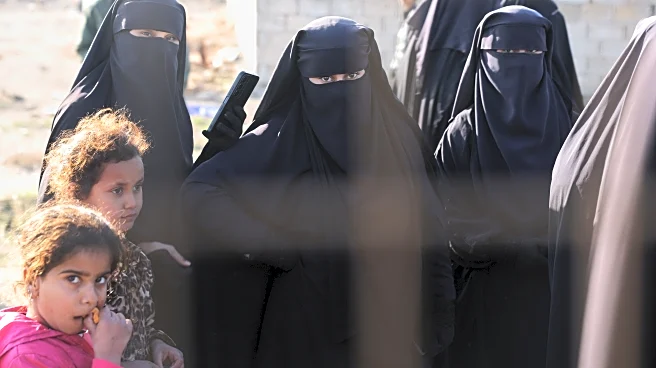
The U.S.-backed Syrian forces also captured tens of thousands of mostly women and children linked to IS. Most of them have been held in the sprawling al-Hol camp near Iraq. A smaller group is held in the Roj camp, near where the frontiers of Syria, Turkey and Iraq converge.
Syrian troops are now in full control of al-Hol camp.
U.S. Central Command said in a statement that the transfer process began on Wednesday, and that 150 IS members have been taken from Syria to “secure locations” in Iraq so far. The statement said that up to 7,000 detainees could be transferred to Iraqi-controlled facilities.
The U.S. move came as Syrian government forces have captured wide areas that had been controlled by the SDF for years in an offensive that took everyone by surprise. Forces loyal to Syrian President Ahmad al-Sharaa are close to several detention centers and the Roj camp, after they took over al-Hol camp and Shaddeh prison.
There also have been tensions around al-Aqtan prison in Raqqa province, which is now encircled by government forces.
Apart from the Shaddadeh escape, no IS suspects have managed to flee from other facilities.
Syria’s government joined the U.S.-led international coalition fighting against IS in late 2025. The government recently has said that authorities are ready to take over and manage the camps and prisons, vowing that they are committed to fighting extremists.
When IS declared a caliphate in large parts of Syria and Iraq in 2014, they attracted extremists from around the world. From their caliphate, the extremists plotted attacks around the world that left hundreds dead from Europe to Asia to Arab countries.
The group also carried out brutalities in Syria and Iraq, including the enslavement of thousands of Yazidi women and girls who were taken when the militants overran northern Iraq in their 2014 campaign.
IS militant boasted of their exploits with videos they released at the time including beheading people or cutting of their hands over charges of theft. Women who were accused of adultery were stoned to death while gays were thrown from high-rises.
The possible escape of detainees raises concerns that they could join the group’s sleeper cells that still carry out deadly attacks.
There are several prisons in Syria where IS suspects are held and they are spread out over northern and northeastern Syria.
According to a U.S. State Department report, an estimated 9,000 IS fighters, including 1,600 Iraqis and 1,800 fighters from countries outside Syria and Iraq remained in detention facilities controlled by the SDF.
The largest detention facility is the Gweiran prison, now called Panorama, and has held about 4,500 IS-linked detainees for years. The prison is in Hassakeh, which is under the SDF’s full control.
Besides Shaddadeh prison, a facility that also witnessed tensions is the al-Aqtan prison near the northern city of Raqqa, which was once IS’ de facto capital.
Other detention facilities include the Cherkin prison in the northern city of Qamishli, and Derik prison near the border with Iraq and Turkey.
IS has vowed over the years that it will work to release the extremist group’s detainees from prisons, including women and children from al-Hol and Roj.
An Iraqi intelligence general told The Associated Press that Iraqi authorities have received the first batch of 144 detainees Wednesday night, after which they will be transferred in stages by aircraft.
The general, who spoke on condition of anonymity because he wasn’t authorized to speak with the media, said that the IS members who will be transferred to Iraq are of different nationalities, including around 240 Tunisians and others from countries like Tajikistan and Kazakhstan.
“They will be interrogated and then put on trial. All of them are commanders in IS and are considered highly dangerous,” the general said.
He added that in previous years, 3,194 Iraqi detainees and 47 French citizens have been transferred to Iraq.
The general said that there is a challenge in securing adequate detention facilities for them in Iraq, but specific centers have been designated to hold the detainees in special secure units.
After the defeat of IS in Syria in March 2019, tens of thousands of women, many of them wives and widows of IS fighters, and children were taken by the SDF to the al-Hol camp.
There have been concerns over the years that the camp — which has witnessed crimes by IS sleeper cells against women who were distancing themselves from the group — is a breeding place for future fighters.
On Wednesday, Syrian troops were in full control of al-Hol camp and an AP journalist visited the facility. At its peak in 2019, around 73,000 people were living there, but the numbers have since dropped, with some countries repatriating their citizens.
Al-Hol currently has a population of about 24,000.
There are about 2,500 people at Roj camp, including Shamima Begum, who traveled from Britain as a teenager to join IS nearly 11 years ago.