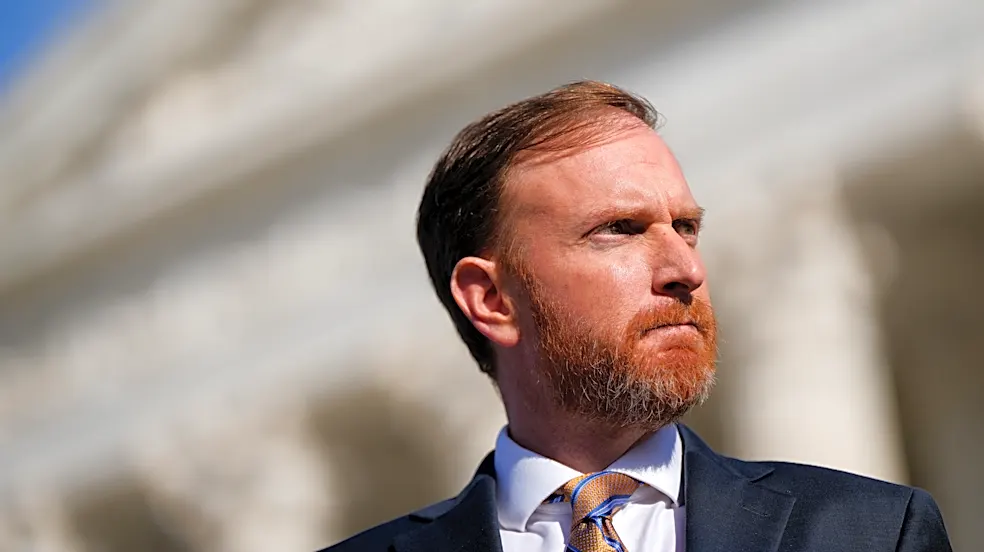






West Virginia's Republican attorney general has launched a broad investigation of the state's leading environmental groups, demanding a decade of internal records involving “unfair or deceptive acts” in their fundraising and climate change advocacy.
The environmental groups decried the inquiry as a sham and filed lawsuits Thursday seeking to dismiss subpoenas they described as harassing and overly broad.
West Virginia Attorney General JB McCuskey has
urged federal authorities to investigate and defund climate advocacy organizations and said that protecting the state’s fossil fuel energy industry from what he’s characterized as overreaching liberal climate and energy policies is a top priority of his office.
The subpoenas seek records related to the groups' public statements on climate and energy, internal deliberations and requests for donations. The documents offer few details of any alleged deception but invoke “possible violations” of the West Virginia Consumer Credit and Protection Act.
“The subpoenas were not issued for any legitimate governmental purpose but are a political action by the attorney general that is intended to stifle speech,” Derek Teaney, an attorney for the West Virginia Rivers Coalition and 350.org, wrote in a court filing in U.S. District Court in West Virginia.
McCuskey did not respond to requests for comment.
McCuskey applauded the Trump administration’s move earlier this year to revoke an Obama-era scientific finding that had underpinned much of the last 15 years of U.S. action to regulate greenhouse gas emissions and fight climate change.
His office also led a 22-state challenge against New York state’s climate “superfund” law, which a federal judge struck down in September. The law, an attempt to make fossil fuel-producing industries pay into a $75 billion fund for damages related to climate change, exceeded the state’s responsibility, the judge found.
David Cole, a Georgetown Law professor and First Amendment scholar, called the West Virginia investigation “frivolous” and said the subpoenas should be quashed.
“If government officials can start prosecuting nonprofit groups because they disagree with the political view they take on a matter of public concern, that would chill a tremendous amount of protected political expression,” Cole told The Associated Press. “The proper place to fight this out is in the court of public opinion and in the labs of scientists — not in criminal investigations that essentially seek to weaponize the criminal arm of the state to take sides in a political debate.”
The investigation follows similar efforts elsewhere by Republican attorneys general and members of Congress to scrutinize the work of climate-focused advocacy groups.
In Florida, Republican Attorney General James Utheimer announced in April that his office had issued a subpoena to the Environmental Law Institute and its Climate Judiciary Project, which seeks to educate judges on the science of climate change, “as part of an investigation into suspicions” that the nonprofit had violated Florida’s Deceptive and Unfair Trade Practices Act. The group has also faced scrutiny from GOP members of Congress.
Utheimer’s office didn’t respond to an inquiry from AP about where the effort stands.
Nick Collins, a spokesperson for the institute, said in a statement that ELI had faced years of “meritless allegations” and “answered countless questions and provided thousands of pages of documents.”
“Despite these facts, certain politicians — including a number of Republican state attorneys general — continue to attack ELI’s programs using these same meritless claims,” he said.