




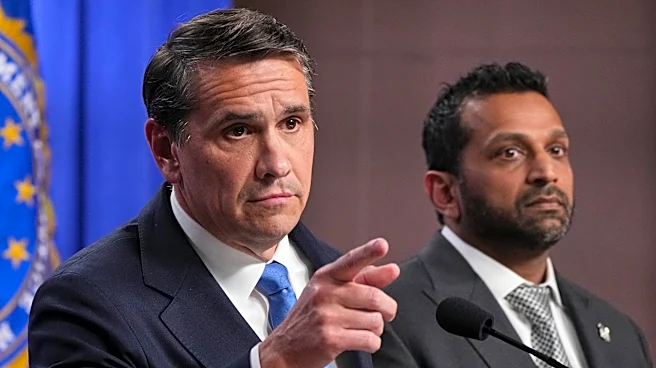

BANGKOK (AP) — U.S. officials have announced a sweeping crackdown on Southeast Asian cyberscam operations as part of what U.S. Attorney Jeanine Pirro characterized Friday as a “new theater of war” launched by the Trump administration against Chinese transnational organized crime.
The crackdown, led by a U.S. government Scam Center Strike Force, includes the Treasury Department's sanctioning of a prominent lawmaker and 28 other people and companies
accused of operating from Cambodia. Criminal charges also were filed against two Chinese nationals involved in a similar operation in Myanmar.
The initiative includes a warrant to seize and shut down a major online recruitment channel on the Telegram messaging app and freezing hundreds of millions of dollars in illicit assets, Pirro said in a virtual press conference connecting her from Washington to journalists in Asia.
Cybercrime has flourished in Southeast Asia in recent years, particularly in Cambodia and Myanmar, with illegal operations making mammoth profits from victims around the world, according to United Nations experts and other analysts. Americans lost nearly $21 billion to cyber-enabled crimes and online scams in 2025 alone, according to the Federal Bureau of Investigation.
The illicit industry is closely involved in human trafficking, with foreign nationals employed to run romance and cryptocurrency scams, often after being recruited with false offers of legitimate jobs and then forced to work in conditions of near-slavery.
The Scam Center Strike Force comprises Pirro’s U.S. Attorney’s Office for the District of Columbia, the Department of Justice’s Criminal Division, the FBI and the U.S. Secret Service.
The most prominent target of the crackdown is Kok An, a Cambodian senator and prominent businessman described by the Treasury Department as a “scam center kingpin."
The department's Office of Foreign Assets Control announced sanctions against Kok An and associates for their roles in a network that has allegedly defrauded U.S. citizens of millions of dollars. They include blocking Kok An’s assets in the United States and prohibiting U.S. entities from doing business with him.
The Associated Press was unable to contact Kok An or any of his representatives for comment.
“His Excellency Kok An is a Cambodian Senator and he was elected by elections, and as a senator he has parliamentary immunity," said Chea Thyrith, a Cambodian Senate spokesperson, who added that only the U.S. side could speak clearly about the sanctions.
Kok An is at least the second Cambodian senator to be sanctioned by the U.S. In 2024, Washington acted against another top tycoon, Ly Yong Phat, who also was accused of being connected with forced labor, human trafficking and lucrative online scams.
Pirro said the latest crackdown was set in motion in November when FBI agents sent to Thailand accessed copious evidence seized from an abandoned scam center in Myanmar, including more than 8,000 phones and 1,500 computers.
That led to charges of wire fraud conspiracy against two Chinese nationals, Huang Xing Shan and Jiang Wen Jie, who were managers of the compound before seeking to reestablish their operations in Cambodia. They are being held by Thai authorities for immigration violations and the U.S. is seeking their extradition, Pirro said.
Cambodian lawmakers unanimously adopted a new law in March targeting online scam operations with up to life in prison, following a government pledge to shut down the centers by the end of April.
In January, Cambodia extradited to China another alleged scam kingpin, Chen Zhi, the founder of business and banking conglomerate Prince Holding Group, even though U.S. authorities had sought custody after indicting him last year for allegedly running a huge scam operation.
___
Sopheng Cheang in Phnom Penh, Cambodia, and Michael Kunelman in Washington contributed to this report.