




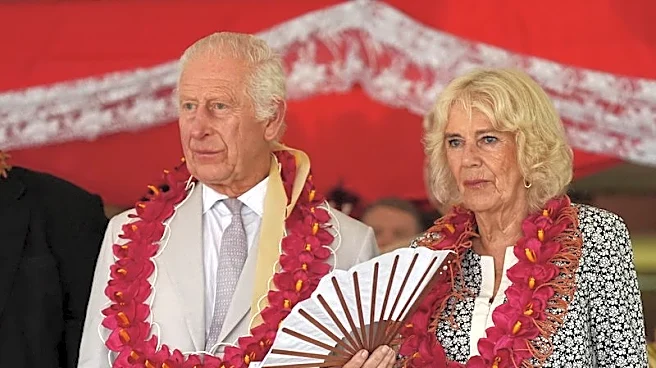

GEORGETOWN, Guyana (AP) — King Charles III arrived Thursday in Guyana, a former British colony that was the site of one of the biggest slave revolts in the Caribbean during the colonial era.
Charles landed in the South American country following an invitation from Guyanese President Irfaan Ali, who has publicly requested an apology as some Caribbean leaders press for slavery reparations.
Charles, who is on a nine-day official trip in the Caribbean,
descended from the plane in a tan suit and greeted Ali, who was wearing an all-ivory Jodhpuri suit.
Guyana is a diverse country of some 840,000 people that recently became one of the world’s largest offshore oil producers after massive oil deposits were discovered off its coast more than a decade ago.
About 36% of Guyana’s population is Black while 50% is East Indian, descended from indentured servants from India brought to the South American country after slavery was abolished.
Charles last visited Guyana in 2000 as a prince.
He is scheduled to meet with Ali, business owners and elected leaders of Amerindian villages known as “toshaos” during his two-day stay in Guyana.
Hilary Beckles, head of the Caribbean Reparations Commission, said at a recent press conference that the region has never been better prepared to confront Britain and the monarchy about its links to slavery.
“The region is mobilized, the governments are mobilized," he said.
The commission was established by regional governments to make Britain and other former European slave-trading nations pay reparations for their role.
In a recent interview with ITV News, Ali said Charles has “rightfully recognized slavery as the darkest days in human history.”
“Moving to the apology is the next step,” he added. “You exploited the region. You destroyed lives. You created underdevelopment.”
The British government has consistently rejected demands for either an apology or reparations.
Charles was previously in the Bahamas and is scheduled to arrive Friday in Antigua and Barbuda for the Commonwealth Heads of Government Meeting and meet with leaders of 56 member states. Talks are expected to focus on climate, trade and development, but some Caribbean leaders have said slavery reparations should dominate conversations.
___
Coto reported from San Juan, Puerto Rico.