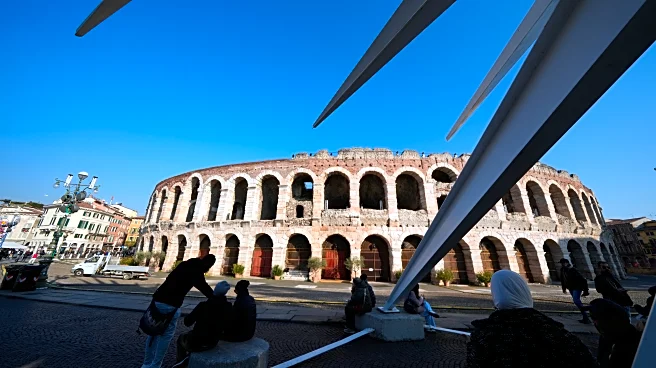




VERONA, Italy (AP) — Verona’s ancient Roman Arena will receive a modern facelift and become more accessible to people with disabilities ahead of the 2026 Milan Cortina Games, where it will host both the Olympic closing ceremony and the Paralympic opening ceremony.
Built by the Romans in the 1st Century, the Verona Arena was envisioned for gladiator fights and ancient hunts of exotic beasts, repurposed as a Medieval marketplace and most recently functions
as the venue of a renowned opera festival.
In none of its previous iterations has the imposing structure been made suitably accessible for disabled people or those needing assistance of any kind. In addition, some safety features intended as stopgaps have endured for decades without being updated.
The upcoming Games have provided the occasion to give the ancient Arena — which predates the Roman Colosseum by decades — an accessibility and safety makeover before it hosts an expected 11,000 people for the Feb. 22 closing ceremony and nearly 10,000 for the Paralympic opening ceremony on March 6.
“This is an ancient monument that is some 2,000 years old, that remains active and hosts audiences,” said architect Giulio Fenyves, whose Milan studio designed the new safety and accessibility features.
“The occasion of the Olympics has made it possible to reconsider a series of logistical aspects, including facilitating the entry and exit, precisely because it continues to host major events with thousands of people,” Fenyves said.
The facelift is part of a 18 million euro ($21 million) project that improves accessibility for the entire area surrounding the Arena and is being overseen by the governmental company responsible for Olympic infrastructure.
The works include making a kilometer-stretch of sidewalks from Verona’s main train station to the Arena safer for wheelchairs or baby strollers by building small curb ramps. Dedicated bike lanes are also being built.
Paralympians participating in the Parade of Athletes up Corso Porta Nuova, across Piazza Bra, and into the Arena will find that the route has been significantly upgraded for people who require wheelchairs or have other mobility issues.
The work is being coordinated with officials responsible for the preservation of the monument as well as those overseeing accessibility codes to bring the structure more in line with current legislation.
The new elements “must be integrated in the most delicate and harmonious way possible to a monument that is both robust and fragile at the same time,” Fenyves said.
Inside the Arena, the centerpiece project is a wheelchair-accessible ramp clad with pre-rusted steel and the same Prun stone from the Lessinia hills above Verona that was used by the Romans to build the Arena.
The local stone gives the Arena its pinkish-yellow hue and contains fossilized shells — remnants of a prehistoric sea that once covered this region now known for hills and vineyards.
The ramp will be removable, but project manager Paolo Zecchinelli said he hopes that it will be retained as a legacy of the Games.
Until now, people with wheelchairs or walkers approached from a natural slope leading down from the adjacent Piazza Bra.
In addition to the ramp that is meant to blend with the Arena’s original features, the local organizing committee is planning an ad hoc temporary ramp to accommodate not only disabled spectators and athletes, but also the elderly, families with children and anyone needing assistance.
The overall project also includes a new railing along the top level of the Arena to replace one built in the 1950s that was meant to be temporary, as well as new handrails at varied heights on internal stairways and at the 72 entrances to the tiered seats. Bathrooms are being renovated by the city, and the infrastructure company is making new ramps to make them more accessible.
Work will continue after the Olympics and Paralympics, including the installation of an elevator that will allow people with limited mobility to reach the Arena's uppermost level, either to watch a show or take in a view of the surrounding hills.
“A part will remain as a gift to the city, which will help this beautiful monument to be more accessible both to people who tour it and those who attend opera performances and other concerts,” Zecchinelli said.
___
More AP coverage: https://apnews.com/hub/milan-cortina-2026-winter-olympics