


BANGKOK (AP) — Shares declined in Europe and Asia on Wednesday as artificial intelligence-related stocks were hit by heavy selling.
Germany's DAX shed 0.2% to 26,085.69, while the CAC 40 in Paris rose 0.3% to 8,532.16. Britain's FTSE 100 slipped 0.2% to 10,707.36.
The futures for the S&P 500 and Dow Jones Industrial Average were nearly unchanged.
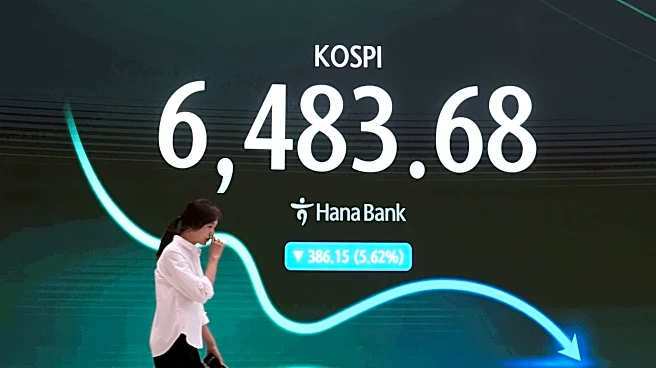
South Korea’s Kospi led the declines in Asia, dropping 5.8% to 6,471.17. The two biggest Korean companies
benefiting from the AI boom tracked losses for their U.S. rivals. Samsung Electronics shed 7.8%, while memory chipmaker SK Hynix tumbled 9.8%.
In Tokyo, the Nikkei 225 sank 3.2% to 65,326.42 as worries over rising bond yields coupled with selling of tech shares pulled the benchmark lower.
The yield on 10-year Japanese government bonds has been trading near a three-decade high of over 2.9% due to expectations that the Bank of Japan will soon raise its benchmark rate to counter inflation.
The Shanghai Composite index shed 2.4% to 3,894.42. Shares in Chinese humanoid robot maker Unitree soared nearly 630% initially in their trading debut on the Shanghai Stock Exchange's Nasdaq-like STAR market. The company reaped about $900 million with its initial public offering. Its shares closed 460% higher.
Shares in UBTech, another major Chinese humanoid robot maker, whose stock is traded in Hong Kong, fell 10.7%.
The Hang Seng in Hong Kong rose 0.1% to 25,495.07.
Taiwan's Taiex fell 1.3%, and Australia's S&P/ASX 200 slipped 0.2% to 9,053.80.
Apart from renewed jitters over criticism that AI-related stocks have shot too high, rising oil prices have been clouding market sentiment.
Crude prices have been swinging sharply due to uncertainty about when and whether the United States and Iran can reach a deal to allow oil tankers to exit the Persian Gulf freely again. Brent was going for $72.87 per barrel just before the start of the war.
Brent crude, the international standard, gained 0.8% to $91.78 per barrel. U.S. benchmark crude oil gained 1% to $84.86 per barrel
On Tuesday, Wall Street pulled further from its all-time high. The S&P 500 fell 0.7% for a third straight modest loss. The Dow industrials dipped 0.2%, and the Nasdaq composite sank 1.3%.
Stocks that have been big winners in the boom around AI technology led the decline. They’ve been veering up and down this summer on worries that their prices have shot too high and that the strong demand for memory, processors and other building blocks of data centers may fizzle if AI proves less profitable than promised.
Micron Technology dropped 7%, and the seller of computer memory was one of the heaviest weights on the S&P 500. So were chip companies Nvidia, which fell 2.3%, and Broadcom, which sank 3.2%.
Bond yields have been another concern. They have jumped since the war began because high oil prices are pushing inflation higher. That adds to worries over huge debt loads for governments, while surging borrowing keeps yields high.
The yield on the 10-year U.S. Treasury edged down to 4.70% from 4.72% late Monday but remains well above its 3.97% level from just before the war with Iran began. The 30-year Treasury yield also ticked lower but is still near its highest level since 2007.
When bond yields are high, investors are less willing to pay high prices for stocks and other kinds of investments, particularly those seen as the most expensive.
High yields have already sent the average long-term U.S. mortgage rate near its highest level in a year, which has hurt the housing industry. They also could slow borrowing by Big Tech companies to pay for data centers, threatening a big source of growth for the U.S. economy.
In other dealings early Wednesday, the U.S. dollar fell to 159.11 Japanese yen from 159.61 yen. The euro rose to $1.1607 from $1.1577.
___
Associated Press Business Writer Chan Ho-him in Hong Kong contributed.