


NAHUNTA, Ga. (AP) — Two large wildfires burning in drought-stricken southeast Georgia have destroyed more than 120 homes and are threatening nearly 1,000 more, Gov. Brian Kemp said Friday.
Kemp told reporters after touring the fire area that state officials believe the fires have burned more homes than any other in Georgia’s history.
The fire in rural Brantley County has burned 87 homes since it began Friday. Kemp said officials believe it was sparked
by a balloon landing on a live power line.
“There’s no way to stop this fire,” Kemp said. “They’re having to contain the flanks and the back of it and then, hopefully, we get a change in the weather.”
The second and larger fire in sparsely populated Clinch and Echols counties at the Florida state line has destroyed 35 homes, according to the governor.
No fire deaths or injuries have been reported in Georgia.
THIS IS A BREAKING NEWS UPDATE. AP’s earlier story follows below.
NAHUNTA, Ga. (AP) — A wildfire that has charred dozens of homes in southeast Georgia prompted officials to order more evacuations Friday as the growing blaze threatened a wider area and fire crews helped residents hose down properties in a scramble to limit the damage.
The fire burning in rural Brantley County has spread across more than 8 square miles (20 square kilometers) since it ignited Monday, fanned by gusty winds into pine woods that are dry as tinder. Nearly 90 homes have been destroyed, some with scorched husks of abandoned cars nearby, among blackened tree trunks and heat-blistered road signs.
The Georgia Forestry Commission said the Brantley County blaze was 15% contained Friday. Local officials have ordered evacuations across an expanding area almost daily, including Friday.
“If you receive a mandatory evacuation notice, we need you to evacuate just as quickly as possible,” Joey Cason, county manager for Brantley County, said in a Facebook video Friday. “That containment can move from 15% to 0% in a matter of minutes with the wind."
Firefighters are battling more than 150 other wildfires in Georgia and Florida that have sent smoky haze into places far from the flames, triggering air quality warnings for some cities.
Scientists say the Eastern U.S. is at greater risk of intense wildfires due to factors such as climate change, record drought and dead trees still littering some Southern forests after being toppled by Hurricane Helene in 2024.
Local officials estimate roughly 200 Brantley County residents have been ordered to evacuate, leaving those displaced to worry about animals left behind and whether they will have homes to return to. No deaths or injuries have been reported.
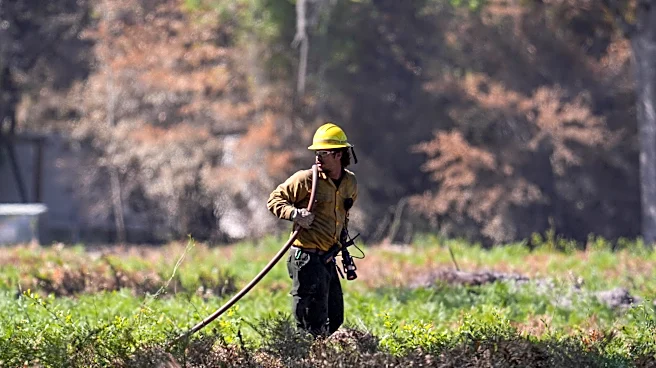
While crews with bulldozers work to clear fire breaks around the burning areas, firefighters from dozens of local agencies have focused on protecting nearby homes and other structures — clearing away dry brush and using hoses and sprinklers to keep houses and yards wet.
"We’ve definitely had the local fire guys out there literally hosing stuff down,” said Seth Hawkins, a Georgia Forestry Commission spokesperson dispatched to the Brantley County fire.
Farther to the west, Georgia’s biggest fire in a sparsely populated area near the Florida state line has burned about 50 square miles (129 square kilometers), an area twice the size of Manhattan.
In Florida, firefighters were battling more than 120 wildfires Friday, mostly in the state’s northern half. Fire crews in Georgia responded to 31 new and relatively small blazes Thursday, the state forestry commission said.
Officials say soaking rain is needed to snuff out the larger fires. Areas where the two big wildfires are burning in Georgia have a 20% to 40% chance of showers and possible thunderstorms over the weekend.
That might produce enough rain to slow the big fires down, Hawkins said, but won't extinguish them. And lightning from thunderstorms could spark more fire, he said.
“We’re going to need several inches of rain, and then maybe another blast of several inches, to extinguish this thing,” Hawkins said.