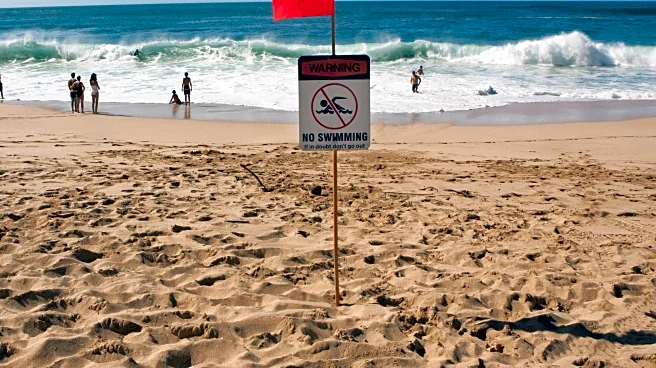




About 800 people have drowned in the waters off Hawaii’s roughly 1,000-mile coastline in the last decade, with an increasing number of people frequenting remote stretches of coastline with little to warn them of risks. Yet the state has not called for a single new warning sign to be put up on a beach in more than 13 years.
Water safety advocates say more needs to be done to educate people about the dangers. Now, following Civil Beat’s reporting and
pressure from the Hawaiian Lifeguard Association, the state appears poised to act.
The state Department of Land and Natural Resources is planning to revive a task force charged with putting up warning signs at dangerous beaches. The group has not met since 2012.
“It’s a huge win,” said Kirsten Hermstad, executive director of the lifeguards’ association, which pushed for the change. “They’re listening, they think it’s important too, and they’re letting us do our work. And that’s huge.”
The state and counties have a legal mandate to warn the public about risks like strong rip currents and powerful waves at state and county beach parks. But a Civil Beat investigation last year found that the state has routinely fallen short of meaningful intervention to reduce the number of people dying, particularly when it comes to residents.
The change comes at a moment of optimism about addressing water safety in a state that has long struggled to reduce the number of residents and visitors who drown in the ocean. Last year, the newly formed Hawaii Water Safety Coalition released the state’s first Water Safety Plan. Ocean safety is seeing more investment, particularly on Oahu where lifeguards now make up their own county government agency.
The Department of Health has increased investment and staffing for drowning prevention. And the state and nonprofits are funding more swimming lessons, a crucial piece considering about half of Hawaii’s children don’t know how to swim despite drowning being the leading cause of death for children under 15.
For families who have lost loved ones to ocean accidents, the move to reinvigorate the Beach and Water Safety Task Force is a welcome development, though one tinged with frustration.
“Why does it take the public coming out and speaking up for these things after tragedies happen for these things to be reevaluated?” said Rachel Able, whose daughter Lily died in 2022 after a surfing accident at a popular Big Island beach that didn’t have any warning signs.
Learning about the progress just days before what should have been her daughter’s 19th birthday, Able said, was particularly meaningful. She is relieved that the task force is coming back and that the state is making what she sees as a bigger commitment to “try to make Hawaii’s oceans safer.”
Hawaii has the second-highest rate of residential drownings in the country, though much of the attention on prevention has focused on tourists.
A Civil Beat investigation last year found that the state’s response has been fragmented and there have been few proactive efforts or significant investments in addressing the problem. Others efforts, like the warning signs, have suffered from a lack of follow-through.
Since 1996, the Department of Land and Natural Resources has been required to hang signs at county and state beach parks to inform the public about the dangers of Hawaii’s oceans. The intent was two-fold: to fulfill a legal duty to warn the public of danger and to shield against costly lawsuits.
At the start of the signage effort, members of the Beach and Water Safety Task Force worked with county ocean safety officers to evaluate the risks at each beach and determine where to put signs indicating dangerous shorebreaks and strong currents.
But off the bat, there were limitations. The law only applies to state and county beach parks, which means there is no duty to warn about dangers at some popular beaches, tourist attractions and remote rocky cliffs frequented by fishermen. The initiative was also unfunded and once signs were in place, maintaining the signs and reevaluating where new ones should go didn’t rise to the top of officials’ to-do lists. The last time the task force met was in 2012, according to reports submitted to the Legislature.
“It’s clear it was not a priority,” said Rep. David Tarnas, who opposed several proposals over the years to disband the task force.
Tarnas said he is frustrated that the task force had not met for years, something he thinks is due to a lack of support from officials at DLNR.
“I think it was a lost opportunity,” he said.
Just because the task force isn’t meeting doesn’t mean public safety has fallen by the wayside, according to Alan Carpenter, the acting administrator for the division in charge of state parks at the department.
“I’m far more interested in keeping people safe than I am about liability. Signs protect against liability. That’s great, but who cares?” he said. “We don’t want people dying in our waters or in our streams. That’s the most important thing.”
Still, three decades after the group’s creation, DLNR has placed enough warning signs to cover only a fraction of Hawaii’s more than 1,000 miles of coastline. About 150 signs dot seven official state beach parks stretching across roughly 3,000 acres, not including Maui, according to Carpenter. That includes 28 signs at state beaches on Oahu, about 26 on the Big Island and 95 on Kauai.
The task force has not recommended any new signs at additional beaches in more than a decade, Civil Beat found.
In 2021 and again in 2024, DLNR supported a bill to dissolve the Beach and Water Safety Task Force, arguing that it had become standard practice to hang these signs in dangerous spots and eliminating the group could streamline the process. Once all the initial signs had been erected, officials said, the brunt of the task force’s work was done.
Ocean safety experts and bereaved families disagree.
Able said the beach where Lily died exploded in popularity after a new road made it easier to access, right around the time that the task force stopped meeting. Civil Beat highlighted Able’s concerns about the lack of signage at the beach in a series last summer.
“It’s not about blame,” she said. “It’s more about committing to coordination, accountability and prevention. We can’t go back and change the past, but going forward, how can we have these safety measures in place so that we don’t have to ask why the committee hasn’t been meeting.”
Behind the scenes last fall, the Hawaiian Lifeguard Association encouraged DLNR to bring back the task force. In December, the department informed lawmakers of its intent to do so.
“We agreed that if the counties and lifeguards feel it’s necessary, we’ll play,” Carpenter said. “But let’s amend the way this system works.”
Carpenter wants to see counties take the lead and the responsibility for these warnings to be “more in the hands of the experts who are out there every day.” The vast majority of beach parks are operated by counties, yet the state has historically managed the task force.
The Hawaiian Lifeguard Association has volunteered to take over the operation of the task force, Hermstad said.
Carpenter and Tarnas are also weighing whether the law needs to change as social media drives people to remote stretches of coastline and away from beaches with lifeguards. Currently, the state and counties only have an obligation to warn the public about risks on state and county beach parks.
“I would look to this Task Force on Beach and Water Safety to come back to us and say, ‘Things have changed. We need to modify the statute in order to encompass all of these other places which are now destinations that are not formal state beach parks or county beach parks,’” Tarnas said.
That could be a way off though. Hermstad said her first priority is getting the task force back on track and meeting again.
Jessamy Town Hornor, a long-time ocean safety advocate and co-founder of the Hawaii Water Safety Coalition, thinks there needs to be a more comprehensive and collaborative approach to educating the public.
She wants signs to use newer technology to share more actionable information — the sort of thing she thinks could have prevented the tragedy that shattered her family in 2016. Hornor’s 6-year-old daughter Mina and husband Mark were swept out to sea by a rogue wave at Makapuu Tide Pools on the east side of Oahu in 2016. Had her husband known about the remnants of a hurricane offshore, she thinks he wouldn’t have gone out that day.
“Just as a static sign, it simply does not adequately convey the variability of that location that it could look perfectly safe to swim in and become a death trap, really, in an instant,” she said.
Hornor and Tarnas point to things like geofencing that sends an alert to people’s cell phones when they cross into a certain area or live condition alerts and QR codes on signs so people can weigh the risks using real-time information.
Hornor is encouraged to see the Beach and Water Safety Task Force reinstated. But she says fulfilling the state and counties’ duty to warn people should be the baseline, not the target.
“We need to do more on the prevention side,” Hornor said. “That truly should be the mission of this effort.”
___
This story was originally published by Honolulu Civil Beat and distributed through a partnership with The Associated Press.