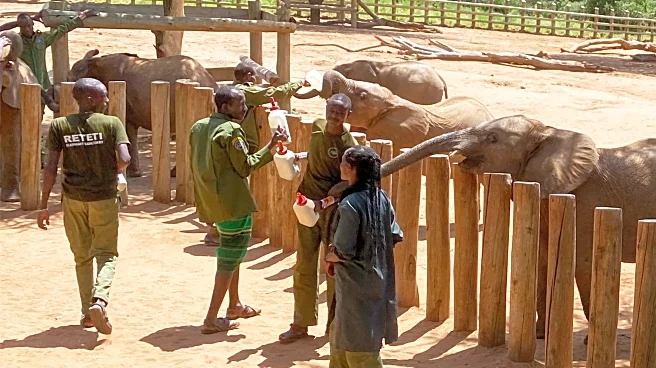

RETETI ELEPHANT SANCTUARY, Kenya (AP) — We stood at the edge of a dusty corral baked by the equatorial sun and ringed by chest-high posts as thick as telephone poles. On some posts, workers had perched
plastic jugs of goat's milk, each holding a couple of liters and equipped with red nipples the size of a man’s finger.
Across the corral, a young elephant ambled into view, head bobbing, trunk curling, ears flapping, trundling along as fast as its tree-trunk legs could carry it. Another followed, then a steady stream, bumping and jostling, kicking up orange dust — a joyful stampede of 2,000-pound toddlers.
It was feeding time for the orphan elephants of Reteti Elephant Sanctuary in Kenya.
The keepers tipped the jugs into the elephants’ hungry mouths while sing-chanting a traditional lyric that praises them for being good eaters. Each jug was drained in seconds. Some elephants managed to wrap their trunk around a jug and gulp down lunch on their own.
We were about halfway through a two-week trip through Kenya organized by a fledgling nonprofit that contributes a share of its revenue to local development in the country. The trek combined a traditional safari with chances to meet the Kenyan people who are working to preserve the wildlife. And, unexpected and most compelling, we saw how tourism and wildlife conservation are improving the lives of Indigenous people.
Reteti, run by the Samburu tribe, rescues young elephants that villagers notice have become separated from their families. A threshold problem was how to feed the orphans; manufactured formula was costly and nutritionally unsuitable. The answer was in the omnipresent goat herds in rural Kenya. Goat's milk, it turned out, was a suitable substitute for elephant's milk, wildlife caretakers at Reteti said.
More than 1,200 Samburu women sell nearly 700 liters (185 gallons) of milk from their goat herds to Reteti each day. Along with enabling them to buy better clothing and food, that gives them some financial independence from their husbands — a break from tradition.
Reteti also employs about 100 Samburu people and says it is the only elephant sanctuary in Africa entirely run by Indigenous people.
“We can say that elephants are the keystone of the entire economy,” said Dorothy Lowakutuk, a Samburu woman and elephant keeper who has become a spokesperson for the sanctuary.
Uplift Travel, which organized the safari, was founded with the intent to provide support to communities in Kenya, particularly with projects that help women and girls. Kim Schneider, a Michigan-based travel writer, created the group with a partner in philanthropy, Tanja Wittrock, after they discovered how a little money could have a huge impact on quality of life.
“I set out with a heart for travel and a heart for helping people, and this has married the two,” she said.
“Safari” is Swahili for “journey,” and almost all of the overland drives qualified. A trip of 100 miles (160 kilometers) could take most of the day, traversing two-lane highways clogged with slow-moving semitrailers or backroads whose gullies and piano-size potholes tested the brawny, seven-passenger Toyota Land Cruisers at every turn.
In the wildlife areas, we rarely left the vehicles, save for photos at the equator and a brief stop to tiptoe across Kenya’s southern border into Tanzania.
Within two hours on our first drive of the trip, in Amboseli National Park on Kenya’s southern border, we saw elephants, lions, giraffe, zebras and a brief glimpse of a leopard, the most elusive of Africa’s “big five” wild animals. Amboseli is also where we met members of Team Lioness, an all-women unit of anti-poaching wildlife rangers. They are the first women in their Masai tribal community to have jobs outside the home.
At the Sheldrick Wildlife Trust elephant orphanage in Nairobi, said to be the world’s oldest, each young elephant has its own room. Keepers sleep with babies, and human and elephant each has their own mattress.
At the Ol Pejeta Conservancy, I had the honor of feeding a carrot to one of the most celebrated wild animals in Africa – Najin, 36, one of only two northern white rhinos in existence. Najin lives with her daughter, Fatu, 25, under 24-hour armed guard on acres of fenced grassland. An international team of scientists is working to perpetuate the species using sperm from the last male northern white, Sudan, who died in 2014, and a southern white rhino as surrogate mom.
The conservancy has not lost a rhino to poachers since 2017. But much of the danger to Kenya’s wildlife today arises from conflicts between the animals and the people who live on the land. Elephants trample crops, lions and leopards prey on livestock. Giraffe and other wild animals are sometimes poached for meat.
Indigenous Kenyans sometimes lack patience for conservation efforts, said Edwin Lusichi, head keeper at Sheldrick.
But at the Masai village of Japan B, so named by residents after a visitor extolled the wonders of Japan, the chief proudly displayed one of a ring of 33 beehives used to keep lions and elephants at bay. The buzzing and stinging of the tiny insects wards off the huge animals.
Most of our accommodations in Kenya’s wildlife reserves were run by Serena Hotels, an operator of luxury resorts and hotels in Africa and South Asia. Rooms or cabins had safari-themed touches. At a couple stops, cabins were built to look like tents, with canvas roofs, solid floors, electricity and hot showers. Breakfasts and dinners were buffet-style.
The most memorable stay was at Kileleoni Mara Gateway House in the Masai region, a sprawling, comfortable home with five guest rooms and two cottages in a fenced compound. It was as if a Masai friend had invited us to stay at her country house, serving us meat and vegetable stews at a long table under the stars. Innkeeper Yianti “Sylvia” Lerionka uses proceeds to sponsor a village for women who escape abusive relationships, and young widows.
On our last night in Kenya, we were told that if each of our group pitched in $20, we could buy a cow for the women of Sylvia’s village. Sadly, cows were going for more than $300 that day — but the $240 still landed a steer.
Uplift Travel safaris vary in itinerary and length and can be customized, so prices range. A typical 14-day trip could cost about $9,000 per person, based on double occupancy, including hotel, meals, ground transportation and guides.
My airfare in May 2025 was $1,426 on British Airways from Chicago to Nairobi via London.