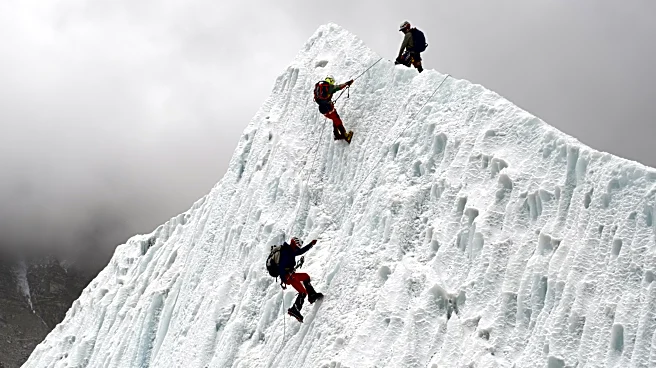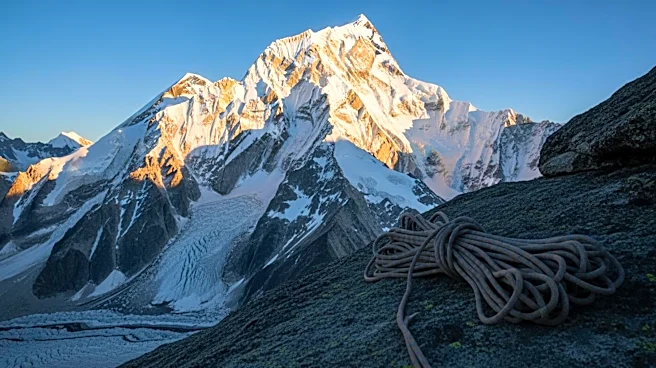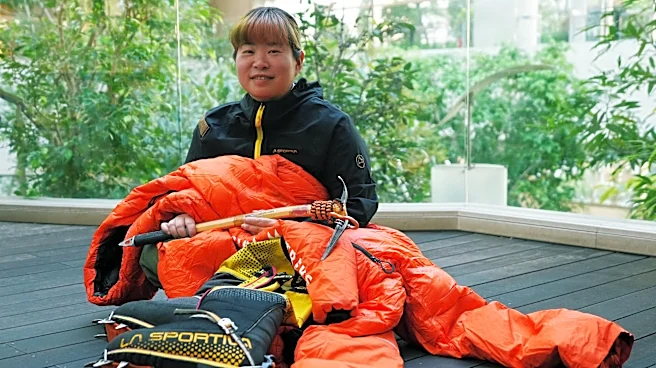








TOKYO (AP) — The first woman to conquer the world's second-highest peak, K2, three times has also summited all 14 of the world's tallest mountains.
But Naoko Watanabe, 44, says climbing is less about piling up records than enjoying an adventure, being happy and experiencing new people, food and culture. She's planning to return in June to her favorite climb, Pakistan's Nanga Parbat, known as the “killer mountain,” with a group of amateur trekkers.
“I’m just an ordinary person who has happened to achieve records while climbing the Himalayas during my vacations,” Watanabe told The Associated Press in a recent interview in Tokyo. “I don’t consider myself a mountaineer.”
In 2006, when she was a student nurse, Watanabe successfully reached the 8,201-meter (26,906-foot) summit of the world's sixth-highest mountain, Cho Oyu, on the Nepal-China border.
It was the first time she climbed one of the world's 14 peaks exceeding 8,000 meters (26,246 feet).
After becoming a full-time university hospital nurse in 2009, she struggled to balance work and climbing, eventually switching to temporary nursing so she could climb more often.
She has since regularly scaled the Himalayas and sees it as a way to regain her peace of mind from Japan's often stressful conformity-bound environment. She now wants to share the joy of mountain climbing with those who need a break.
Watanabe is preparing for a trek in June to Nanga Parbat in Pakistan, the world's ninth-highest peak, which she reached in her second attempt in 2022. This time, she plans to go with a group of amateurs, most of whom will stay at the base camp.
“The Nanga Parbat base camp is extremely scenic and it's my favorite among the 14 peaks," Watanabe said. “I want everyone to see that.” The participants are encouraged to follow at their own pace, freely stop, take photos and talk to the Sherpa guides.
“They are not supposed to be working hard,” Watanabe says. ”I want (the climbers) to be free from the stereotypes and realize that the Himalayas can be fun ... and to know there are more important things than reaching the summit."
Born in Onojo City in southern Japan in 1981, Watanabe was encouraged by her mother to join a kids’ adventure club and started climbing at age 3. She went to an island camp in China, an expedition on the Mongolian grasslands with other children, and climbed a snowy mountain in Pakistan at 12.
Growing up, she said that her passion for adventure and climbing helped her pull through difficult times as she struggled with pressure in Japan to join collective activities and not stand out.
Her medical training has helped during her 31 expeditions over the past 20 years.
“The experience (as a nurse) has become useful in the mountains when I face emergencies and need to make a quick decision on the spot about the weather or my own health conditions."
In her first attempt at Everest in 2011, with the peak just 150 meters (160 yards) away, she decided to turn back when the weather suddenly deteriorated. Her tearful Sherpa protested, saying it was only an hour to the top. But Watanabe said she anticipated a shortage of oxygen in the tank if the weather worsened and slowed them down. On the way back, she lost her sight. They made it back safely, although she came down with pneumonia.
Back at Everest in 2013 on an extremely windy day, the conditions seemed better. Other climbers retreated, but she carefully went on and safely reached the summit.
Watanabe became the first Japanese women to scale the world's 14 highest peaks in October 2024, when she reached the 8,027-meter (26,335-foot) Mount Shishapangma in China.
In July 2024, she also became the first woman to reach the top of the 8,611-meter (28,251-foot) K2, the world's second-highest mountain, three times, an achievement recognized by the Guinness World Records.
Watanabe plans to keep climbing for the joy it brings her.
“I will probably end up climbing (mountains in the Himalayas) about 100 times,” she says. “It would be fun if that eventually becomes a record that I set in my own unique way."