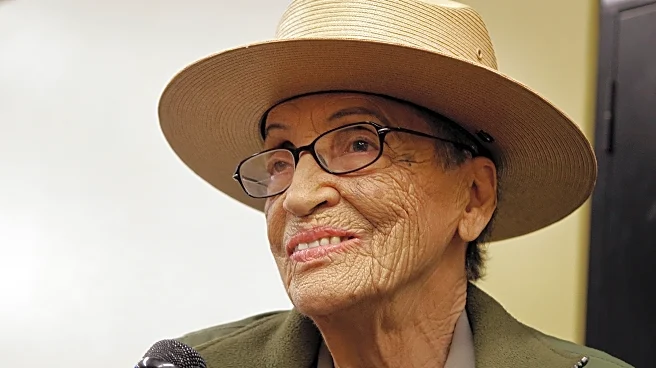




RICHMOND, Calif. (AP) — Betty Reid Soskin, who rose to national fame as the oldest National Park Service ranger and used the spotlight to talk about the African American experience during World War II, has died. She was 104.
Her family and the park service announced her death through social media, saying she was surrounded by loved ones at her home in California when she died Sunday. They did not release a cause of death.
“She was a powerful voice for
sharing her personal experiences, highlighting untold stories, and honoring the contributions of women from diverse backgrounds who worked on the World War II Home Front. Thank you for your service, Ranger Betty,” the park service said in a statement.
When she was 85, the longtime community activist was hired as an interpretive ranger at the Rosie the Riveter WWII Home Front National Historical Park in Richmond, California. The site at a former shipyard and other parts of the working-class city honors American civilians, including the women who worked in war-related industries, who worked on the homefront during the war.
Soskin helped plan the park while working as a state legislative aide. She played a key role in shaping and designing the park by ensuring that it included the oftentimes overlooked contributions of Black men and women.
They include the 202 Black sailors who were killed in the July 1944 explosion at Port Chicago, on the northeastern flank of San Francisco Bay, where they were assigned to a segregated unit, loading munitions onto cargo ships bound for the Pacific Theater. Unsafe working conditions led 50 survivors of the blast to refuse loading munitions. They were court-martialed and convicted of mutiny in a trial that exposed systemic racial inequality in the Navy.
As a Black woman, Soskin worked as a clerk for the all-Black boilermaker’s union in Richmond. She advocated for telling the stories of the “non Rosies” who didn’t get to help build the battleships because who didn’t get to help build the battleships because of the color of their skin.
“Rosie the Riveter represents the white woman’s experience on the homefront during the war, but as a woman of color, I was never recognized for my work,” she wrote in an October 2020 essay for Newsweek.
“I had never understood that I had been involved in the building of the ships. Because at the time, I was 20 years old. I didn’t realize what my role was until I began to go back and recount it for others. It was rather amazing.”
Those who got to meet Soskin during visits to the park took to social media Monday to say it was an honor and that she was an amazing woman. One described her as a jewel of the park system, while others said she served as a great inspiration for young rangers.
Born in 1921, Soskin wore many hats throughout her life — a mother, daughter, musician, author, political activist, wife, record store owner, songwriter, painter, grandmother, great-grandmother, prolific blogger and more, as her family recounted.
Her family posted on social media that she had led “a fully packed life and was ready to leave.”
While a public memorial has yet to be announced, the family said people can share their affection for Soskin through donations to a school that had been renamed in her honor: Betty Reid Soskin Middle School in El Sobrante, California.
She had just celebrated her birthday with a visit to the school in September, cheers erupting as she waved to excited children.
In 1995, Soskin was named Woman of the Year by the California State Legislature and about a decade later she received the National WWII Museum’s Silver Service Medallion.
She explored her nine decades of living through extraordinary moments of history in her 2018 autobiography “Sign My Name to Freedom: A Memoir of a Pioneering Life.”
Her experiences included opening Reid’s Records, an influential Black-owned record store in Berkeley with her first husband, Mel Reid, and being the first Black family to live in suburban Walnut Creek.
Someone burned a cross on their lawn, she wrote, but her family refused to move. She pointed out that the same community that tried to drive her family away elected her 20 years later to serve as a delegate to the 1972 Democratic National Convention.
“That is how fast social change occurred,” she said.
At the park, her weekly lectures drew large audiences. They also garnered national attention, including the chance to introduce then-President Barack Obama at the Christmas tree lighting ceremony in 2015. In 2008, Glamour Magazine named her one of its women of the year.
“I became a ranger when most people retire so I had no idea what it required of me, but it opened up a lot of opportunities that would have been closed to me otherwise,” she wrote in her essay.
She retired on March 31, 2022.
Soskin is survived by two of her four children: Bob and Dorian Reid.
___
Biographical material in this story was written by AP journalist Daisy Nguyen. Susan Montoya Bryan in Albuquerque, New Mexico, contributed to this report.