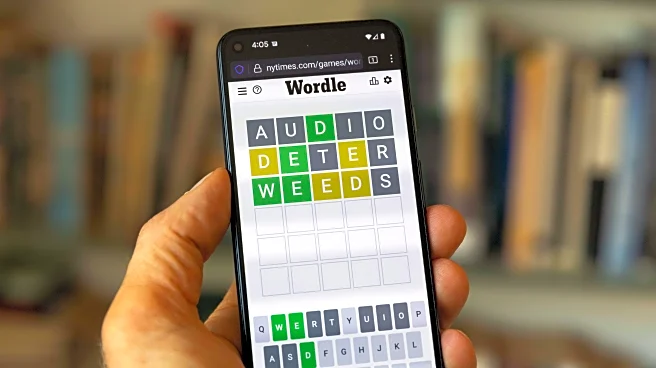

For subscribers to The New York Times who are as interested in solving Wordle or filling in the crossword puzzle as in reading the latest political or business news, Wednesday is a big day.
The Times' popular
Games unit is debuting Crossplay, a Scrabble-like electronic feature that represents its first designed multiplayer game. It becomes the website's 11th game, joining a lineup of puzzles that were collectively played over 11.2 billion times in 2025.
Ancillary products like Games, a cooking app and the Wirecutter product recommendations have fueled remarkable digital growth at The Times over the past decade.
“It has been a huge boon to the journalism,” said Dan Kennedy, a Northeastern University professor. The Times says it has about 3,000 journalists on staff, its most ever and more than twice what it had a decade ago. It is thriving at a troubled time for the industry: More than 350,000 journalists worked at U.S. newspapers in 2005, and it was down to 91,550 last year, according to Northwestern University.
Kennedy tries the crossword puzzle — on its easiest day. His daughter is a Wordle devotee. They both love Wirecutter, which on Tuesday touted cat beds and a vibrator that doubled as a necklace. His wife regularly uses the Cooking app, where thousands of recipes for all occasions are available.
“As remarkable as it's been, I kind of scratch my head at the other news organizations that have tried to replicate it,” Kennedy said. “It just seems like they were so thoroughly beaten to this idea that it's hard for them to compete.”
The Times likens itself to a solar system. The newspaper is the sun, with the other products the planets revolving around it.
Some have jokingly referred to it as a game company that happens to have news. The research company YipitData reported in 2023 that subscribers spent more time in Games than it did with the digital newspaper (the company didn't respond to questions about whether it had more current data).
The Times reported 12.33 million subscribers by the end of last September, up 9% from 2024 and all but about a half million of them digital. Subscription revenue for digital-only products increased by 14%. About half of Times subscribers buy a $30 monthly package that bundles all of its products, the rest buy portions of what it offers a la carte. Last year saw a decrease in people subscribing to just the news.
“I now get out of bed in the morning knowing that the work I do is advancing the mission that we have as a company — seek the truth, understand the world, keep the journalists independent and well-funded,” said Jonathan Knight, the company's head of games. “If I can play a role in that, that's incredibly rewarding.”
Puzzles, contests and games aren't novel for newspapers; The Times introduced its crossword puzzle in 1942 and it went digital in 2009. It was late last decade when its spelling bee game proved popular, particularly among people intimidated by the crossword.
Times executives realized the potential and rebranded its app in 2020. But the game-changer came in 2022.
Developed by a Brooklyn software engineer named Josh Wardle, the addictive puzzle known as Wordle requires players to guess a five-letter word by eliminating potential letters. The fewer turns it takes, the better. Knight learned about it from colleagues who saw it online; he moved fast and bought the game from Wardle within weeks after first playing it.
Last year Wordle was played 4.2 billion times. Morning social feeds brim with people posting their results and bragging about — or lamenting — their perfdormance that day.
“I knew we could get to this scale,” Knight said of his site. “I didn't think we could get to it in this amount of time.”
The Wordle rhythm — one word a day — is something Knight's team keeps in mind. They're always trying new games, but keep standards high, and have generally added one new game a year. He doesn't want a site with 30 or so games, some of them low-quality. “We want to make sure that everything we do is human-crafted,” he said.
“We're respectful of your time,” Knight said. “We're not trying to get you in the app all day. We're not nagging you to come back in. We don't want 24/7 engagement. We want a very healthy daily habit where you feel good about what you've done.”
One popular addition has been Connections, where people need to group different things that relate to one another. But not every game works. Digits, a logic puzzle with numbers, failed despite two tries. The conclusion, Knight says: “We have been cautious about math and numbers games ever since."
Staff members at Games stay in touch with users through a newsletter and forums devoted to specific puzzles. “They are fanatical,” Knight said. “They care deeply. They're very passionate. They're also very kind and joyful people, and we really value engaging with the community all the time.”
The enduring popularity of the board game Scrabble points to the potential of Crossplay, and improving on the ad-choked Scrabble Go app would seem a low bar to surmount. The games are similar, though there are some small differences in how Crossplay is played — how the game board is designed and some letter values, for example.
People can invite friends to play or compete against a computer, keep track of records and engage with the Cross Bot feature, which gives a postgame analysis and tells players about moves they could have made to score more points. Unlike some of the other individual Times games, people can download a specific Crossplay app.
Game on — for users and, it's clear as well, for the Times.
___
David Bauder writes about the intersection of media and entertainment for the AP. Follow him at http://x.com/dbauder and https://bsky.app/profile/dbauder.bsky.social.