






GLASGOW, Scotland (AP) — The most serious cyberattacks in the U.K. are now carried out by hostile nations including Russia, Iran and China, the head of the U.K.’s National Cyber Security Centre (NCSC) said in a speech Wednesday.
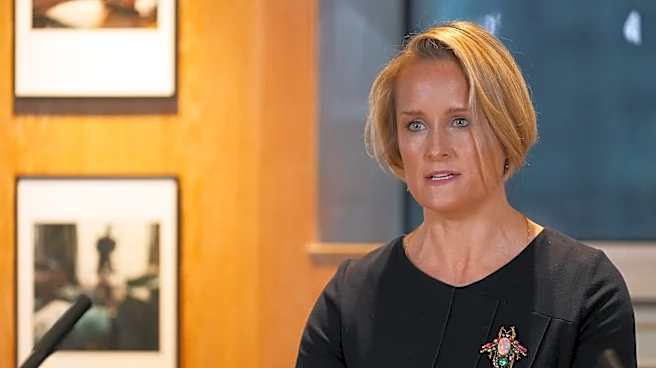
Richard Horne, the head of the NCSC — part of the U.K's signals intelligence agency GCHQ — warned that the U.K. is living through “the most seismic geopolitical shift in modern history.” British businesses, he said, need to prepare
themselves to defend against cyberattacks because the U.K. could be targeted “at scale,” if it became involved in an international conflict.
In recent months, authorities in Sweden, Poland, Denmark and Norway have all warned that hackers linked to Russia have targeted their critical infrastructure including power plants and dams.
Horne said the NCSC currently handles around four “nationally significant” cyber incidents a week and while criminal activity, such as ransomware, remains the most common problem, the most serious threat comes from cyberattacks carried out directly or indirectly by other states.
Dan Jarvis, the U.K. security minister, said the NCSC handled more than 200 nationally significant incidents last year — more than double the year before. Jarvis and Horne spoke at the CyberUK conference in the Scottish city of Glasgow.
In December, Blaise Metreweli, the head of Britain's Secret Intelligence Service, or MI6, said the world is more dangerous and contested now than it has been for decades and that the U.K. is operating in a space between peace and war.
“Let’s be clear, cyberspace is part of that contest,” Horne said.
China's intelligence and military agencies display an “eye-watering level of sophistication in their cyber operations,” while Iran is “almost certainly using cyber activity to support the repression of British individuals on our streets who are seen as a threat to the regime,” he said.
Moscow, meanwhile, is using tactics and techniques honed during its war in Ukraine and is “moving them beyond the battlefield,” Horne said, pointing to “sustained Russian hybrid activity” targeting the U.K. and Europe. Companies, he said, must learn how cyber operations have been used in conflict situations in order to boost their own resilience.
Hostile states, Jarvis said, know the most effective way to act is “not to confront us directly, but to quietly hollow us out,” by hacking logistics systems which move goods, for example, or compromising businesses.
He compared a cyberattack at Britain's biggest automaker Jaguar Land Rover — that dented Britain's economic growth late last year — to masked criminals turning up at car dealerships, breaking glass, smashing computers and stealing vehicles from the parking lot.
AI, Jarvis said, is also making it easier for adversaries to attack by finding vulnerabilities in systems “faster than any human team can patch them.” He called for AI companies to work with the U.K. government to develop bespoke programs to boost Britain's cyber defenses.
In a conflict situation, Horne said, the U.K. would likely face cyberattacks at scale but — unlike with ransomware — companies will not be able to pay their way out in order to recover data and access to systems. For that reason, he said, every organization needs to understand the “full extent” of the risk they face and improve their cyber defenses before it is too late.
On Friday, Swedish authorities said that a pro-Russian group with links to Russia’s security and intelligence services was behind a cyberattack on a heating plant last year.
Carl-Oskar Bohlin, Sweden's minister for civil defense, compared it to incidents in Poland in December, when coordinated cyberattacks hit combined heat and power plants supplying heat to almost 500,000 customers, as well as wind and solar farms. Poland later said evidence indicated hackers were “directly linked to the Russian services.” Norwegian authorities also warned that a hack in April 2025 which affected water flows from a dam was linked to Russia while in December, Danish authorities said another attack on a water utility company in 2024 left some houses without water.
The four cyberattacks are among more than 155 incidents of disruption — including arson, sabotage and espionage — linked to Russia or its proxies by Western officials and tracked by The Associated Press since Moscow's full scale invasion of Ukraine in February 2022.
Other incidents linked to Russia by European officials include an attack on German air traffic control, attempts to gain access to Signal and WhatsApp accounts belonging to officials and journalists and attempts by hackers linked to Russian military intelligence to steal users' sensitive data by exploiting a weakness in some internet routers.