



Step outside a train station in Tokyo, and you’ll find all sorts of amenities: neon-lit neighborhoods, shopping malls with bustling food courts, and public spaces where people engage in a range of activities — from sipping matcha to playing music and holding pick-up arm wrestling tournaments.
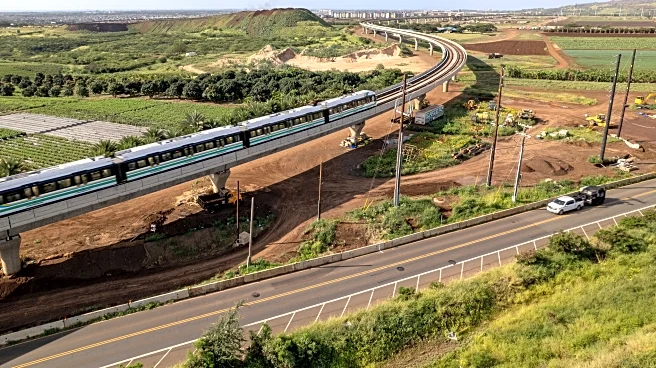
Outside a Honolulu Skyline station, by contrast, you’re likely to find little more than a red dirt road and a “No Trespassing” sign. Typically, there’s not even
a bathroom open to the public.
Now, the State of Hawaiʻi is negotiating an agreement with a Tokyo-based railroad conglomerate with a century of expertise in transit-oriented development. The goal is to help Honolulu’s struggling Skyline project attract riders, spawn development of affordable housing and enhance the quality of life of residents who are forking out more than $10 billion to pay for the rail line.
A memorandum of understanding being negotiated between the state and Japan’s Tokyu Group marks a deepening relationship between Gov. Josh Green’s administration and the Tokyo-based company best known for turning formerly empty land into Tokyo’s Shibuya ward, a bustling neighborhood that’s home to the famous Shibuya Scramble pedestrian crossing.
When Green went to Tokyo soon after becoming governor, he met with Tokyu executives and saw what the company has done at Shibuya in the 100 years since it started.
“It kind of knocked my socks off — to see what can be done with serious investment and serious planning,” he said.
“I thought I was going there originally, to talk about tourism,” Green said of his first visit to Japan. “And what I realized after several meetings in Japan, I was actually talking about partnerships.”
The anticipated agreement with Tokyu is part of Green’s broader initiative to strengthen trade and investment ties with Japan. The initiative involves not only seeking Tokyu’s advice and potential investment in transit-oriented development, but also tapping into a $550 billion pledge the Japanese government has made to invest in U.S. infrastructure. Green has written U.S. Commerce Secretary Howard Lutnick with a request to steer some of that money to Hawaiʻi to help pay for infrastructure along the rail line.
Nobody is expecting any of Oʻahu’s rail stops to become like Shibuya, or anywhere else in Tokyo. But rail proponents have long touted the prospect that the Skyline would help spawn developments that would attract riders and reduce the need for people to drive cars.
Central to Green’s vision is promoting housing development around train stations. Tokyu’s strategy has been to develop not only housing but also commercial amenities that draw train passengers from elsewhere.
Part of the plan for Hawaiʻi involves modular homes, which can be built quickly and inexpensively, along with traditionally built structures — something Hawaiʻi’s powerful construction trade unions are on board with after years of voicing skepticism about pre-fab houses.
“You can build many thousands of homes, condos, apartments, basically in and around hubs, and you can generate enough economic activity to justify building the homes,” Green said. “And you need the homes, of course, for our next generation.”
The memorandum of agreement would formalize work Tokyu has been doing as part of an advisory committee Green set up in July 2024 to engage the private sector to help with transit-oriented development, especially housing. Public response to the rail has been underwhelming, with the system attracting about 11,000-12,000 daily riders on weekdays and far fewer on weekends. Officials hope the rail will attract 84,000 daily riders when its extension to Ala Moana Center is completed.
Green set up the Governor’s Advisory Committee on TOD in July 2024 to help promote development of “affordable housing, mixed-use community development, and resilient communities along Oahu’s Rail line.”
Members include Tokyu transit-oriented development expert Masafumi Ota; Lori Kahikina, executive director of the Honolulu Authority for Rapid Transportation; state planning director Mary Alice Evans, and developers Stanford Carr and BJ Kobayashi. The committee is chaired by Paul Yonamine, chairman emeritus of Central Pacific Bank and former president of IBM’s Japan operations, who has been advising Green on how to strengthen business ties between Hawaiʻi and Japan.
In October, Tokyu’s Ota outlined ideas for Skyline to the committee. The 83-slide presentation outlines Tokyu’s thoughts about TOD along the Skyline. Central to the presentation is the overarching idea of building out areas around stations into what Tokyu calls “ensen,” high-density, mixed-used neighborhoods built near the stations with bus links extending into more suburban areas.
It focuses particularly on the three stations at the western end of the rail — the Honoluliuli station at Hoopili, Keoneae at the University of Hawaiʻi, West Oʻahu and Kualakaa at East Kapolei — as places where the rail line can integrate with development plans.
While the presentation envisions some infrastructure coming from private developers, it also speaks of the government paying for infrastructure like bus terminals to better link stations to outlying areas.
The presentation also points to the value of something HART didn’t design into Skyline: extra, parallel lengths of track at certain stations, which would allow some trains to bypass the stations and operate as express lines, cutting travel time for passengers want to go long distances.
Carr, who is leading plans to redevelop land around Honolulu’s Aloha Stadium, applauds Ota’s input.
“They know how to do things right,” Carr said. “We’re very fortunate to have them participating.”
Skyline’s Honouliuli stop on a recent Tuesday afternoon bore no resemblance to a typical Tokyo train station. On one side of the station was a parking lot, on the other a red dirt road guarded by a no-trespassing sign. The beep-beep-beep of a reversing truck in the distance was the only sound, muffled by the wind. A Civil Beat reporter was the only disembarking passenger.
Tokyo stations, by contrast, are hubs of activity. And Shibuya is the hyper-charged, neon-lit centerpiece of Tokyu’s achievements. Through a variety of its more than 200 subsidiaries, Tokyu Group has built hotels, condos, malls, offices and public spaces. The Shibuya Scramble adjoining Tokyu’s has been called the world’s busiest pedestrian crossing. Lonely Planet calls Shibuya “arguably the most vibrant part of Tokyo, which in turn, is arguably the most energetic corner of Japan.”
But Shibuya didn’t happen by accident. The area’s terminal once was as sleepy as Skyline’s Honouliuli station, serving little more than a dozen people a day. Tokyu’s concept is simple: to develop housing and commercial amenities around train stations to drive passenger traffic. But it’s refined this idea with such sophistication that the World Bank holds Tokyu out as a case study in how cash-strapped governments in developing nations can build rail systems using TOD as a central component – and without breaking their taxpayers.
Riding the Skyline past Honouliuli on Tuesday was Matt Cavert, a professor at UH-West Oʻahu. Cavert had ridden the train to its terminus at Middle Street and then caught a bus downtown, where he had lunch with his wife. The couple lives in West Kapolei, Cavert said, and Skyline is a big part of their lives.
Cavert uses the rail and bus to run errands. And once a week or so, he heads into town to meet his wife for dinner somewhere near the line. Having more places to eat closer to stations would be a plus, he said. So would better pedestrian access from train stations to Pearl Highlands and Pearlridge shopping centers. Amenities and public spaces at UH-West Oʻahu stop would be good for students, he said.
Brian Beland, a retired Marine who often takes the train and bus to the Joint Base Pearl Harbor-Hickam Fitness Center to work out, has a more modest request: bathrooms at the train stations. He said he’s been told that rail security will let him use staff bathrooms in case of emergencies.
But he said, “Every time you ask, they say they can’t do that. Someone said, ‘Call the mayor.’”
Tokyu isn’t the only company involved in Green’s Hawaiʻi-Japan TOD initiative. Also serving on the governor’s TOD advisory committee is Ryuji Yamaguchi of Daiwa House Industry Co., Ltd. The modular home builder recently completed a project in Toyota City, Japan, comprising 21 modular, energy self-sufficient homes with solar and battery storage and energy management systems that enable the homes to share excess energy with each other.
Daiwa House also has experience in Hawaiʻi, helping set up 50 modular homes for people impacted by the Maui wildfires.
Green sees working with Daiwa house, along with traditional builders, as a way to get homes built quickly and inexpensively.
“We could finally get ahead of some of our housing shortage, because we could accelerate some housing developments,” he said. “We could continue to do the great work that regular builders do, and the combo gets us there, especially along rail.”
“And because there’s this deep, deep, deep well of experience with Tokyu, it feels like it’s a good opportunity,” Green added.
Perhaps most important, the idea has the support of Hawaiʻis construction trade unions, a powerful force in Hawaiʻi politics and a key supporter of Green.
Andrew Pereira is a spokesman for Pacific Resource Partnership, an organization that represents the state’s largest construction union, the Hawaiʻi Regional Council of Carpenters, and more than 250 contractors.
The Daiwa House homes make sense to PRP, he said, chiefly because of their quality and the way they’re shipped: packed flat in containers to be assembled by contractors in Hawaiʻi. The design enables various inspections to be performed as workers are constructing the units.
Compared to some of the pre-built units shipped to Hawaiʻi as emergency shelters for Maui wildfire survivors, Pereira said, the Daiwa House homes are “a more quality product and ensures that the homebuyer is getting something durable that will last.”
The administration is well aware of some of the pushback that greeted Japanese investors during the 1980s investment boom. Cameron Deptula, a special assistant to Green also working on the TOD committee, is focusing on Hawaiʻi-Japan business relations while working toward his MBA at the University of California-Berkeley’s Haas School of Business.
While money from Japan helped Hawaiʻi enormously as the state’s plantation economy collapsed in the 1980s, Deptula writes in a comprehensive study of Japan-Hawaii business relations, “the capital that did enter Hawaii created inflationary pressure in the housing market,” producing apprehension about the foreign presence in the state.
He points to the case of Genshiro Kawamoto, the infamous Japanese investor known for carrying briefcases of cash to the doorsteps of unsuspecting homeowners in Kāhala when making unsolicited offers to buy their houses.
Residents were dismayed not just because homes were being turned into investment vehicles for offshore buyers. Deptula quotes a letter to the editor of “The Star-Bulletin” expressing fear that Japanese investors would discriminate against residents. “I predict that in the future the Japanese will bring in their own people for all the white collar jobs, with our local people working under them,” reader Ralph Santos wrote. “This will build up resentment and hard feelings even to the point of revolt against the Japanese in Hawaii.”
The upshot, Deptula concludes, is that Hawaiʻi’s experience not only shows opportunities for the state but also “provides lessons for how to better leverage foreign investment opportunities when they do present themselves.”
One takeaway is that “more work could have been made to encourage Japanese firms to better integrate capital and provide opportunities for mutual growth with local businesses through joint ventures.” To address that, while it’s envisioned that Tokyu might invest in Syline TOD, the idea is for the company to work as a co-developer, allowing a local firm to take the lead.
In addition, the memorandum of understanding between the state and Tokyu is anticipated to be merely aspirational, with neither party making financial commitments to the other.
Green sees working with Tokyu Group and Daiwa House as no-brainers, not only because of their expertise in transit-oriented development and modular housing, but also because of Hawaiʻi’s cultural and historical ties to Japan.
“I like the idea of partnering — if I’m going to partner with international partners — with Japan,” Green said.
___
“ Hawaiʻi’s Changing Economy ” is supported by a grant from the Hawaiʻi Community Foundation as part of its work to build equity for all through the CHANGE Framework.
___
This story was originally published by Honolulu Civil Beat and distributed through a partnership with The Associated Press.