

BEIRUT (AP) — Senior officials from the European Union visited Syria for the first time Friday and met with Syrian interim President Ahmad al-Sharaa in the latest sign of the country’s improving relations with the West.
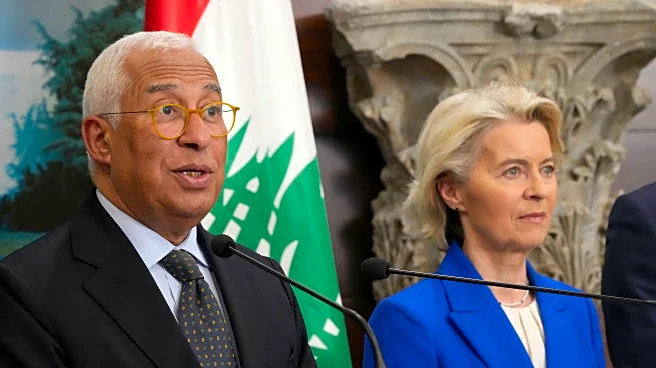
European Commission President Ursula von der Leyen and the President of the European Council António Costa both made statements of support for Syria as it struggles to recover after nearly 14 years of civil war, which ended in December
2024 with the ouster of former President Bashar Assad in a lightning rebel offensive led by al-Sharaa, then the leader of an Islamist rebel group.
Al-Sharaa has launched a largely successful diplomatic offensive and has restored relations with western and Arab countries that had shunned Assad’s government because of widespread reports of human rights abuses by his security forces before and during the war.
During the visit, Costa said the EU will provide 620 million euros ($723 million) in financial support to Syria in 2026 and 2027, including humanitarian aid as well as assistance to begin with reconstruction. Aid for reconstruction was blocked by sanctions under Assad's rule, which have now been lifted.
“After decades of fear and silence, Syrians began a long journey toward hope and renewal. Europe will do everything it can to support Syria’s recovery and reconstruction,” Von der Leyen posted on X.
Since Assad’s fall, Syria has struggled economically and there have been several outbursts of sectarian violence. Al-Sharaa’s government has also struggled to consolidate control over all of Syria.
Clashes have broken out in recent days between Syrian government forces and Kurdish fighters in the northern city of Aleppo amid stalled negotiations for a merger between the new Syrian army and the Kurdish-led Syrian Democratic Forces that controls much of the country’s northeast.
Syria's Defense Ministry announced a ceasefire Friday, though there was no public response from the SDF and it was not clear if Kurdish forces in Aleppo had agreed to the deal.
Costa said during the visit that “the violent escalations of recent days are worrisome” and called for “continued dialogue.”
“We know that the path to reconciliation and recovery remain difficult and long," he said. "Healing, rebuilding lives and creating trust in institutions takes time.
The EU delegation continued a regional tour with a visit to Lebanon, where the army on Thursday announced it had completed the first stage of a plan to remove weapons from nonstate groups, including the powerful militia Hezbollah.
Von der Leyen welcomed the announcement that the disarmament plan has been implemented in the border area south of the Litani river, adding that the EU was “ready to step up our cooperation" to support the cash-strapped military.
She called for a ceasefire deal that ended the latest Israel-Hezbollah war in November 2024 to be “fully respected by all parties.”
“Lebanon’s sovereignty and territorial integrity has to be upheld,” von der Leyen said. “And it is paramount to ensure that Hezbollah is fully disarmed.”
Israel has continued to carry out near-daily airstrikes in Lebanon since the ceasefire, which it says target Hezbollah attempts to rebuild its capabilities, and has threatened to step up the attacks if the group does not fully disarm.
———
Associated Press writer Sam McNeil in Brussels contributed.