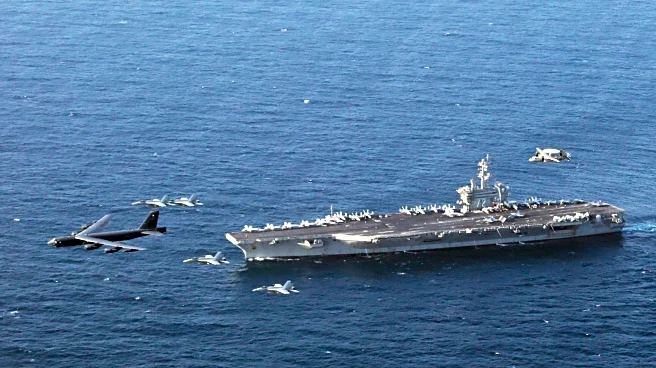




WASHINGTON (AP) — The Pentagon has sent a host of U.S. military assets into the Middle East over the past several weeks, including an aircraft carrier group and its thousands of troops, as President Donald Trump indicates he is maintaining the possibility of strikes on Iran.
“We have a lot of very big, very powerful ships sailing to Iran right now, and it would be great if we didn’t have to use them,” Trump said Thursday.
Trump initially threatened
military action if Iran carried out mass executions of prisoners or killed peaceful demonstrators, but he later claimed that Iran halted the hangings of 800 detained protesters. Iran’s top prosecutor later called Trump's claim “completely false.”
Trump said this week that Iran must make a deal on its nuclear program. He suggested that if the Islamic Republic does not, he would order an attack that would be “far worse” than last year’s U.S. strikes on Iranian nuclear sites.
The aircraft carrier USS Abraham Lincoln and three guided-missile destroyers are in the Arabian Sea, according to U.S. Central Command.
The carrier strike group left the South China Sea last week and arrived in the Middle East on Monday. It joined in the region three other U.S. Navy destroyers, two of which are currently sailing near the Strait of Hormuz and another in the Red Sea.
Three smaller littoral combat ships also are currently at sea in the Persian Gulf.
The arrival of the carrier strike group brought roughly 5,700 additional service members. The U.S. has several bases in the Middle East, including Al Udeid Air Base in Qatar, which hosts thousands of American troops and is the forward headquarters for U.S. Central Command.
Moving in the aircraft carrier comes after the Trump administration had shifted some resources from the region to the Caribbean Sea as part of a pressure campaign on former Venezuelan President Nicolás Maduro.
The world’s largest aircraft carrier, the USS Gerald R. Ford, was ordered in October to sail from the Mediterranean Sea to the Caribbean along with several destroyers. The carrier USS Nimitz, which helped conduct the June strikes on Iran’s nuclear sites, also departed the region in October.
Central Command said on social media that the Air Force F-15E Strike Eagle now has a presence in the Mideast, noting the fighter jet “enhances combat readiness and promotes regional security and stability.”
Similarly, the U.K. Ministry of Defense said last week that it deployed its Typhoon fighter jets to Qatar “in a defensive capacity."
Analysts of flight-tracking data have noticed dozens of U.S. military cargo planes also heading to the region.
The activity is similar to last year when the U.S. moved in air defense hardware, like a Patriot missile system, in anticipation of an Iranian counterattack following the bombing of three key nuclear sites. Iran launched over a dozen missiles at Al Udeid Air Base days after the strikes.
Defense Secretary Pete Hegseth said Thursday that the U.S. military “will be prepared to deliver whatever the president expects,” a day after Trump warned that he wants movement toward a deal over Iran's nuclear program and that “time is running out."
“They have all the options to make a deal,” Hegseth said at a Cabinet meeting, referring to Iran. “They should not pursue nuclear capabilities.”
Hegseth cited the U.S. military raid to capture then-Venezuelan President Nicolás Maduro in his Iran warning, saying the military was ready to deliver what Trump wants “just like we did this month.”
Secretary of State Marco Rubio described the increasing military presence as an effort “to defend against what could be an Iranian threat against our personnel.” He said during a congressional hearing Wednesday that it was wise to have a force that could “if necessary, preemptively prevent the attack against thousands of American servicemen and other facilities in the region and our allies.”
Trump said Thursday night that his message to Iran was “no nuclear” and “stop killing protesters.”
Iran cracked down on nationwide protests that were sparked by economic woes and broadened into a challenge to the theocracy. Activists say at least 6,479 people were killed in the crackdown.
The Trump administration and the European Union this week imposed new sanctions targeting high-ranking Iranian officials over the crackdown.