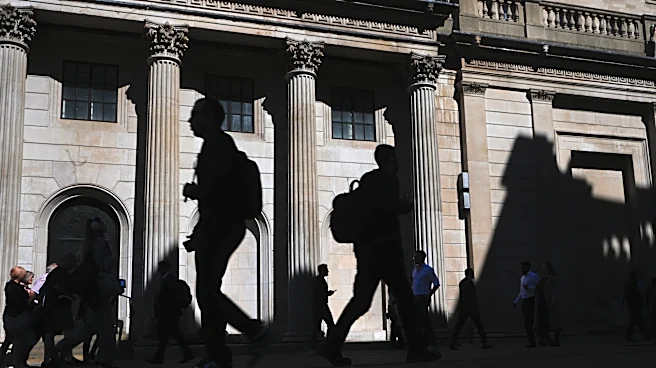







LONDON (AP) — The Bank of England kept the U.K.’s main interest rate unchanged at 3.75% Thursday even though inflation in the United Kingdom has risen to a five-month high as the fallout from the Iran war continues to ratchet up fuel prices.
Like other central banks, the inflation outlook will be key for the Bank of England. Some have already decided to start raising borrowing costs again, including the U.S. Federal Reserve on Wednesday.
Many economists
are forecasting U.K. inflation to rise from the current annual rate of 3.1%, which is already above the Bank of England’s target of 2%, in coming months as households face another increase in their domestic energy bills beginning in October.
As a result, the consensus in financial markets is that interest rates will be raised at one of the next two meetings, either in November or December.
David Rees, head of global economics at Schroders, expected the central bank to leave rates where the were because the economic backdrop, such as wages and the labor market, remains relatively soft.
“That should limit the extent to which imported price pressures become embedded in domestic wages and prices,” he said.
Like other central banks, the inflation outlook will be key for the Bank of England.
Many economists are forecasting inflation to rise from the current annual rate of 3.1%, which is already above the bank's target of 2%, in coming months as households face another increase in their domestic energy bills beginning in October.
As a result, the consensus in financial markets is that interest rates will be raised at one of the next two meetings, either in November or December.
Interest rates in the U.K. had been trending downward from a 15-year high of 5.25% until the U.S. and Israel attacked Iran in late February. The Iran war led to sharp increases in oil and gas prices, partly because the crucial Strait of Hormuz has been largely closed to traffic ever since.
As well as impacting the cost of personal loans and mortgages, the uptick in interest rate expectations is a growing problem for the British government as the servicing of its debt accounts for a higher proportion of its spending.