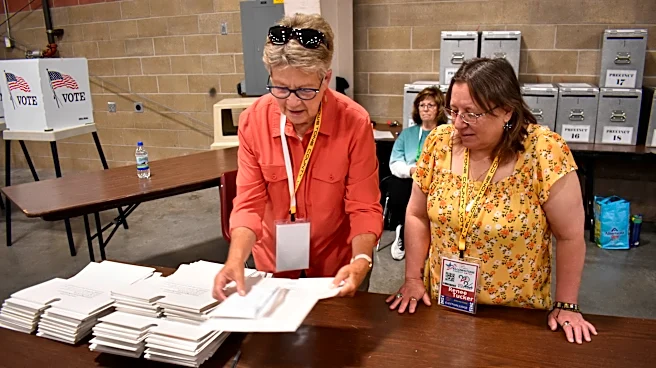

A Montana judge has blocked the state from limiting voter registration on Election Day, concluding the move would disproportionately harm Native American and young voters.
The ruling prevents a law that
was enacted last year by the Republican-controlled Legislature from being enforced that would have prevented voters from casting ballots in presidential, U.S. Senate and U.S. House races if they register after noon on Election Day. It was the second time in five years that legislators attempted to move away from Election Day registrations.
District Judge Adam Larsen's order, issued late Friday, is to remain in effect through the trial of a lawsuit filed by the Montana Federation of Public Employees, later joined by Native American tribes, including the Blackfeet and Northern Cheyenne. However, the state's primary elections are June 2, and the trial isn't until late August.
Larsen, sitting in the county that's home to the state capital of Helena, noted that registering on Election Day is “wildly popular.” Montana has allowed it since 2006, and in 2014, 57% of voters rejected a statewide ballot initiative to end it.
“The undisputed record demonstrates that a substantial number of Montana voters rely on Election Day registration, including during afternoon hours,” Larsen wrote. “The record further establishes that some voters will be unable to register prior to noon due to work schedules, travel constraints, polling place hours or unforeseen registration issues.”
Montana Attorney General Austin Knudsen's office expressed disappointment in the ruling.
“Unrestricted voter registration on Election Day puts a undue burden on Montana’s election administrators who have very important jobs ensuring our elections are secure and run smoothly,” spokesperson Chase Scheuer said in an email.
But Larsen rejected the state's argument that the law would make administering elections easier, saying local election officials would handle voting in federal races differently from state and local races.
Montana polling places for at least 400 voters must remain open from 7 a.m. to 8 p.m. on Election Day, but those for fewer voters don't have to open until noon, something Larsen noted.
The judge said Native American voters face “unique barriers” to voting, including long travel distances and limited access to transportation. Students and other young voters face obstacles to registering because of “scheduling constraints” and because they move more frequently, he wrote.
Amanda Curtis, the Montana public employees group's president, said its lawsuit defended “the fundamental right of every voice to be heard” from “overreaching politicians.”
The group and the tribes also challenged changes in a state law specifying which IDs students can show at the polls to register and vote, but Larsen concluded that they couldn't show that anyone had been prevented from voting because of them. Scheuer said the changes “bolster the integrity of Montana elections.”
In 2021, the Legislature enacted a law ending voter registration on noon the day before Election Day, but the Montana Supreme Court struck it down in 2024 as a violation of an “unequivocal fundamental right” protected by the state Constitution. The justices said more than 70,000 Montana voters had taken advantage of Election Day registration since its inception.
Before legislators enacted the latest law in 2025, their staff warned in a memo that the measure could conflict with the Supreme Court's 2024 decision.