
SPRINGFIELD, Ill. (AP) — You're standing in the middle of an empty highway, staring off into the fading, golden light of Arizona's high desert. The soundtrack playing in your mind? Depeche Mode.
Industrial-leaning synth-pop strains might seem incongruous with such a vista, but it was the alternative rock band's homage to Route 66 that seduced David J. Schwartz. With camera in hand he has made 42 trips over two decades along the celebrated highway,
qualifying himself for the job of creating postage stamps commemorating the Mother Road's centennial.
The U.S. Postal Service on Tuesday (XXX MAY 5 XXX) is releasing eight stamps marking significant parts of the road in each of the states it traverses, passing by vintage diners, gas stations and motels — many since preserved or restored — along with breathtaking vistas and wide horizons of the open road.
Route 66 is paved with history, from its early days as an escape from the Dust Bowl and the Great Depression, through serving as a vital supply route during World War II, to its mid-century role as an antidote for wanderlust. A symbol of freedom and mobility, it has evolved into a time capsule of Americana, steeped in nostalgia and neon.
As teenagers in 1988, Schwartz and his best friend had planned a road trip after girlfriends introduced them to Depeche Mode, where they discovered a cover of Bobby Troup's 1946 pop standard, “(Get Your Kicks on) Route 66.” Schwartz's mother nixed his participation, delaying his first taste of the open road until 2004.
To Schwartz, the road — stretching 2,448 miles (3,940 kilometers) — represents a significant piece of a newly mobile 20th century America, from its debut in 1926 to its decommissioning in 1985: “Road trips, big cars, neon signs.” Though retired from the federal highway system, vast stretches of the route are still in use and a favorite of road warriors and tourists to this day.
“So much to explore. You start here in Illinois on 66 and you’re cruising through prairie land,” Schwartz said during a recent interview in Springfield. “By the time you get out west, you're in the desert or you’re in mountains through hairpin turns. It’s just an incredible journey and you just get such a beautiful slice of America going through it.”
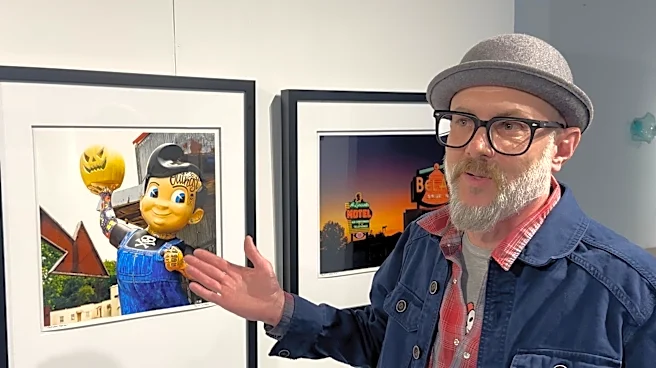
Tired of retail management, Schwartz went back to school to study photography and had the idea of Route 66 stamps as early as a decade ago. He was tapped for the project in 2023. He recalls thinking, “Here is my moment to bring Route 66 to the masses."
Greg Breeding, a USPS art director for stamp design, was working on a graphic showing a map of the road when he discovered Schwartz’s photos. They were beautifully photographed, not commercial and slick.
“They’re as if you were there," he said, "which makes them especially useful for stamps.”
The USPS plate contains 16 stamps, two of each one representing Route 66 host states. A ninth photo serves as selvage, or the image surrounding the block. It's the scene of that empty Arizona highway, shot in 2023 near Seligman, Arizona, when Schwartz and his high school friend finally took that trip 35 years in the making.
But a road is a road, isn't it? Why can't a traveler get the same view standing on one of the interstate highways that ultimately bypassed Route 66?
“You'd probably get run over,” Schwartz said dryly.
“Interstates are designed to move traffic quickly. They cut through the sides of mountains, they do not follow the contour of the land...,” he added. “On Route 66, you’re actually part of the landscape as you move through it. You feel the land as you’re traveling.”
Breeding and Schwartz steered clear of the fabled highway’s most popular spots, not only because those are tougher to get permission to use, but also because they wanted to give people a “fresh look," Breeding said. The stamps are devoid of people, he said, in part to create a sense of allure rather tourist trap vibes.
To that end, the blocks capture both the continuing commerce and the roadside relics that hint at their former vibrancy. Take for example the Conoco Tower Station and U-Drop Inn in Shamrock, Texas, a neon-adorned Art Deco beauty whose luminous lights come alive at dusk.
In Yucca, Arizona, Schwartz photographed the dilapidated “Motel” sign in the relentless noonday sun, revealing desert desolation but also “the enduring pulse of the open road.”
Among his favorites is the Illinois entry, a friend's 1929 Model A Ford rumbling down the only remaining section of Route 66 composed of hand-laid brick in Auburn, just south of Springfield. The goal? Create an image that would make viewers feel as if they were there for the birth of Route 66.
“We wanted to show it to be colorful. We wanted to show the quirkiness. We wanted to show the age,” Breeding said. “It’s like a sort of show, the idea that Route 66 is a living history of the United States, from the past to the present.”
Schwartz said he's amazed that the stamps boasting his work will “travel all over the United States and end up in people's mailboxes.”
He added: “I hope they really inspire people to get out there and travel the road and support the Mom and Pop businesses and keep Route 66 alive for another 100 years.”