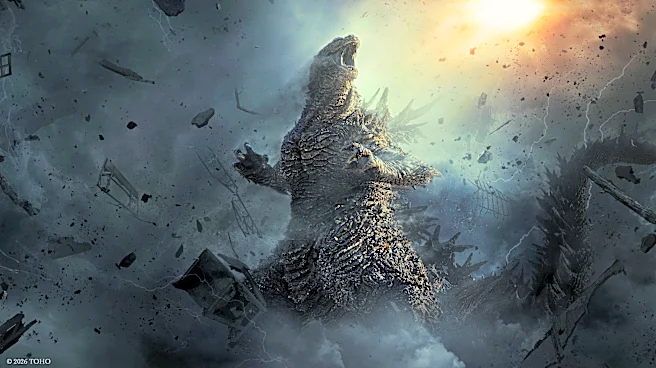








Even Godzilla can be felled by an old hazard: the sophomore slump.
Though Godzilla has been stomping around for more than half a century, “Godzilla Minus Zero” is a sequel. It follows the quite excellent, Oscar-winning “Godzilla Minus One,” a reset for the kaiju franchise that brought Godzilla back to its postwar Japan roots.
Director, writer and visual-effects maven Takashi Yamazaki’s feel for the textures of both the scaly one and period Japan remains
richly rewarding in “Godzilla Minus Zero,” which picks up two years following the previous film, in 1949. The follow-up, like its predecessor, marries human-scaled drama with a flair for stompy-stomp spectacle.
Yet those calibrations are slightly off in “Godzilla Minus Zero.” The melodrama on the ground overtakes the movie, sagging it with a bloated story that leaves you pining for the big guy to turn up again. When he does, Yamazaki’s film has the roaring thunder it needs. But too much of its lengthy runtime feels like the familiar overreach of a too-ambitious sequel.
The film picks up with ex-kamikaze pilot Kōichi Shikishima (Ryunosuke Kamiki), his wife Noriko (Minami Hamabe) and their young daughter, Akiko (Sae Nagatani). The post-WWII atmosphere of trauma and loss still permeates. The parents, conscious of the many orphaned children at Akiko’s school, warn her not to be too overjoyed when they pick her up.
Born in 1954, Godzilla arose out of atom bomb allegory. As the decades wore on, the monster series often lost touch with the grief it was born out of. While Yamazaki’s Toho Japanese-language rebirth is most immediately laudable for its dynamic yet low-budget visuals, his reclamation project is as much about returning to the concussed and traumatized mental state of postwar Japan.
So when the lightning bolt-spewing dragon Ghidorah turns up, its path of destruction is more like a haunting of previous traumas. Professor Kanji Murakami (Min Tanaka), having lost his family in the bombing of Hiroshima and watched Tokyo’s Ginza district leveled in “Godzilla Minus One,” experiences Ghidorah’s smashing of the city of Matsumoto like PTSD.
Murakami isn’t the primary figure of “Godzilla Minus Zero,” but he may be the most interesting. His vengeful fury for the occupying Americans adds a political dimension to the drama. The U.S. Army, absent in “Godzilla Minus One,” is here seen as a purely self-serving presence that wants no part of Japan's new crisis.
Instead, putting a stop to Ghidorah falls to a ragtag group led by the naval engineer Kenji Noda (a charmingly eccentric Hidetaka Yoshioka). His team includes a newcomer: meteorologist Makoto Aoyama (Masami Nagasawa), who can predict kaiju movements based on weather patterns. Kōichi and Noriko also reluctantly join the effort, a torturous decision given that it means leaving their daughter behind, probably for good.
Laudable as the human focus of “Godzilla Minus Zero” may be, none of the characters have enough depth to carry the emphasis they're given. Their deliberations often feel artificial and overwrought. Meanwhile, we impatiently await Godzilla like Godot. For all the movie’s earnest reckonings, he’s the most tragic and meaningful character, and it’s hard not to miss him when he’s away.
There are two massive monster set pieces in “Godzilla Minus Zero,” a relatively paltry offering if kaiju slamma jamma is your thing. It might be enough if they were each as good as the first: an exhilarating mid-movie aerial sequence. Yamazaki has proven himself a master of dread in depth, especially when aided by Naoki Satō’s pulsating score. What Yamazaki can do with a seaplane in the foreground and an emergent Godzilla in the background is, by itself, worth the price of admission. That may be especially true on IMAX screens, on which “Godzilla Minus Zero” is first being released.
Still, if every Godzilla film is building toward its finale, “Minus Zero” doesn’t stick the landing. When Ghidorah and Godzilla face off, the melee is labored and awkwardly staged. What should be a romp instead fizzles with the on-the-ground movements of characters around them. It’s an admittedly tall task to juggle characters the size of skyscrapers with a human ensemble, but that’s the aim of “Godzilla Minus Zero.”
It could be intentional that “Godzilla Minus Zero” keeps its star attraction waiting in the wings like Marlon Brando in “Apocalypse Now.” There is a definite “Act 2” vibe to Yamazaki’s anguished and somber movie, where the Japanese aren’t just reacting to the kaiju but reconciling themselves to the continued presence of ecological disaster. The movie does just enough to whet your appetite for a third movie, should it happen. But it will have to find a numerical solution to the double-negative title of “Godzilla Minus Minus-One.”
“Godzilla Minus Zero,” a GKIDS release on IMAX screens Tuesday and in theaters Friday, is rated R by the Motion Picture Association for some violent content/bloody images. In Japanese with English subtitles. Running time: 135 minutes. Two stars out of four.