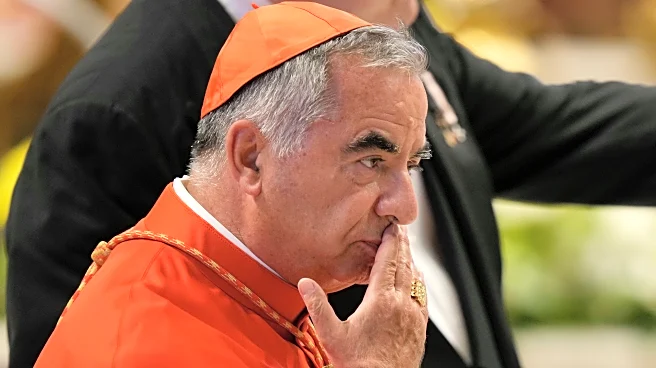




VATICAN CITY (AP) — Defense lawyers in the Vatican’s “trial of the century” argued Tuesday that Pope Francis inadvertently violated the fundamental rights of their clients by issuing four secret decrees that gave prosecutors “surreal carte blanche” to investigate in ways reminiscent of a “fascist” state where laws aren't published.
The tone of argument in the frescoed Vatican tribunal was so charged Tuesday, as the appeals trial resumed after a three-month
break, that at one point the tribunal president asked defense lawyers to refrain from citing Francis by name.
The request by Archbishop Alejandro Arellano Cedillo underscored how Francis' problematic role in the big financial trial poses something of an existential dilemma for the Holy See. On the one hand, popes can only be judged by God. On the other, Francis stands accused of issuing decrees that violated the God-given rights of the defendants.
The case concerns the once-powerful Cardinal Angelo Becciu and eight other defendants, who were convicted of a handful of financial crimes in 2023, after a sprawling two-year trial.
The case, which opened in 2021, had as its main focus the Vatican’s investment of 350 million euros ($413 million) in a London property. Prosecutors alleged brokers and Vatican monsignors fleeced the Holy See of tens of millions of euros in fees and commissions to acquire the property, and then extorted the Holy See for 15 million euros ($16.5 million) to cede control of it.
The original investigation spawned two main tangents involving Becciu, who was convicted of embezzlement and sentenced to 5½ years in prison. The tribunal convicted eight other defendants of embezzlement, abuse of office, fraud and other charges.
All the defendants maintained their innocence and appealed. Prosecutors also appealed, since the tribunal largely threw out their overarching theory of a grand conspiracy to defraud the Holy See and instead convicted the defendants of a handful of serious but secondary charges.
Last month, the Vatican's highest Court of Cassation upheld the lower court's decision to throw out the prosecutor's appeal entirely because prosecutor Alessandro Diddi committed an embarrassing rookie procedural error.
On the same day as the Cassation ruling, Diddi also dropped months of objections and abruptly resigned from the case, rather than face the possibility that the Cassation court would order him removed.
At issue is Diddi’s role in a now-infamous set of WhatsApp chats that have thrown the credibility of the entire trial into question. The chats, which document a yearslong, behind-the-scenes effort to target Becciu, suggest questionable conduct by Vatican police, Vatican prosecutors and Francis himself.
The appeal now proceeds on a next line of defense attack focusing on Francis’ role in the investigation. During the trial, defense attorneys had argued their clients couldn’t receive a fair trial in an absolute monarchy where the pope wields supreme legislative, executive and judicial power.
At issue are four secret executive decrees Francis signed in 2019 and 2020, during the early days of the investigation, that gave Vatican prosecutors wide-ranging powers, including the unchecked use of wiretapping and the right to deviate from existing laws.
The decrees only came to light right before trial and were never officially published. They provided no rationale or time frame for the surveillance, nor oversight of the wiretapping by an independent judge, and were passed specifically for this investigation.
Legal scholars have said the secrecy of the laws and their ad hoc nature violated a basic tenet of the right to a fair trial requiring the “equality of arms” between defense and prosecution. In this case, the defense was completely unaware of the prosecution’s new investigative powers. Even Vatican legal officials have privately conceded that Francis’ failure to publish the decrees was deeply problematic.
On Tuesday, attorney Mario Zanchetti argued the whole trial should be annulled because of the secret decrees. His client, broker Gianluigi Torzi, had his cellphones and laptop seized, and was arrested and detained in the Vatican barracks for 10 days without charge or a judge's warrant, based on the sweeping powers granted to prosecutors by Francis' decrees.
Zanchetti argued that even in Iran and Russia, laws must be published, and that the failure to do so risks “making the Vatican's procedural code fascist.”
He said he wasn't accusing Francis directly of wrongdoing, but said the late pope had been misled by prosecutors who requested the decrees.
At that point, Arellano the judge said: “I would ask you to not name Pope Francis. We all understand, if you avoid referencing the Holy Father.”
Attorney Luigi Panella, for his part, said the decrees provided prosecutors with a “surreal carte blanche” to investigate.
Diddi had argued that Francis’ decrees provided unspecified “guarantees” for the suspects, and the tribunal originally rejected the defense motions arguing the trial should be nullified because of them. In a somewhat convoluted decision, the judges ruled that no violation of the principle of legality had occurred since Francis had made the laws.
Zanchetti offered the appeals tribunal a way to avoid a finding against Francis, suggesting that the judges could find that the decrees were merely administrative acts that, because they were never published, are considered “ineffective."
Such a finding could render the evidence gathered under them inadmissible, but would avoid a finding that Francis himself violated divinely inspired norms guaranteeing the dignity and rights of the defendants.
___
Associated Press religion coverage receives support through the AP’s collaboration with The Conversation US, with funding from Lilly Endowment Inc. The AP is solely responsible for this content.