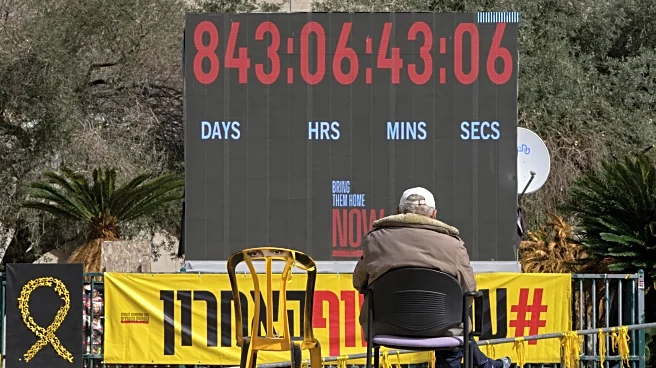




JERUSALEM (AP) — For more than two years, Israelis pinned yellow ribbons to their lapels and gathered to remember the hostages abducted during the deadliest day in the country’s history. But in a sign marking the end of a painful chapter, they removed their ribbons and turned off a clock Tuesday in Tel Aviv's Hostages Square tracking the duration of the hostages’ captivity.
The return of Ran Gvili, a 24-year-old police officer killed while fighting
Hamas militants during the Oct. 7, 2023, attack on Israel, fulfilled nationwide hopes to return all hostages, living or dead.
But before the country could commemorate him, and ahead of his funeral Wednesday, forensic teams combed a cemetery in northern Gaza, working to locate, exhume and identify his remains as part of a broad effort involving search teams, intelligence officers and forensic dentists.
The October 2025 ceasefire required Hamas to return 20 living hostages and the remains of 28 deceased during the agreement’s first phase. The living hostages, as well as the remains of four deceased, were handed over on the day the ceasefire took effect. Efforts to recover more became a sticking point after Israeli Prime Minister Benjamin Netanyahu tied the reopening of a border crossing in Gaza’s southernmost city, Rafah, to their return. Under the terms of the agreement, Israel pledged to return the remains of 15 Palestinians in its custody for each Israeli body recovered.
A spokesman for the Shin Bet, Israel’s domestic security service, said investigators got a breakthrough after interrogating a member of Palestinian Islamic Jihad, whose information helped corroborate intelligence that led to them to Gvili’s remains. Shin Bet said the body had been moved several times.
“More than 20 dentists from the unit worked together for over 24 hours, scanning approximately 250 bodies until the identification of Master Sergeant Ran Gvili,” a military official said, speaking on condition of anonymity under army protocol.
On Tuesday, thousands of people in Hostages Square watched and some cheered as a clock stopped at 843 days, 12 hours, 5 minutes and 59 seconds — a bittersweet ending in a place that became the focal point for the campaign to release the hostages.
“It’s happy and sad, we had been holding out for a miracle, even though all of the signs pointed the other way, that he would come back alive, but it’s such a relief it’s finally over” said Karen Gafen Solomon, who had been involved in the protest movement for the hostages. “It has been the most important thing in our lives for the past two years and two months.”
Militant groups in Gaza contested Israel's narrative about how Gvili’s body was found, with both Hamas and Palestinian Islamic Jihad saying they had provided Israel with information about to locate the remains.
Saraya al-Quds, Islamic Jihad’s military wing, said it shared coordinates with Israel through Arab mediators and accused Israel of delaying the search. Hamas said it also provided information.
Palestinians living nearby said remains exhumed during the search were left exposed in the cemetery without reburial.
“Our dead are in the open. They left them without burial or after just covering them with soil,” said Mohamed Matter, whose relatives are buried in the cemetery. He and others said they attempted to reach the area on Tuesday but were turned away by Israeli forces. Two people were killed in an Israeli drone strike while attempting to reach the area and taken to Shifa Hospital where they were pronounced dead, according to hospital officials.
Israel’s military said it was unaware of strikes and cautioned against relying on unverified reports.
Hamas spokesman Hazem Qassam said Tuesday that Israeli forces had exhumed “hundreds of graves,” calling it a pattern of showing disrespect.
Human remains hold profound importance in both Judaism and Islam, which emphasize swift burial and respect for bodies.
Israeli President Isaac Herzog said the return of Gvili’s remains “closed the circle” for Israel, while U.S. envoy Steve Witkoff on Tuesday called it “a new day in the Middle East.” But in Gaza, families sheltering in tents without fuel for heat said today felt much like yesterday.
In Khan Younis, they questioned whether their lives would quickly improve as the ceasefire agreement moves toward a second phase, with some doubting whether Israel would follow through on the promised breakthrough.
“The crossing is supposed to open now after the last soldier’s body was found,” said Ali Abu Al-Eish, a former resident of Rafah. “Why is it still closed? We have many sick people here. Things should be better than this. Enough.”
“Why are Hamas and Israel stalling?” said Ayda Abu Dheisha. “Let them reach an agreement and resolve this for us. We want to return to our land and our homes.”
Both are among the roughly one million former residents displaced from Rafah, which remains an Israeli military zone. Israeli officials have said the crossing is expected to reopen in a limited fashion following Gvili’s return.
Israel has said Rafah would initially be opened only to people, not goods, which continue to enter Gaza through crossings from Israel. But it has offered few details about who may be eligible to pass through and whether departures will be limited to medical evacuees. It also remains unclear when aid from Egypt will be allowed to enter.
Neither side withdrew from the four-month-old ceasefire during its initial phase, as international mediators pressed Israel and Hamas toward subsequent steps. Those are expected to be more challenging. In addition to reopening Rafah, they include demilitarizing the strip after nearly two decades of Hamas rule.
President Donald Trump’s 20-point plan, published in October, left details vague and major questions unanswered about the ceasefire’s next phase. They includes when Israel might allow the Palestinian technocratic committee meeting in Cairo to enter Gaza, and when Israeli forces might withdraw from areas they currently control, allowing displaced Palestinians to return.
Other uncertainties include how any new governing arrangement would be enforced and monitored, and what conditions would need to be met before large-scale reconstruction.
Gaza’s Health Ministry has recorded 488 people killed since the start of the ceasefire, on both sides of the yellow line to which the Israeli military withdrew in October. The ministry, which is part of the Hamas-led government, maintains casualty records that are viewed as generally reliable by United Nations agencies and independent experts.
Hospitals and the ministry have continued to report new deaths nearly every day, though the pace has slowed since the ceasefire, bringing the total death toll to 71,662 as of Tuesday.
The ministry said Tuesday that about 20,000 Palestinians require medical evacuation from Gaza. Departures to Egypt are expected to be among the first movements permitted through the Rafah crossing.
___ Magdy reported from Cairo. Melanie Lidman in Tel Aviv and Natalie Melzer in Nahariya, Israel, contributed.
___
Find more of AP’s coverage at https://apnews.com/hub/israel-hamas-war