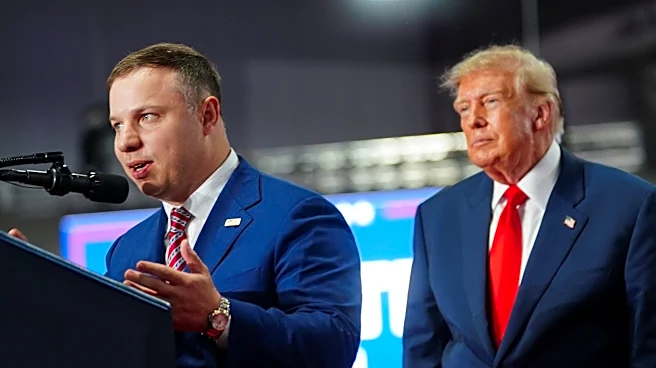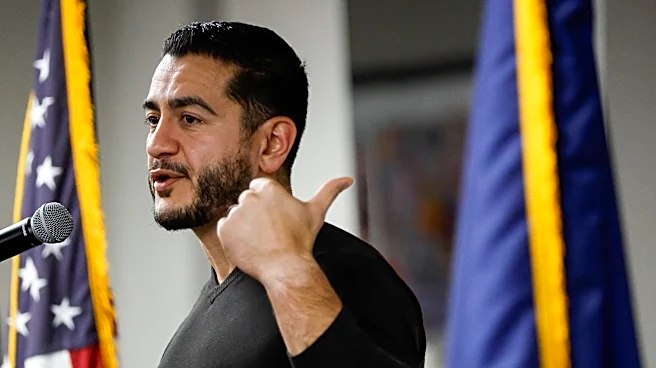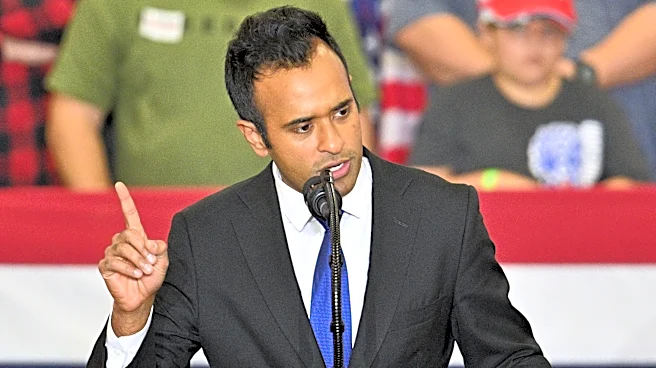

COLUMBUS, Ohio (AP) — A brand-new face will lead Ohio's state government after Tuesday, as two candidates with no elective experience — Republican biotech billionaire Vivek Ramaswamy and Democratic rival
Dr. Amy Acton — vie to succeed a term-limited sitting governor who's spent five decades in politics.
If Acton prevails, she would be the first Democrat elected Ohio governor in two decades and the first woman. If the Trump-endorsed Ramaswamy wins, he will be the first Indian-American to hold the seat.
Spending in the race topped an unprecedented $100 million. While Ramaswamy and his allies significantly outraised and outspent Acton and the Democrats, they failed to pull out the insurmountable lead initially expected in a state Donald Trump won convincingly three times.
In the closing weeks of the contest, Ramaswamy aired a controversial ad featuring Acton's estranged mother that prompted bipartisan backlash across the country.
Acton, the state's former COVID-era health director, benefited from a late surge in fundraising after Ramaswamy started running the spot.
Initially leaked online, the ad featuring Acton’s mother was quickly claimed by Ramaswamy, who defended it as a fair criticism of a pattern of deception by Acton that was being inaccurately spun by Democrats and the media as questioning whether she was abused as a child.
The 60-second spot featured Acton’s mother, Donna Arthur, calling her daughter “a liar” with a “serious problem” with being honest about her past. She urged Ohioans not to vote for Acton.
Arthur has been estranged from Acton for decades. She lost custody of her children after her husband, the children’s stepfather, was indicted for raping Acton from ages 9 to 12 before pleading not guilty and fleeing the state before he could be tried. Acton said she last saw her mother at a courthouse in 1978.
The ad prompted condemnation from politicians across the country, but both President Donald Trump and Vice President JD Vance defended Ramaswamy. The president even expressed jealousy that he’d never had the opportunity to run such an attack against a political rival.
But others, including Republican Gov. Mike DeWine, denounced it and called for Ramaswamy to take it down. It was not the first time during the campaign that DeWine had sided with Acton, a former member of his cabinet, over Ramaswamy, whom he had endorsed. The governor also took Acton's side when Ramaswamy criticized her actions during the pandemic, saying she merely carried out his instructions.
Ohio Republicans, energized by Ramaswamy's high profile, wealth and proximity to Trump, unified around his candidacy early on. His path was facilitated by DeWine, who appointed the leading Republican contender for governor at the time, then-Lt. Gov. Jon Husted, to the U.S. Senate to fill the seat JD Vance vacated to become vice president.
The party's decision to endorse a newcomer to Ohio politics left a number of veteran Republican politicians — including the attorney general and state treasurer — scrambling to adjust their own plans. And it wasn't long before the move prompted some anxiety within the party.
Ramaswamy, a former presidential candidate, faced an unexpectedly energetic primary challenge from fierce critic Casey “The Car Guy” Putsch, a vehicle designer and YouTube provocateur whose $130,000 campaign attracted nearly 18% of the Republican vote. Putsch also directed veiled ethnic and religious attacks at Ramaswamy, who is Hindu.
Acton, meanwhile, was able to consolidate support by running unopposed in the Democratic primary.
Many Democrats were initially reluctant to back her as they awaited an announcement from former Sen. Sherrod Brown, who eventually decided to run for U.S. Senate, but they quickly coalesced behind Acton. A third candidate — Libertarian Donald Kissick, a Navy veteran who did two tours in the Middle East — also appears on general election ballots.
Despite this being Acton's first run for elective office, she entered the race as one of Ohio Democrats' most recognizable names because she was the state's health director during the initial response to the COVID-19 pandemic.
Ramaswamy has made Acton's pandemic response a key point of attack, saying she harmed the state by being too aggressive in shutting schools and businesses.
Both leading candidates put economic issues at the heart of their campaigns, but offered sharply different solutions to voters' pains.
Ramaswamy presented his success in business as something he could replicate as Ohio's governor — putting more wealth in people's pockets by phasing out Ohio's income tax, rolling back property taxes, cracking down on Medicaid fraud and requiring AI data centers to pay neighboring residents' electricity bills.
Acton, who described spending a portion of her childhood homeless, blasted Ramaswamy as a “self-serving billionaire” whose actions as a candidate — including frequent use of a private jet for campaign stops and a trip to Paris on July Fourth — showed that he was out of touch with the financial struggles of average Ohioans.
She targeted her affordability agenda at tax cuts and credits for middle- and lower-income residents, and said she would direct taxes collected from wealthier Ohioans toward improving schools, lowering healthcare costs and other priorities. Acton said any new data centers must cover their own utility costs, use all-union labor and not pave over farmland.
Tuesday's outcome could depend heavily on Democrats' stepped-up campaign to regain support for Acton and other Democrats in rural Ohio counties, which have turned sharply Republican in the decade since Trump entered the nation's political scene.
Ramaswamy and Republicans also worked hard to appeal to voters in those areas, where many are dissatisfied with data centers, high gas prices and the war in Iran.