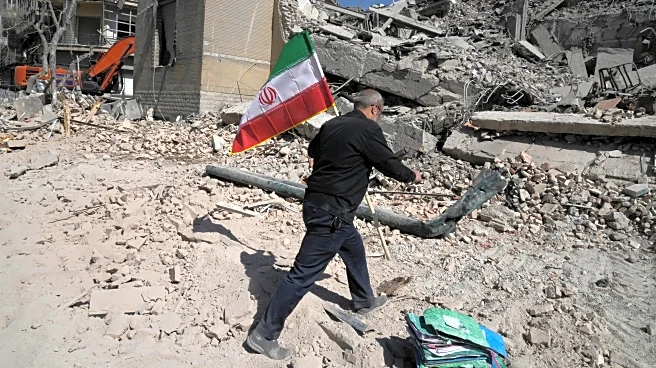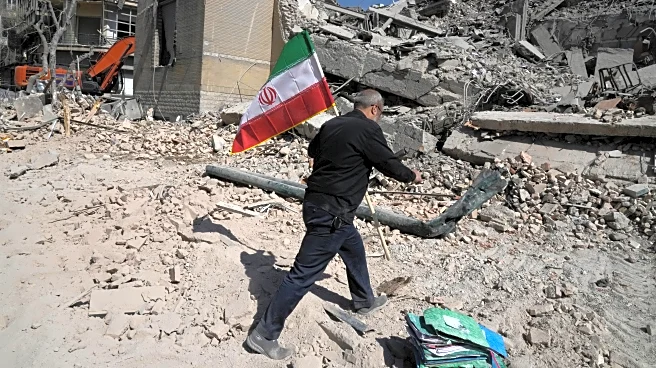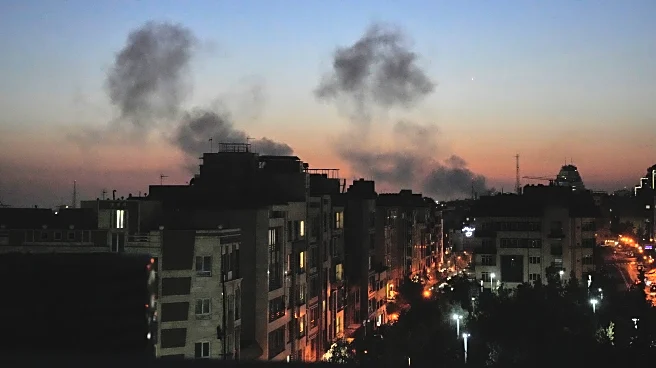

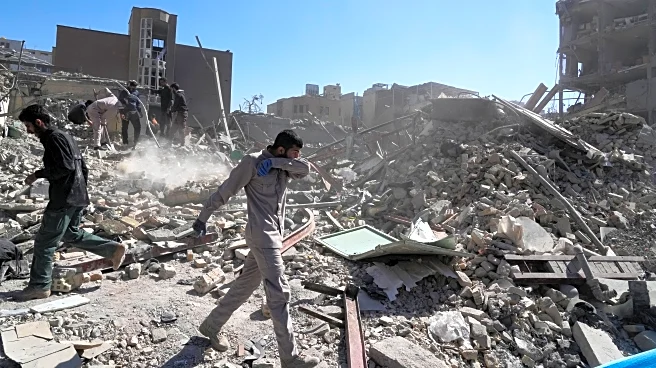
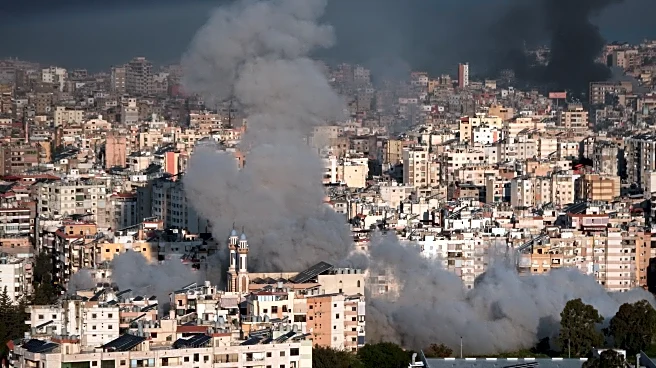
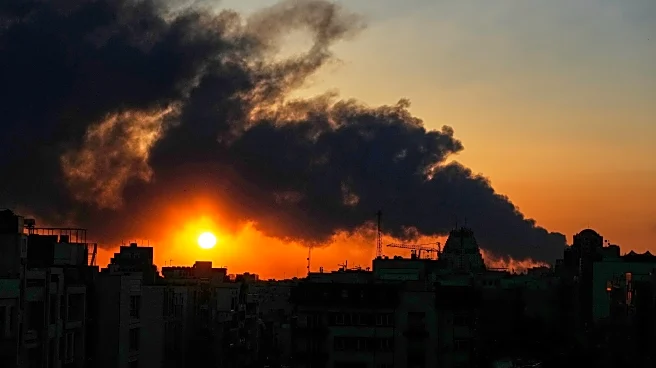
Israeli warplanes pounded Beirut and Tehran on Friday as Iran launched another wave of retaliatory strikes against Israel and Gulf countries that host U.S. forces.
1. U.S. President Donald Trump appeared to rule out negotiations with Iran in a social media post calling for its “unconditional surrender.” Trump told media outlets on Thursday that he wants to be involved in picking Iran’s next leader.
2. The death toll continues to rise. At least 1,230
people in Iran, more than 200 in Lebanon and around a dozen in Israel have been killed, according to officials in those countries. Six U.S. troops have been killed.
3. The U.S. military said early Friday that it struck an Iranian drone carrier, setting it ablaze. Its Central Command released black-and-white footage of the burning carrier. The Iranian military did not immediately acknowledge the attack.
4. London police said Friday that four men have been arrested on suspicion of aiding Iran by spying on the Jewish community. The Metropolitan Police said the suspects — one Iranian and three dual British-Iranian nationals — were taken into custody and that searches are ongoing.
Here is the latest:
Russia has provided Iran with information that could help Tehran strike American warships, aircraft and other assets in the region, according to two officials familiar with U.S. intelligence on the matter.
The people, who were not authorized to comment publicly on the sensitive matter and spoke on the condition of anonymity, cautioned that the U.S. intelligence has not uncovered that Russia is directing Iran on what to do with the information.
Still, it’s the first indication that Moscow has sought to get involved in the war that the U.S. and Israel launched on Iran a week ago. Russia has tightened its relationship with Iran as it looked for badly needed missiles and drones to utilize in its four-year war Ukraine. Tehran, meanwhile, has been isolated for years over its nuclear program and its support of proxy groups, including Hezbollah, Hamas and the Houthis, that have wreaked havoc in the Middle East.
Asked what Trump meant by accepting only “unconditional surrender,” Karoline Leavitt said Friday that will be achieved when the president “determines that Iran no longer poses a threat to the United States of America” and the mission’s goals have “been fully realized.”
“Then Iran will essentially be in a place of unconditional surrender,” she told reporters outside the White House “whether they say it themselves or not. Frankly they don’t have a lot of people to say that for them.”
Leavitt also said she didn’t have anything to share on the Pentagon’s investigation into whether the U.S. military struck an Iranian girls school.
“Again, as I said at the briefing two days ago, I don’t have any updates with respect to the investigation. I would expect those to come from the Pentagon,” she said.
Secretary-General Antonio Guterres stressed that “the stakes could not be higher.”
“All the unlawful attacks in the Middle East and beyond are causing tremendous suffering and harm to civilians throughout the region – and pose a grave a risk to the global economy,” he said.
In a statement Friday, Guterres called for an end to the war that started in Iran and is now affecting more than a dozen other countries, and for serious diplomatic negotiations.
How could this get worse?
U.N. spokesman Stephane Dujarric responded to the question by saying the unity of some countries could be threatened, civilian suffering can escalate, and the situation around the Strait of Hormuz can worsen. Shipping in the vital waterway on Iran’s southern coast is at a halt, affecting oil tankers and vessels carrying other critical items. The resulting spike in oil prices can impact the price of food, transport and fertilizers, he said.
Remarks by U.S. Defense Secretary Pete Hegseth point to government reluctance in recent decades to expose the public to the human cost of conflict.
Hegseth said during a Pentagon briefing Wednesday that U.S. media coverage highlighting American casualties in the Iran war was intended to make President Donald Trump “look bad.” His remarks came as he spoke about the six U.S. army reservists killed in an Iranian strike on an operations center in Kuwait.
Similar comments from the Trump administration raised questions about how the war is communicated to the public, particularly as the conflict intensifies and leads to more casualties and instability.
Coverage of the Vietnam War shocked many Americans in the 1960s and left a legacy: “For many presidents, the lesson seemed to be: Don’t allow the realities of war into people’s living rooms if you can help it,” said Timothy Naftali, senior research scholar at Columbia University’s School of International and Public Affairs.
▶ Read more
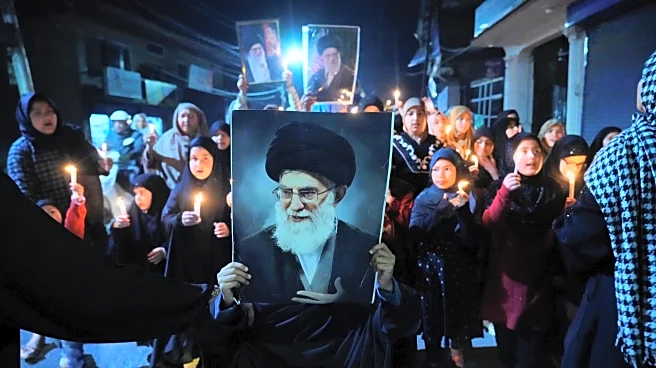
The U.S. Embassy In Islamabad issued a security alert warning Americans of possible violence as the protesters took to the streets.
Amid heavy police presence, about 300 protesters staged a sit-in, holding posters of Khamenei and chanting “Death to America” and “Death to Israel.”
Khamenei, who ruled Iran since 1989, has long been a central religious and political figure for Shiites worldwide, including in Pakistan. His death in a joint U.S.-Israeli operation at the start of this war sparked outrage among many Shiites.
▶ Read more
The vessel sought assistance as tensions mounted in the Indian Ocean following the sinking of an Iranian warship by a U.S. submarine.
Sri Lankan President Anura Kumara Dissanayake said they decided to take control of the IRIS Bushehr after discussions with Iranian officials and the ship’s captain, after one of its engines failed.
“No civilian should die in wars. Our approach is that every single life is as precious as our own.” Dissanayake posted on X on Friday.
Sri Lankan navy spokesperson Cmdr. Buddhika Sampath said 204 sailors were brought to its Welisara Naval Base, while about 15 others remain on board with Sri Lankan naval personnel.
The broadening Middle East conflict is putting strategically located Sri Lanka in a delicate position as it tries to balance humanitarian obligations, international maritime law and its longstanding policy of non-alignment.
▶ Read more
The son of Israel’s far-right Finance Minister Bezalel Smotrich was lightly wounded near Israel’s border with Lebanon.
“Thank God, his condition is mild and he is OK,” said the minister’s spokesperson, Efraim David.
Bezalel Smotrich had warned that Beirut’s southern suburbs would soon look like Gaza, as Israel responded to Hezbollah rocket fire.
The Israeli strikes have been the heaviest since a 2024 ceasefire with the Iran-backed militant group.
Canada’s foreign minister, Anita Anand, says its efforts include:
— a chartered flight is set to take 180 Canadians from Dubai to Istanbul on Saturday
— blocks of 50 seats each booked on Air Arabia flights from Dubai to Istanbul
— 51 seats for Canadians on an Emirates flight leaving Dubai for Toronto on Saturday
— 200 seats on four separate flights from Beirut to Istanbul in the coming days.
— roughly 325 seats on commercial flights secured for Canadians by diplomatic staff in Beirut
Anand said Canadians are also making their own arrangements. “I want to reiterate that any ground transportation carries risk,” Anand said.
Anand also said that United States and Israel do not have a “blank cheque” in their bombing campaign in Iran, and remain bound by international law. Prime Minister Mark Carney initially expressed support for Washington’s decision to launch the war, but later said the airstrikes likely violate international law and said his support comes with “regret.”
U.S and Israel jointly claimed to have hit around 4,000 targets in the first four days in Iran, according to UK-based Airwars.
That is more targets than in the first six months of the U.S-led coalition’s bombing campaign against the Islamic State group, and nearly double the average number of targets per day claimed by Israel in the first four days of its Gaza war, considered one of the most intense bombing campaigns in the 21st century.
Only the opening salvo of Israel’s war against Lebanon in 2024 may compare. Israel claimed it hit 1,600 targets in the first 24 hours, but the daily rate subsequently dropped, said Airwars, which with a sister organization monitors civilian casualties and the use of munitions.
The increase in targets hit per day has been facilitated by the extensive use of artificial intelligence in targeting by Israel’s military. AI is likely feeding the U.S. target banks as well, Airwars said.
Britain says Iran’s military command and control remains intact, though weakened, after almost a week of U.S. and Israeli airstrikes.
The Foreign Office says Iran’s governing system likely is resilient enough to continue operating in at least the short term.
In an assessment on Friday, the Foreign Office said Iranian missile and drone attacks are coming at a lower tempo than in the first days of the war, largely due to U.S.-Israeli success at taking out Iran’s missile launchers and air defenses. But Iran’s range of targets is diversifying, with an increasing focus on economic and energy-industry targets.
The Ministry of Natural Resources in northern Iraq’s semi-autonomous Kurdish region announced on Friday that production at an oil field in Dohuk province has stopped following a “terrorist” attack from inside Iraq.
The ministry said in a statement that the HKN oil field in the Sarsang area of Dohuk province was targeted the night before, causing material damage to the field and forcing a halt to production.
Iran and allied groups in Iraq have launched dozens of missile and drone attacks on the Kurdish region, which hosts U.S. bases as well as bases of Kurdish Iranian dissident groups that have threatened to launch attacks in Iran.
Merve Pourkaz, 32, a hairdresser from Iran’s Golestan province, crossed into Turkey Friday to wait out the war. She left after airstrikes hit her area and planned to stay in a hotel in the Turkish border city of Van as long as she could.
“If they let me, I will stay in Van until the war ends,” she said. “If the war doesn’t end, maybe I’ll go back and die.”
Meanwhile, Leila Rabetnezhadfard, 45, was returning to Iran to be with her family. She had been in Istanbul with her fiance, a German university professor, when the war broke out. She postponed their marriage to return.
“How can I feel safe in Istanbul when my family is living in Iran during the war?” she said. And bringing them to Istanbul was not an option — her brother needs medical care that would be too expensive in Turkey.
“I will not leave Iran until the war ends,” she said.
The price for a barrel of benchmark U.S. crude rose above $90 for the first time in more than two years Friday as the war in Iran spreads.
Pain at the pump has followed closely behind, rising 34 cents in just one week to a national average of $3.32 per gallon, according to motor club AAA.
Energy prices took off almost immediately after the U.S. and Israel launched attacks on Iran. Trump on Friday appeared to rule out negotiations to bring the war to a close, calling for “unconditional surrender” by Iran.
A barrel of crude in the U.S. last crossed the $90 mark in October 2023.
The Israeli military says that that in coordination with the Israel Security Agency, Shin Bet, it struck a fundraising office used by the Palestinian group Hamas in south Lebanon.
The army said Hamas’s fundraising officer, Issam Hashan, and others operated through the clandestine office to collect hundreds of millions of dollars worldwide for the Palestinian group.
Earlier Friday, an Israeli drone strike hit an office inside a building in the southern Lebanese port city of Sidon, killing five people and wounding seven.
El Al, Israel’s flag carrier, said it expects to start flying stranded travelers out of Israel at 8 a.m. local time on Sunday.
Under the government-backed plan, the recovery flights will initially carry no more than 70 passengers each. The airline said it is contacting passengers who are not residents of Israel to return them home at no additional cost, and that flights will depart to 22 destinations.
Passengers are being assigned seats based on their original flight dates, though the airline said it is also reviewing “exceptional medical humanitarian cases,” including those needing urgent medical treatment or surgery, as well as pregnant travelers.
The tanker was empty and in Gazan waters when it came under fire from the sea on Thursday, U.N. Undersecretary-General Jorge Moreira da Silva said.
No one was injured, he said, but gave no further details as he called for a full investigation.
“Fuel must be allowed into Gaza consistently, its delivery facilitated safely and without interruption,” said da Silva. He leads the U.N. agency known as UNOPS, which helps the U.N, governments and others with projects, procurement and deliveries.
His statement Friday said fuel is critical to the operations of humanitarian and essential services including hospitals, water and sewage systems, and bakeries.
The State Department said Friday that nearly 24,000 Americans have returned to the United States from the Middle East since the start of U.S.-Israeli military operations against Iran that have sparked fierce Iranian retaliation in the region.
The vast majority of the 24,000 were able to make their way home on their own through commercial means, although the department has arranged and is continuing to organize charter flights for Americans who have sought assistance in leaving.
“Several flights have safely returned hundreds of Americans to the United States with additional flights scheduled to take place over the coming days, as security conditions allow,” the department said in a statement. It reiterated a request for U.S. citizens in Bahrain, Israel, Kuwait, Oman, Qatar, Saudi Arabia and the United Arab Emirates to fill out a Crisis Intake Form to receive information about options.
There have been several very large explosions in Tehran Friday afternoon, with columns of smoke rising, multiple eyewitnesses tell The Associated Press.
Numerous explosions also were heard in northern Iran, around the city of Rasht in Gilan province.
It remains unclear what the strikes’ targets were.
The president is hosting defense industry executives Friday to push them to expedite supplies of more American-made weapons. Invited companies include Lockheed Martin, Northrop Grumman, RTX Corporation, Boeing, Honeywell and L3Harris Technologies.
White House press secretary Karoline Leavitt said Friday that the U.S. military has “more than enough munitions, ammo, and weapons stockpiles” to continue its operations in the Middle East.
“Nevertheless, President Trump has always been intensely focused on strengthening our military, which is why this meeting with defense contractors was scheduled weeks ago,” Leavitt continued.
Lebanon’s state-run National News Agency reported the air strike. It was not immediately clear how close it was to the Iranian compound.
Iran’s military spokesperson earlier this week threatened that if Israel targets Iran’s embassy in Lebanon, Iran will consider all of Israel’s embassies in neighboring countries to be legitimate targets.
Israel’s military did not immediately respond to questions about the strike.
The number of people killed by Israeli strikes in Lebanon since Monday has risen to 217, with another 798 wounded, Lebanon’s health ministry said.
It was not clear how many were civilians. Tens of thousands more have been displaced.
After the attacks by the U.S. and Israel on Iran triggered a new war in the Middle East, Hezbollah launched missiles and drones into Israel Monday for the first time in over a year. Israel has retaliated by bombarding southern Lebanon and Beirut’s southern suburbs.
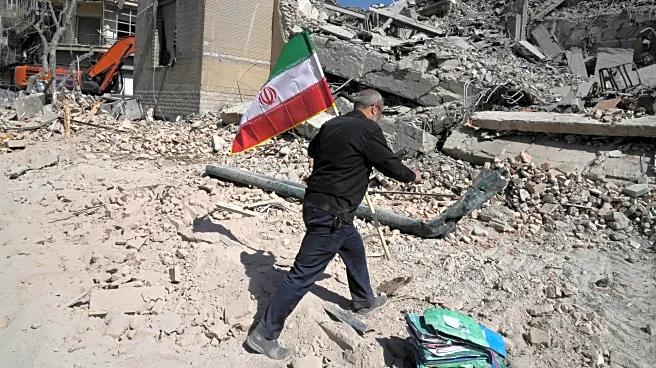
Israel’s military said Friday that it had deployed more than 50 fighter jets while pummelling an underground bunker Iranian leaders had planned to use in emergencies with more than 100 munitions.
“This is a large-scale underground bunker located under several residential neighborhoods in Tehran, dozens of meters deep. The secret bunker from which Khamenei was supposed to conduct the fighting against Israel. He was eliminated before he could use it,” Israeli military spokesperson Brig. Gen. Effie Defrin said on Friday.
He said Iran’s elected officials continued to use the bunker because they thought it was impenetrable. “They were wrong,” he said.
He said the Israeli military is assessing the results of the attack, which witnesses in Iran said happened around 5:40 a.m. Iran has spent decades constructing underground bunkers for a range of purposes and contingencies, many of which have been targeted this week.
Rabbi Axel Wahnish told Radio Rivadavia in Buenos Aires on Friday that 260 Argentine tourists are stranded, and their relatives and contacts are begging for help leaving Israel.
He noted that both official instructions and unofficial recommendations say “the safest thing” to do is to wait and stay close to a shelter.
“The skies are completely closed for departure,” Wahnish said. “The only way out is via Egypt in the south, at the Taba crossing, but you have a four-hour land trip, which is risky.”
He said many Argentines are trying to flee to Egypt despite the danger, and the embassy is helping them “to evacuate via that route.”
“The psychological pressure is real. The sound of explosions and the uncertainty about what might happen next make it hard to sleep,” the 29-year-old told The Associated Press. He declined to be identified due to safety concerns.
“At the same time, people are trying to keep hope alive and believe that this difficult time will eventually pass,” he said.
He and his family are among many residents choosing to remain in the city, although others had left for safer locations, he said in text messages.
A lack of reliable information and air raid warnings are adding to people’s anxiety. “During the Iran–Iraq war, people say there were sirens to warn civilians but today there is no such system,” he said.
While there were no shortages, many businesses are closed and prices are rising daily.
Beirut’s roads were choked with traffic and its squares and parks dotted with tents as residents fled Israeli strikes Friday.
As smoke from airstrikes rose over the city’s southern districts, Israel’s warnings to leave the area caused gridlock downtown. More than 95,000 people have been displaced.
Those unable to find shelter in schools put up tents or slept in cars. Others laid blankets on pavement.
“What can we do? We prayed here under the tree. During the night we slept in the car because there is no place to stay,” said Jihan Shehadeh, who like many others is fasting for the Muslim holy month of Ramadan.
“They threatened the southern suburbs, so we gathered our things, left and moved out of the whole area. Now we’re living a tragic life here, displaced,” added Jamal Saif Al-Din.
Portugal said Friday that two repatriation flights from the Mideast had reached its territory. A TAP charter plane arriving Friday morning from Oman carried 147 passengers, 139 of them Portuguese. The rest were foreign nationals, Portuguese Prime Minister Luís Montenegro said at a summit.
A separate military flight reached Portugal on Friday carrying 24 Portuguese nationals and 15 foreigners, the government said.
Portugal has allowed the U.S. to use the Lajes air base on the Azores Islands for its air campaign against Iran. This contrasts starkly with that of neighboring Spain, which disallowed Washington to use bases within its territory, sparking a diplomatic tussle with the Trump administration.
Montenegro defended Portugal’s stance on Friday, citing its long-standing relationship with the U.S. and Iran’s violations of international law.
U.S. President Donald Trump appeared to rule out negotiations with Iran to end the conflict in the Middle East, saying in a social media post Friday that there will be no deal absent “unconditional surrender” from Tehran.
“After that, and the selection of a GREAT & ACCEPTABLE Leader(s), we, and many of our wonderful and very brave allies and partners, will work tirelessly to bring Iran back from the brink of destruction, making it economically bigger, better, and stronger than ever before,” Trump said.
He has said multiple times that whomever takes over leadership of Iran must be to the U.S.’s liking.
Trump signed off the social media post with “MAKE IRAN GREAT AGAIN (MIGA!),” a riff on his longtime campaign slogan, “Make America Great Again.”
The International Paralympic Committee says Iranian athlete Aboulfazl Khatibi won’t compete at the Milan Cortina Paralympic Games because he can’t safely travel to Italy during the intensifying Middle East conflict.
The announcement came just hours before the opening ceremony in Verona.
Khatibi is a cross-country skier and was the only athlete from Iran set to participate in the Games that are beginning less than a week since the United States and Israel launched a military attack against Iran.
Hezbollah’s military command is calling on the group’s gunmen to fight to the death, saying that the war they are fighting is similar to that fought by one of Shiite Islam’s most important religious figures 13 centuries ago.
The group’s command also said in a statement directed to fighters that they should “defend the nation” to keep Hezbollah’s yellow banner flying.
“Kill them wherever you find them,” the command said, describing the ongoing war as a religious battle similar to the one fought by Imam Hussein in Karbala.
Imam Hussein was killed in a climactic battle in Karbala, which is now part of Iraq, in A.D. 680.
“Karbala is happening again,” the statement said.
Chancellor Friedrich Merz says he doesn’t want to see a “Syrian scenario” in Iran, referring to Syria’s long civil war.
Merz says that “we want this state to be capable of functioning by itself.”
He says his appeal in his discussions with the U.S. and Israel is “to create as quickly as possible the preconditions for this country to be stabilized, for it to get a democratically legitimized government and for it to continue to exist as a state.”
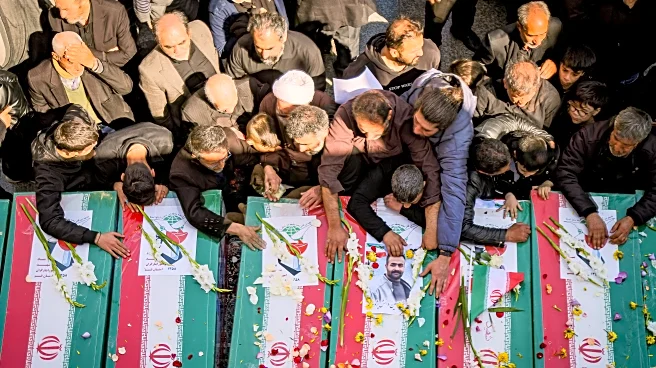
Thousands of men and women gathered in Tehran’s streets Friday in a show of defiance and to hold prayers in the open.
Waving clenched fists and Iranian flags as they filed past a poster of the late Supreme Leader Ayatollah Ali Khamenei, the marchers chanted “We’ll fight, we’ll die, we won’t accept humiliation” and “No compromise, no surrender, destruction of Israel.”
Hassan Fathollahi, 54, said he had brough his children to “make our enemies understand that we and our children will sacrifice our lives for the (Islamic) revolution.”
“We will not give up the blood of our leader. Every single son of Iran is ready to fight America and Israel until victory, God willing,” he said.
Three aerial drones hit the United Arab Emirates on Friday, the country’s Defense Ministry said on X. It did not elaborate on where they fell or any damage caused.
The UAE’s air defenses destroyed nine ballistic missiles and intercepted a further 109 drones on Friday, the ministry added. Since the start of the war, 205 ballistic missiles and 1,184 drones have been detected in UAE territory, with most destroyed, officials said.
The International Energy Agency director says the conflict in Iran has halted exports of Iranian gas to largely Asian markets, a stoppage that if drawn out will likely lead to a bidding war between Europe and Asia and energy prices will soar.
“If the crisis continues this way, the Asian buyers and the European buyers will need to compete for the LNG which will get scarcer and scarcer," IEA Executive Director Fatih Birol said Friday after meeting with European Commission chief Ursula von der Leyen.
“So this will be the challenge for European countries if the crisis continues in the next days or weeks to come," Birol added.
Israel’s military has issued a warning that people should flee an industrial area of Qom, the Shiite seminary city south of Iran’s capital, Tehran.
Iran’s president says that there are “mediation efforts” ongoing about the war in the Middle East.
Masoud Pezeshkian says “some countries” had started mediating, without naming them.
“Let’s be clear: we are committed to lasting peace in the region yet we have no hesitation in defending our nation’s dignity & sovereignty,” the president wrote on X. “Mediation should address those who underestimated the Iranian people and ignited this conflict.”
Israel’s military says it has begun new airstrikes targeting Iran’s capital, Tehran.
Iranian state television also announced a new missile attack, including the Islamic Republic firing off its larger Khorramshahr-4 missiles.
The sound of explosions could be heard in Tel Aviv, Israel, after the warning about incoming missile fire from Iran, as air defense systems worked to intercept the barrage.
An Israeli strike in the southern coastal city of Sidon in Lebanon killed five people and wounded seven others, Lebanon’s health ministry says.
There was no immediate statement from the Israeli military, which announced earlier Friday that it was conducting new strikes on Beirut.
As of Thursday evening, 123 people had been killed in Lebanon and 683 wounded in the resurgence of hostilities between Israel and the Lebanese militant group Hezbollah. It’s not clear how many were civilians.
Azerbaijan Foreign Minister Jeyhun Bayramov says the country will evacuate its diplomats from Iran after the Iranian drone attacks.
Bayramov said the staff of Azerbaijan’s Embassy in Tehran and its Consulate General in Tabriz will return home on orders from Azerbaijan President Ilham Aliyev.
Azerbaijan said Thursday that Iranian drones attacked its exclave of Nakhchivan, wounding four civilians and damaging an airport building in what Aliyev denounced as a “groundless act of terror and aggression.”
Hundreds of thousands of people in Lebanon have been displaced so far in the dayslong conflict between Israel and the Hezbollah militant group, the International Committee of the Red Cross says.
“Across Lebanon, hundreds of thousands of people have had to flee their homes,” said Hachem Osseiran, ICRC spokesperson for the Middle East.
“The intensification of hostilities, coupled with evacuation orders covering entire districts in Beirut, southern Lebanon, and the Bekaa Valley, has sown panic and confusion. Many people have fled, some on foot, with nothing but the clothes on their backs and no clear sense of where to go.”
The British ambassador to Bahrain says the U.K. would be part of “defending” Bahrain by having Royal Air Force fighter jets flying over the island kingdom as it faces attacks from Iran.
Ambassador Alastair Long made the announcement in an Instagram post.
“Today, I’m delighted to tell to people that the U.K. will be flying RAF jets above Bahrain as a contribution to the defense of Bahrain, one of our closest allies in the whole world,” Long said.
“This matters hugely to the U.K. that we are part of defending Bahrain and making sure it prevails in this terrible attack against it by Iran.”
The World Health Organization said earlier this week that operations were on hold because of insecurity, airspace closures and restrictions of the Strait of Hormuz.
But WHO’s eastern Mediterranean chief, Dr. Hanan Balkhy, said Friday that after the “temporary pause,” they are resuming as airspace reopens.
Balkhy said that more than 50 emergency supply requests regarding 25 countries and meant to benefit more than 1.5 million people had been hit by the enforced pause. Those included shipments destined for Lebanon, Gaza, Yemen and Somalia.
She said that “what we’ll be doing over the next few days is to identify now the urgent shipments that need to go out quicker than others.”
The Campaign Against Antisemitism says it’s grateful to police “for foiling this alleged plot,” after four men were arrested in and around London on suspicion of aiding Iran by spying on the Jewish community.
But the group accused the U.K. government of not taking the threat from Iran seriously enough.
“The U.K. may not be acting against Iran but Iran is acting against us,” it said in a statement.
“The government’s failure to keep its promise to proscribe the Islamic Revolutionary Guard Corps — the main instrument that the Islamic Republic uses to foment antisemitic violence worldwide — has sent the message that support for the brutal Iranian regime and its Jew-hating and West-hating ideology is perfectly acceptable in Britain,” the statement said.
Qatar has denounced an Iranian attack on Bahrain that targeted buildings housing elements of its forces there.
Doha says the attack targeted the unified military command of the Gulf Cooperation Council, a six-nation bloc in the region.
It says none of the Qatari sailors were hurt and called the assault “a direct threat to its security and stability and the security of the region.”
Prime Minister Nawaf Salam is calling on the international community to help Lebanon amid the ongoing Israel-Hezbollah war.
“A humanitarian disaster is looming” because of huge displacements of people, Salam said.
Salam criticized both Israel and Hezbollah over the current crisis saying that the Lebanese state and people “did not choose this war.”
Speaking to heads of diplomatic missions in Beirut, Salam appealed to the friends of Lebanon to support “us in this endeavor” and called on the international community to help stop Israel’s attacks and spare the country’s infrastructure.
Air China, China Southern and a few other Chinese carriers are resuming direct flights to Saudi Arabia, Oman and the United Arab Emirates.
Air China resumed a flight from Beijing to Riyadh Thursday, state media reported.
China is also helping citizens evacuate from the region, saying it received a plane carrying 300 passengers from Dubai on Wednesday.
“We once again remind that the situation in the Middle East remains complex and severe, with considerable uncertainty,” Ministry of Foreign Affairs spokesperson Mao Ning said about the evacuations and flights.
Volker Türk, the U.N. high commissioner for human rights, says that “the world urgently needs to see steps to contain and extinguish this blaze.”
He lamented that “instead we are only seeing more inflammatory, bellicose rhetoric, more bombings, more destruction, killings and escalation, that fuels it further.”
Türk is urging the countries involved in the war “to take immediate steps to de-escalate, to give peace a chance.” And he says that other countries should “call clearly on those involved to pull back.”
He’s also “extremely concerned” about the situation in Lebanon following Hezbollah’s strikes on Israel and Israel’s counterstrikes.
Türk said he’s particularly worried about what he described as “blanket, massive displacement orders” by Israel to civilians in Lebanon.
“Obviously, this raises serious concern under international humanitarian law and in particular when it comes to issues around forced transfer," he said.
Australia’s government confirmed that three Australians were aboard a submarine that sank the Iranian frigate in the Indian Ocean near Sri Lanka this week, killing at least 87 people.
Sen. David Shoebridge, the influential Green Party's defense spokesperson, told reporters on Friday: “This makes Australia obviously, clearly, unambiguously, part of an illegal war.”
The Australians were aboard the boat as part of the trilateral U.S., Australian and British partnership known as AUKUS that will deliver Australia a fleet of submarines powered by U.S. nuclear technology.
Neil James, executive director of the Australian Defense Association policy think tank, said an Australian would not have fired the torpedo that sank the Iranian ship.
London police say four men have been arrested on suspicion of aiding Iran by spying on the Jewish community.
The suspects, one Iranian and three dual British-Iranian nationals, have been taken into custody on suspicion of assisting a foreign intelligence service, the Metropolitan Police said.
The force said the men, ages 22, 40, 52 and 55, were arrested at addresses in and around north London shortly after 1 a.m.
The men are suspected on spying on locations and individuals.
“We understand the public may be concerned, in particular the Jewish community, and as always, I would ask them to remain vigilant and if they see or hear anything that concerns them, then to contact us,” said Metropolitan Police Commander Helen Flanagan, who is in charge of counterterrorism policing in London.
The Indonesian government is currently holding off on all discussions related to Trump’s Board of Peace as the country focuses on the safety of Indonesian nationals in the Middle East, officials said Friday.
Yvonne Mewengkang, spokesperson for Indonesia’s Foreign Affairs, said “any decision regarding Indonesia’s participation in any international mechanism will be based on the principle of Indonesia’s foreign policy and the most important thing, our national interests.”
More than 519,000 Indonesian nationals live across the Middle East, including 329 in Iran, mostly students.
Indonesia plans to begin evacuating its citizens from Iran on Friday.