







KUALA LUMPUR, Malaysia (AP) — Malaysia’s maritime agency says it has limited ability to stop Iranian-linked tankers from transferring oil to other ships off its coast, allowing Iran to skirt sanctions and drawing growing criticism.
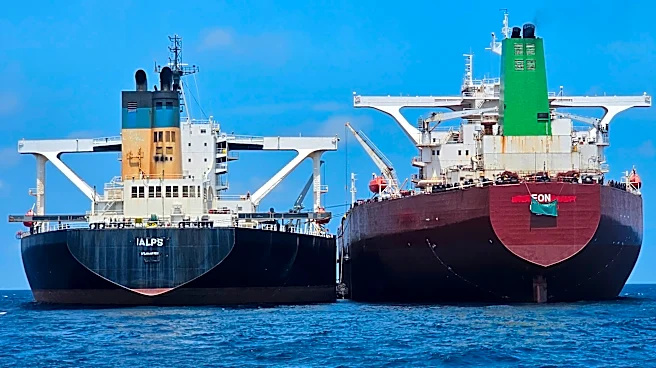
United Against Nuclear Iran, a U.S.-based advocacy group, says there have been 42 ship-to-ship transfers of Iranian oil conducted in the waters about 70 kilometers (45 miles) off Malaysia’s southern Johor state, since Feb.
28, when the U.S. and Israel attacked Iran, starting a war in the Middle East. UANI used satellite imagery to observe the operations.
The ship-to-ship transfers have been criticized by shipping industry organizations and UANI, which has accused Malaysia of being too lax in enforcement efforts.
Malaysian Maritime Enforcement Agency Director-General Mohamad Rosli Abdullah says the transfers are often done in international waters where Malaysia has no jurisdiction, and that these vessels, known as “shadow fleet,” are also often able to evade detection by switching off tracking systems, using false identities, operating at night and exploiting complex ownership structures.
“The issues raised do not align with the actual situation on the ground and do not reflect the operational realities of maritime enforcement conducted by the MMEA,” Mohamad Rosli told The Associated Press.
U.S. officials have previously said Iranian oil exports rely heavily on service providers and ship-to-ship transfers operating near Malaysian waters.
The area, known as the Eastern Outer Port Limits, or EOPL, in the South China Sea, lies along one of the world’s busiest maritime trade routes and is about halfway between Iran and China, which buys about 90% of Iranian oil.
Clandestine high-seas transfers from Iranian-linked tankers have persisted for years, allowing Tehran to sell its crude while offering buyers plausible deniability about the oil’s source.
While not illegal, Malaysia discourages unsanctioned transfers outside designated areas, where such operations can be supervised as they greatly increase the likelihood of a spill, involve aging vessels, and are carried out far from ports, where mistakes could be more easily contained.
Neither the Iranian Embassy in Kuala Lumpur nor the U.S. State Department immediately responded to a request for comment.
Despite a U.S. blockade of Iranian ports that started in mid-April, UANI has tracked Iranian-linked tankers still operating, though it is not clear how many are now getting through.
As of Tuesday, two dozen Iranian-linked tankers tracked by UANI were anchored or loitering near the EOPL area used for transfers off Johor, though it was not clear how many had sailed before the blockade was put in place.
“It’s business as usual,” senior UANI adviser Charlie Brown told the AP.
“Because of Malaysia’s inaction, it is facilitating this business model by Iran and China and dark fleet actors,” he said, warning Malaysia is becoming “a facilitator rather than merely a transit point” for illicit activity.
UANI maintains that Malaysia could enforce environmental regulations for advance notification of ship-to-ship transfers, prevent Malaysian companies from providing support to ships involved and require all ships to carry adequate insurance against accidents and oil spills, among other things.
But Mohamad Rosli said there is little Malaysia can do, since the “activities are typically conducted outside Malaysian territorial waters, particularly in areas located near maritime boundaries or international shipping routes.”
He added that enforcement is conducted strictly under Malaysian law and relevant international conventions, and that authorities have “never compromised nor provided any special treatment or privileges to any country.”
Though the area where the oil transfers are taking place is widely regarded as part of Malaysia’s broader economic zone, it borders the Riau Archipelago, which is Indonesian territory.
Indonesia’s Foreign Ministry said authorities were reviewing the situation to determine the legality of the activity.
“Indonesia does not permit its territory or maritime zones to be used for unlawful activities,” said Foreign Ministry spokesperson Yvonne Mewengkang.
“At the same time, Indonesia continues to uphold legitimate navigational rights under UNCLOS (the United Nations Convention on the Law of the Sea), including the right of innocent passage, transit passage, and the right of passage through Indonesian maritime zones.”
Mohamad Rosli noted that Malaysia had earlier this year seized two vessels, one stateless and the other flagged Cameroon, involved in the transfer of 2 million barrels of crude oil in Malaysian territorial waters.
The two vessels were later released on bond for conducting unauthorized oil transfers. Brown said one of the vessels was spotted earlier this month conducting a ship-to-ship transfer of suspected Iranian oil in the waters off Johor.
Malaysian authorities “will continue to strengthen monitoring and enhance strategic cooperation with relevant agencies to ensure that the nation’s maritime domain’s safety and sovereignty are consistently safeguarded,” Mohamad Rosli said.
_____
David Rising in Bangkok and Edna Tarigan in Jakarta, Indonesia contributed to this report.