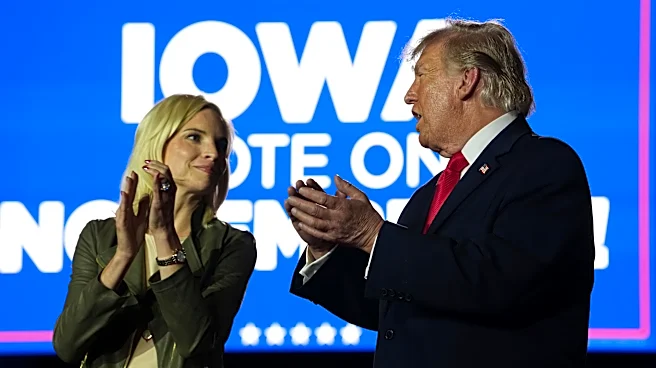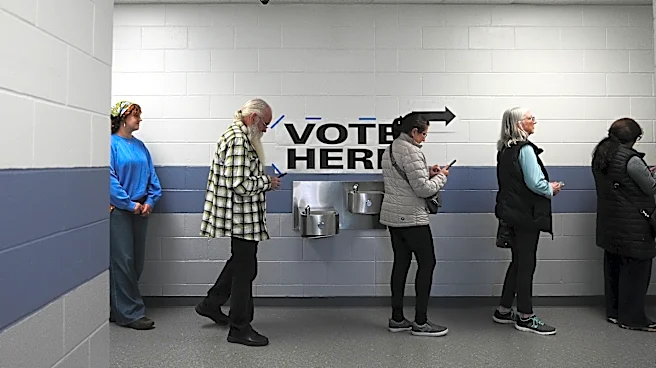






TOPEKA, Kan. (AP) — Democrats in Kansas went into Tuesday's election hoping that dissatisfaction with President Donald Trump, combined with the appeal of megachurch pastor Adam Hamilton's well-funded campaign to middle-of-the-road voters, would oust Republican Sen. Roger Marshall and end a 94-year streak of losing Senate races.
The unusually competitive campaign in a state Trump carried easily in his three races for president reflects Republicans'
nationwide challenges with inflation and unhappiness over the Iran war, and it's bolstered Democrats’ hopes of winning the Senate majority in Washington.
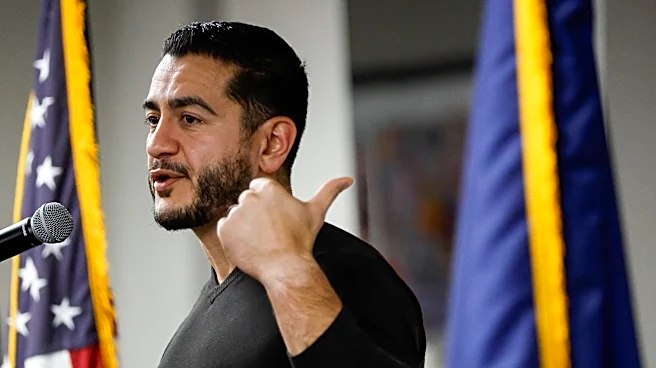
Hamilton brought a friendly, centrist persona and a knack for fundraising to the race as the founder of the 25,000-member Church of the Resurrection in the Kansas City area, the nation's largest United Methodist congregation.
He tapped into voters' frustration with rising prices, particularly for diesel that fuels the state's agricultural economy, as the war continues for a ninth month despite Trump's promises of a quick resolution.
Hamilton also accused Marshall of abandoning the state to live in Florida, though Marshall said he bought his vacation home so he could spend time with family there and sold it in October. Marshall, a retired obstetrician, remained closely aligned with Trump, defended the war, insisted the economy was strong and continued backing Trump's tariffs.
Democrats committed $64 million to television and digital advertising to the race, according to the ad-tracking firm AdImpact. Republicans dedicated about $44 million, and Marshall proved to be a lackluster fundraiser. The total spending, $108 million, was easily a record for any race in Kansas.
Democrats last won a Senate race in Kansas in 1932, making it the longest current Senate losing streak in the country. The last truly close contest was in 1974, when future Republican icon Bob Dole won a second term by less than 2 percentage points following the Watergate scandal that forced President Richard Nixon from office.
Democrats have had well-funded candidates in races that looked like tossups before, only to see Republican-leaning voters who flirted with bolting the party drift back by Election Day.
Still, Trump's drop in popularity nationally has boosted Democrats' hopes, and the party hopes to take advantage of a recent shift in Kansas politics. Although the state is often viewed as ruby red, there's a sizable bloc of moderate voters who have regularly swung governor's races to Democrats. Suburbs near Kansas City, Missouri, have become increasingly blue, making it easier for Democrats to win statewide races by carrying just the most populous counties.
In previous years, Kansas Republicans have kept their seats by arguing that ousting them would put or leave liberal Democrats in charge in Washington. Hamilton said he opposes retaining New York's Charles Schumer as the Senate's Democratic leader, but Marshall argued that a Hamilton victory still would put “big-government socialists” in control.
Hamilton's comments about Schumer demonstrate the balance he tried to strike in wooing independent and Republican voters. He made a point of describing himself as “independent-minded" and distancing himself from democratic socialists who've been gaining influence on the left. He has said their movement “is not going to fly” in Kansas, positioning himself as a potential moderate counterweight in Washington.
In another example, he criticized U.S. Immigration and Customs Enforcement during an event in Topeka but stopped short of calling to abolish the agency, as many progressives have done.
“They were formed to make sure that people didn’t fly airplanes into buildings again,” he said, referencing the 9/11 terror attacks. “If they stick to what they were created for, I’m grateful for them.”
Republicans not only portrayed Hamilton as too “woke” for Kansas but focused heavily in the campaign's final weeks on two cases of alleged sexual abuse of teenage boys by an adult leader at annual camps for Hamilton's church, one in 2005 and the other in 2006.
The church investigated the first incident in 2005 but did not report it to law enforcement when the victims couldn't positively identify the perpetrator, and the man returned for the 2006 camp. The second incident was reported to law enforcement, and the church turned over its records on the first case, but the local prosecutor did not pursue criminal charges.
The church changed its child protection policies and since the 2005 case has required all incidents to be reported to law enforcement. Hamilton acknowledged that it was a mistake for the church not to report the first incident in 2005 and for him to not personally check to see that the man didn't return in 2006. One of the Hamilton campaign's last television spots featured the sister of one of the 2005 victims calling Republican claims about the cases “absolute lies.”
Meanwhile, Hamilton's campaign hammered Marshall — who uses “Doc” on his stationery — over questions about how he pursued unpaid patient bills before he won a U.S. House seat in 2016.
The New York Times reported that Marshall and his practice sued more than 700 patients during his decades-long medical career. In 81 cases, patients were arrested for missing court dates, and two experts called his tactics extreme, according to the report. During a televised debate, Marshall called attacks on him a “gross mischaracterization” of his professional record.