






MANILA, Philippines (AP) — Some of the world’s most intractable conflicts will be high on the agenda when Southeast Asian leaders gather in the Philippine capital for annual summit meetings this weekend. U.S. President Donald Trump is expected to join them for the final talks.
The three-day summit of the Association of Southeast Asian Nations and their Asian and Western counterparts starts Sunday in a heavily guarded convention center in Manila Bay.
According to drafts of prepared post-summit communiques seen by The Associated Press, no breakthroughs are expected in the discussions that will focus on calling for the peaceful resolution of the South China Sea disputes, the civil strife in Myanmar and the wars in the Middle East and Ukraine.
This year, the Philippines holds the rotating leadership of ASEAN, a conservative regional bloc of 11 democratic and authoritarian states, including police states. The bloc has managed to keep together such a diverse grouping since its founding in 1967 largely because of its bedrock policy of non-interference in the members' domestic affairs.
In Manila, key rivals will again be face-to-face but no shake-ups are anticipated. ASEAN is known more for its photo-ops that project unity, cultural pomp and pageantry than for effectively dealing with the region's conflicts, including the civil war in Myanmar.
Trump will land in Manila with U.S. Secretary of State Marco Rubio on Tuesday afternoon, after the main ASEAN summit meetings have concluded and the Philippines has turned over the regional bloc’s annual leadership to Singapore.
He will, however, be joining three key meetings on Tuesday night, including a special summit with ASEAN leaders over cocktails and a meeting of the Quadrilateral Security Dialogue consisting of the United States, Japan, Australia and India, according to Philippine officials.
China will be represented by its premier, Li Qiang, who will meet ASEAN leaders on Monday, but will leave before Trump arrives, the officials said.
The prepared communiques say ASEAN leaders and their major Asian and Western counterparts will exchange “views on regional and international issues of concern," before listing the conflicts that will be discussed.
“We reaffirmed our shared commitment to upholding international law, including the United Nations Charter,” the prepared statement says. It also underlines the "importance of the peaceful resolution of disputes, upholding freedom of navigation and overflight and other lawful uses of the sea, including the right of transit passage in straits used for international navigation.”
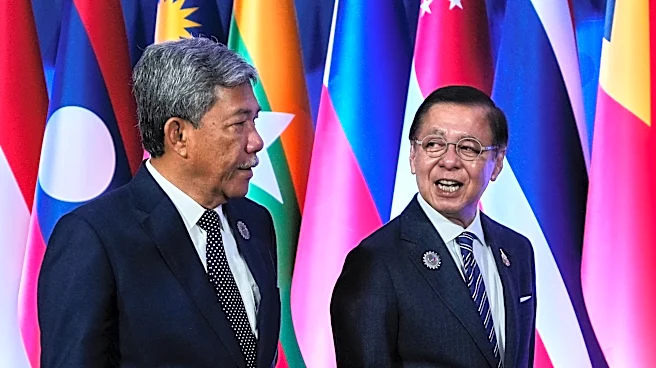
On Saturday, ASEAN foreign ministers met for pre-summit talks, linking hands and posing for a joint photo on stage, their national flags lined up behind them.
The talks, hosted by Philippine Foreign Secretary Theresa Lazaro, will include her report on a recent trip to Myanmar, where she pressed longstanding calls for the civil strife-plagued country to do more to comply with a five-point peace plan crafted by ASEAN leaders five years ago.
The leader and foreign minister of Myanmar, an ASEAN member, have been banned from attending the bloc’s annual meetings because of their government's failure to fully comply with the peace plan that calls for an immediate end to the deadly fighting that has gripped the country.
The prepared communiques also urged "all parties to commit to an immediate cessation of violence, safe and unhindered humanitarian access, inclusive dialogue with all stakeholders and the unconditional release of all those unjustly detained” in Myanmar.
On the South China Sea disputes that involve China, Taiwan and four ASEAN members — Brunei, Malaysia, the Philippines and Vietnam — substantial progress has been made in negotiations for a non-aggression pact called the “ code of conduct ” between Beijing and the regional bloc, according to three Southeast Asian diplomats who spoke to the AP earlier.
They said, however, that the pact — which has seen more than two decades of consultations and negotiations between China and ASEAN — will not be finalized this year. Negotiations about it will resume next year.
The pact aims to prevent on-and-off confrontation in the disputed waters from degenerating into a full-blown conflict that can endanger Asia’s economies.