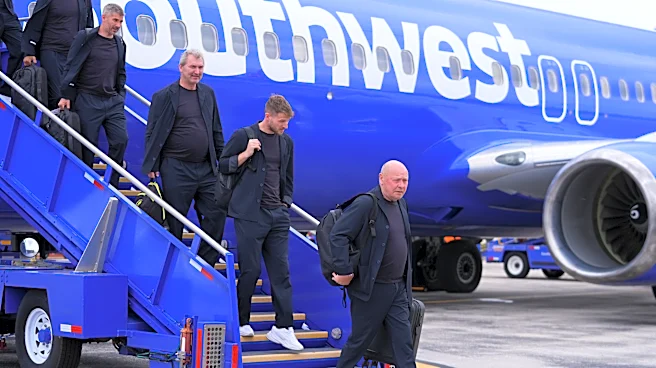











GUADALAJARA, Mexico (AP) — The Czech Republic started its World Cup campaign by traveling from its base camp in Dallas across the border to Guadalajara in Mexico. The team is now back in Texas preparing for its next game in Atlanta. It will then return to Mexico for its third group match.
Newcomer Curacao is expected to travel some 5,300 miles (8,600 kilometers) back-and-forth from its base in Florida to games in Houston, Kansas City and Philadelphia.
Bosnia-Herzegovina will rack up nearly 5,200 miles (8,400 kilometers) across Canada and the U.S. while going from its base in Utah to games in Toronto, Los Angeles and Seattle.
The biggest World Cup ever has brought some logistics challenges to the 48 teams in the tournament being played across three countries and four time zones.
“We just have to live with it because that’s what others planned for us,” Czech Republic coach Miroslav Koubek said through a translator after a 2-1 loss to South Korea in Guadalajara last Thursday. “We're happy to be here and we want to have the best possible results. Our logistics behind the scenes is good, but of course it’s not ideal that we have to travel that much.”
Turkey coach Vincenzo Montella said “this is the reality, we have to adapt.”
His squad trains in Arizona, about 1,200 miles (1,930 kilometers) from Vancouver, where it opened with a 2-0 loss to Australia.
“Of course after the match we’ll be back at 5 o’clock in the morning, and it’s not easy to recover, especially for people my age,” the 51-year-old Montella said through a translator ahead of the match. “After a night out you know it takes a few days to recover. America is big, Canada is very big. Mexico is big. We have to adapt. I know these things you can’t change. You can’t choose. You just have to adapt so you don’t have any excuses.”
Canada's squad had to fly nearly five hours to cover the more than 2,000 miles (3,200 kilometers) between Toronto and Vancouver after its opener. The U.S. team will travel nearly that distance in total while going back-and-forth between its training camp in Irvine, California, and its games in the Los Angeles area and Seattle. Mexico is expected to travel less than 600 miles (965 kilometers) within the country.
The England team is set to travel the most among the main title contenders, having its camp in Kansas City and playing games in Dallas, Boston and New York. Spain will have to fly nearly four hours from its base in Atlanta to a match in Guadalajara.
Argentina and France, the finalists at the 2022 World Cup in Qatar, face fewer travel challenges. Argentina is based in Kansas City, where it will open its title defense before playing two matches in Dallas. France has its camp in Boston. It will play one game there and the other two in Philadelphia and New York.
FIFA has long recognized the logistic challenges for the World Cup scattered across North America. It tried to separate teams in geographical clusters where they are based and where they will play most of their matches.
Lengthy traveling was a non-issue at the previous World Cup in Qatar, which is roughly the size of Connecticut and is smaller than Switzerland. But teams faced similar travel challenges in 2018 in Russia and 2014 in Brazil.
South Korea's squad doesn’t have to leave Mexico for its group matches, but does have to deal with the high altitude both in Mexico City (about 2,200 meters, 7,200 feet) and Guadalajara (about 1,500 meters, 4,900 feet).
The South Koreans did specific training to adjust to the altitude, and coach Hong Myung-bo said it “helped a lot” but still wasn’t enough.
“In the second half, I think we could see that everyone was very tired,” Hong said after his team’s come-from-behind win over the Czech Republic.
Heat and humidity could also become an issue for many teams training and playing in U.S. cities such as Houston, Dallas, New York and Miami.
Brazil forward Vinícius Júnior complained of the conditions after the 1-1 draw with Morocco on Saturday in East Rutherford, New Jersey.
“Because of the weather, the heat, the field dries up too quickly and the game gets really stuck and we can’t have game rhythm. That makes it difficult for us because we want to play, we want to move the ball from side to side, and that gets in the way of our game,” he said. “But we’re going to have to adapt because I believe it’s going to be like that for the whole competition where everyone is going to have the same field of play.”
___
AP Sports Writer Anne M. Peterson contributed from Vancouver.
___
AP World Cup coverage: https://apnews.com/hub/fifa-world-cup