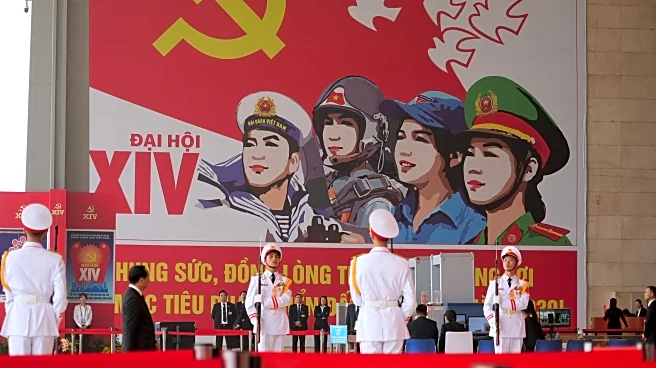

HANOI, Vietnam (AP) — Vietnam’s most important political conclave began Monday, as the ruling Communist Party convened to decide the country’s leadership and broad policy course for the next five years.
About 1,588 delegates from across Vietnam gathered in the capital, Hanoi, for the National Congress, the party’s highest decision-making body, which meets every five years to elect its top leadership and set priorities shaping the country’s political and economic direction.
Delegates will elect about 200 members to the party’s Central Committee, which in turn appoints 17 to 19 members to the powerful Politburo in a tightly choreographed process.
Beyond settling the question of who will lead Vietnam through 2031, the Congress will also determine how the country’s single-party system responds to far more turbulent world, as the Southeast Asian export powerhouse pursues its ambitious goal of becoming a high-income economy by 2045 amid intensifying U.S.–China rivalry and a splintering global economy.
Here is what to expect.
Communist Party General Secretary To Lam is expected to be confirmed to a full five-year term.
A crucial question is whether he will also move to combine the roles of party chief and state president, as many diplomats and analysts expect. This will concentrate power in an echo of the political model of China under Xi Jinping and neighboring Laos.
Vietnam has traditionally been governed through a “four pillars” system, in which the party chief, president, prime minister and National Assembly chair balance one another. Collapsing those roles would weaken that arrangement and make To Lam the most powerful leader in Vietnam in decades.
He has overseen the most ambitious round of bureaucratic and economic reforms since the late 1980s, when Vietnam liberalized its economy, including cutting tens of thousands of public-sector jobs, redrawing administrative boundaries to speed decision-making, and initiating dozens of major infrastructure projects.
Lam spent decades in the Ministry of Public Security before becoming its minister in 2016. He led the anti-corruption campaign championed by his predecessor, Nguyen Phu Trong. His rise took place while Vietnam’s Politburo lost of six of its 18 members during an anti-corruption campaign, including two former presidents and Vietnam’s parliamentary head.
His faction within the party is aligned with the ministry while the other main grouping is close to the more conservative military, said Nguyen Khac Giang, a visiting fellow in the Vietnam Studies Program at Singapore’s ISEAS–Yusof Ishak Institute.
He said conservatives were uneasy about Lam’s reform agenda, fearing the “Vietnamese socialist system could go astray,” and want conservative voices to remain within the leadership as a check on power concentration and to keep the country on a socialist path.
Hanging over the Congress is a defining national ambition: whether Vietnam can transform itself into a high-income country by 2045, a goal that will shape its politics, economy and its place in the world.
Delegates will finalizes a resolution of a draft released in October that aimed for an average annual GDP growth of 10% or more from 2026 to 2030, after falling short of the 6.5% to 7.0% growth target set for the first half of the decade. The country's 2025 GDP grew at 8%.
To do this, the draft calls for changing how the economy grows, with a focus on upgrading industry, modernizing production, and relying more on science, technology and digital tools to drive growth.
For instance, the military-run Viettel broke ground on its first semiconductor chipmaking plant in January. The project aims to begin trial production by 2027 and is part of Hanoi’s broader strategy to build high-tech capacity and reduce reliance on foreign suppliers.
The draft also describes the private sector as “one of the most important driving forces of the economy,” underscoring To Lam’s emphasis on business-led growth and a shift away from the dominance of state-owned companies in the communist country.
Giang said To Lam may seek to deepen that approach by giving large private conglomerates a greater role in major projects across Vietnam.
The document also places “foreign affairs and international integration” on the same footing as national defense and security, underscoring how dependent Vietnam’s export-driven economy is on global markets and geopolitics.
The document also elevates environmental protection to a “central” task alongside economic and social development, a notable shift in Vietnam, where rapid growth has fueled worsening air pollution and other environmental pressures.