


Iranian semiofficial media said Tuesday the country has begun firing missiles and drones in response to U.S. strikes, as hostilities flare again after a month without military action. Hours earlier, the U.S. military said it was striking new targets in Iran over recent attempted attacks against commercial shipping in the Strait of Hormuz. The renewed fighting, which the U.S. military has tried to cast as limited, comes after President Donald Trump
appeared to pivot last month toward punishing Iran economically with sanctions.
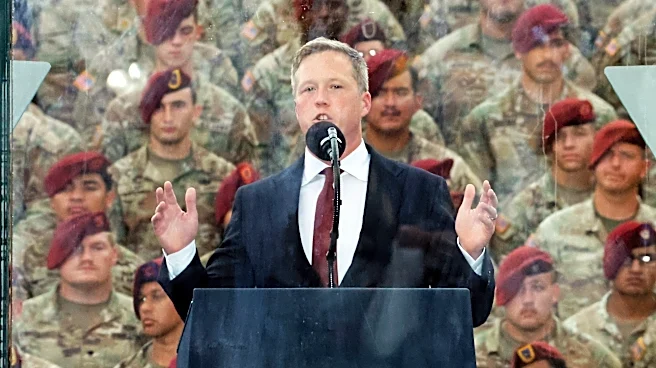
Army Secretary Dan Driscoll is stepping down after just 18 months on the job. The White House announced his departure after Driscoll spoke with President Donald Trump about the current state of the Army, an Army official told The Associated Press on condition of anonymity. He's only the latest top military leader to leave during the Trump administration.
Here's the Latest:
The president told Fox News that the latest round of strikes focused heavily on efforts to reconstruct radar that had been decimated by earlier U.S.-Israel strikes in the six-month old conflict.
Trump, in a phone call with the network, said the U.S. military had been monitoring Iran’s efforts to rebuild radar systems and waited until the work was almost completed before carrying out the strikes, according correspondent Trey Yingst.
Earlier Tuesday, Iran’s President Masoud Pezeshkian said his country was ready to return to a ceasefire agreement brokered with the U.S. in June if Washington was willing to abide by the terms.
But Trump appeared to pour cold water on the possibility of a return to the ceasefire, at least in the near term. Yingst said Trump told him, “I think an agreement with them isn’t worth the paper it’s written on.”
Iranian semiofficial media say the country has begun firing missiles and drones in response to U.S. strikes.
The Fars and Tasnim news agencies, seen as close to Iran’s security forces, reported late Tuesday that it had launched such operations. This came after the U.S. military hit targets in Iran after it said Tehran tried to attack commercial ships and American forces in the Middle East as hostilities flare once again in an intermittent war that has lasted more than six months.
▶ Read more
“Wisdom would be the exact word I would use,” Rep. Brian Mast, R-Fla., said after the U.S. military hit new targets in Iran on Tuesday.
“You have an enemy that has waged a forever war against us,” he said.
When asked whether the new hostilities would be a reason for Congress to hold a formal vote backing the war in Iran, Mast said such a move was “not necessarily” needed.
“I don’t think that they need a declaration of war to be conducting strikes against an imminent threat against the United States of America, which is what Iran is,” Mast said.
The House passed a short-term measure Tuesday to fund the federal government into early December, a move designed to avoid a chaotic shutdown as lawmakers campaign for reelection.
Lawmakers needed to act before the fiscal year concludes at the end of September to avoid a funding lapse. They were determined not to bump up against that deadline during the campaign season following this past year’s historic shutdowns.
The House passed the bill by a vote of 370-48. The Senate has already overwhelmingly approved the measure, so it now moves to President Donald Trump’s desk for his signature.
“It gives the nation and our constituents certainty, certainty that the government will remain open, certainty that our service members will be paid,” said Rep. Tom Cole, the Republican chairman of the House Appropriations Committee.
▶ Read more
Republican Sen. Mike Rounds, a member of the Senate Armed Services Committee, said he was disappointed in the resignation of Army Secretary Dan Driscoll.
“I’m hearing the same language everybody else is, that he was frustrated with some of his top generals being released,” Rounds said. “That’s not the first time I’ve heard that, and I think that points to questions that we’re going to be asking when we get back, in terms of where is the leadership?”
Asked if he is still confident in Defense Secretary Pete Hegseth’s leadership, Rounds said “it’s a matter of whether or not the president is.”
The Senate returns to Washington Sept. 14. The House returned Monday.
More than 150 organizations have joined the Center for American Progress in CAP’s fight against a legal threat from President Donald Trump.
A lawyer for the president threatened last month to sue the left-leaning think tank unless it retracted a report that said his National Guard deployments to various cities did not reduce crime as he said.
“We stand with the Center for American Progress, not in agreement with every view they hold, but in steadfast support for their rights to voice those views freely and without political retribution,” the groups said in a joint statement.
The signatories include civil rights groups, policy organizations, and civic institutions.
CAP has not retracted the report. The lawsuit has not been filed.
The State Department on Tuesday renewed a region-wide travel alert for the Middle East as hostilities between the United States and Iran resumed.
“Due to tensions in the Middle East, the security environment remains complex with the potential for unforeseen escalation,” the department said in a blanket advisory covering all countries in the region. The language is similar to previous warnings that came before a lull in combat activities and said Americans in the Mideast should exercise heightened vigilance and be aware of potential travel disruptions.
“Iran and groups supportive of Iran may target U.S. interests overseas or at locations associated with the United States and Americans throughout the world, including U.S. businesses and other institutions,” it said.
Several individual U.S. embassies, including those in Israel, Jordan, Qatar and the virtual embassy in Iran, sent out identical alerts targeted to Americans currently in those countries.
As the trade fight between the U.S. and Canada escalates, a new Ipsos poll finds that most Americans want some amount of compromise with Canada, and few support additional tariffs on their northern neighbor.
About 7 in 10 U.S. adults say the U.S. should be willing to make tradeoffs with Canada, even if it means it doesn’t get most of what it wants, while only 25% say the U.S. should take a tough stance and insist on getting most of what it wants, according to the survey, which was conducted from August 28-30.
Only about 2 in 10 support the U.S. placing additional tariffs on Canada, while a majority, 57%, are opposed and 21% don’t know enough to say.
Most Americans, 68%, also oppose Trump’s recent move to rename Lake Ontario “Lake America.”
The president said in a post on social media that the U.S. was striking targets near the Strait of Hormuz.
“If the failed Nation of Iran retaliates for this very justified attack, they will be hit again at a much harder and higher level, but it will not be the biggest attack of them all, that is waiting in the wings,” he said.
Trump added: “When it is over, there will be very little left of the Islamic Republic of Iran!”
Oil giant Chevron is expected to soon announce it will expand operations in Venezuela, a U.S. official said Tuesday.
The official, who briefed reporters on the expected announcement, said that the company’s officials and Energy Secretary Chris Wright are expected to visit Venezuela on Wednesday where the new investment will be formally unveiled. The official spoke under condition of anonymity under ground rules set by the White House for the call.
Chevron is the second-largest U.S. oil company and the only one with a major presence in Venezuela. The announcement comes after the White House confirmed on Monday it is partnering with North American Blue Energy Partners as part of President Donald Trump ’s push to tap into Venezuela’s oil industry.
▶ Read more
— Aameer Madhani
The U.S. military has tried to cast the renewed fighting as limited.
Central Command said in a statement on X on Monday that its attacks on Iranian targets on Sunday were narrowly focused on preventing IRGC forces from placing new mines in the Straight of Hormuz.
“U.S. forces took limited, precise action against IRGC minelaying forces posing an imminent threat in the Strait of Hormuz,” Central Command stated. “In essence, Iran created the threat and the U.S. military eliminated it to protect civilian mariners, commercial shipping, and the free flow of global commerce.”
Central Command reiterated on Tuesday that its attacks only followed Iranian aggression against commercial vessels and American troops in the region.
The renewed fighting also comes after Trump appeared to pivot last month toward punishing Iran economically with sanctions, with the president promising an “economic D-Day” against a country that has withstood nearly five decades of punishing American sanctions.
The Trump administration argued that it was only a matter of time and that striking the right economic target would get Tehran to its breaking point.
But at the same time, U.S. stockpiles of advanced weapons have been diminishing, while the war has been unpopular among Americans and could make Republicans vulnerable in November’s midterm elections.
The U.S. military says it’s striking new targets in Iran as hostilities flare again after a month without military action.
U.S. Central Command said Tuesday that the strikes “follow recent attempted attacks by the IRGC against commercial shipping in the Strait of Hormuz and against American service members deployed to the region.”
On Sunday, the U.S. military said it struck rocket launchers on Larak Island in the Strait of Hormuz. Iran responded by launching missiles at U.S. sites in Jordan, which were intercepted, while United Arab Emirates said it stopped an Iranian drone over its waters.
President Donald Trump acknowledged Monday that more strikes might be necessary.
Rep. Pete Aguilar of California said the oil deal that hands an ownership stake to the Pentagon is “concerning for all of us.”
“This is an area that’s ripe for oversight,” said Aguilar, who is the chairman of the House Democratic caucus.
Previewing the agenda ahead if Democrats win control of the House in the midterm elections, he said, “When there is a time and moment for us to exercise oversight and accountability, you can count on House Democrats to do that.”
Rep. Pete Aguilar of California said the oil deal that hands an ownership stake to the Pentagon is “concerning for all of us.”
“This is an area that’s ripe for oversight,” said Aguilar, who is the chairman of the House Democratic caucus.
Previewing the agenda ahead if Democrats win control of the House in the midterm elections, he said, “When there is a time and moment for us to exercise oversight and accountability, you can count on House Democrats to do that.”
Rep. Ted Lieu said House Democrats have been researching potential Trump administration voter suppression scenarios similar to one revealed in a whistleblower’s claim that the U.S. Postal Service is possibly jeopardizing mail-in ballots.
Lieu said the message he wants to give Americans is simple: ”Just go … vote,” he said, using a profanity.
He encouraged voters to make sure they’re registered vote and cast ballots early or in person, if need be.
“That’s the best way to stick to the administration that’s trying to keep you from voting,” he said. “Go vote.”
House Speaker Mike Johnson said he was unaware of the whistleblower’s complaint.
Markwayne Mullin says Immigration and Customs Enforcement made roughly 2,100 arrests in a targeted operation in New York carried out over the last month.
During a news conference in New York, Mullin said the people arrested were “criminals” and slammed New York’s governor and mayor for not working with ICE.
The news conference comes as ICE has ramped up operations nationwide this summer but data shows that the agency is increasingly arresting people who do not have a criminal record.
Data released by the Deportation Data Project shows ICE arrests jumping to nearly 50,000 in July but more than half of those arrested had not been convicted of any crimes and weren’t facing criminal charges.
New York Gov. Kathy Hochul and New York City Mayor Zohran Mamdani held their own press conference at the same time as Mullin’s, telling reporters that the Trump administration was withholding $87 million in counterterrorism funding to New York.
The British military’s United Kingdom Maritime Trade Operations Centre said it received reports of an attack on a ship in the Strait of Hormuz, and a second report of an incident involving a tanker in waters nearby.
In the first, the UKMTO said a tanker was hit by three projectiles Monday on its way out of the Persian Gulf through the strait east of Oman. The monitoring agency said there were no reports of casualties on the boat or any environmental impact from the attack.
In the second, the UKMTO said it had received a report “involving a tanker and military forces” on Monday off the coast of Oman, also east of the strait. There was no immediate claim of responsibility for the attacks.
The Strait of Hormuz “is a place where at least 120 ships used to transit every 24 hours. Even if two or three ships manage to pass through on some nights now, that in fact shows that we have control over the entire Strait of Hormuz,” Mohammad Bagher Qalibaf said in a video posted on a state TV Telegram channel.
“The information we have — open and covert, visible and hidden — shows us that after failing in the military and diplomatic arenas, the enemy has added a very broad economic war and cognitive war to its military campaign,” Qalibaf said. “The enemy’s objective in this hybrid war is to create unrest and chaos inside the country. That is their malicious intention. ... Or they may try to force us to surrender through diplomacy. Never.”
Scott Bessent said the Strait of Hormuz will be a “worthless piece of water in two years,” after predicting that shippers and other users of the narrow strait will find alternative means of transit as they conduct less and less business with Iran.
The Trump administration launched “Operation Economic Outcast” against the Islamic Republic in August as a means to economically punish the country and encourage other nations to do so.
He made the comments on the sidelines of the G20 Tuesday morning as he spoke with Fox Business host Larry Kudlow.
The American job market is hardly booming, but it is ambling along despite an energy shock caused by the fighting with Iran that has squeezed family budgets. U.S. job openings ticked up to 7.27 million in July from a revised 7.18 million in June, the Labor Department reported Tuesday.
U.S. employers — companies, nonprofits and government agencies — added an average of 61,000 net jobs a month this year. The figure is unimpressive, but it’s an improvement on 2025 when job growth came in below 10,000 a month — the weakest hiring outside a recession since 2002 — as the lingering effect of high interest rates and Trump tariffs uncertainty discouraged hiring. At least U.S. employers aren’t firing much — the number of people signing up for unemployment benefits has come in low week after week.
Iran’s President Masoud Pezeshkian vented about the Trump administration in public before his private meeting with Russia’s Vladimir Putin.
“The aggression that America carried out against Iran had no legal, scientific, or logical justification. They martyred our leader, they martyred our commanders, they martyred our scientists, they martyred our innocent students, they beat our people; in other words, this behavior cannot be justified in any mental, rational, or international framework,” Pezeshkian said.
“Unfortunately, they claim human rights, they claim to be law-abiding, and the things they are doing are not documented in any framework that can be relied upon.”
“As I have stated repeatedly, Russia stands in solidarity with the Iranian people. We admire your courage and resilience in the pursuit of your national interests,” Vladimir Putin said in public before his meeting with Iranian leader Masoud Pezeshkian Tuesdayon the sidelines of the Shanghai Cooperation Organization summit.
Putin also said that Moscow has welcomed Iran’s ceasefire agreement with the United States early this year, but that “truce proved unstable and all too fragile.” So meanwhile, Russia has continued to supply Iran with “essential goods” while maintaining momentum on trade.
In turn, Pezeshkian thanked Moscow for its support amid both U.S. sanctions and its conflict with Israel and Washington. Iran has scrambled to sustain trade amid U.S. threats to sanction any country that refuses to break ties with the Islamic Republic.
Iran’s President Masoud Pezeshkian during a summit in Kyrgyzstan that “if the U.S. returns to its commitments in the memorandum of understanding, the Islamic Republic of Iran will immediately reciprocate,” Iranian state media reported.
The June memorandum started a 60-day period for negotiations aimed at reaching a wider peace deal. Iran agreed to clear the Strait of Hormuz of mines and allow ships to pass during the period, and the U.S. agreed to end its naval blockade, lift sanctions, issue waivers for Iranian oil exports and begin work on a reconstruction package for Iran, among other things. But the ceasefire broke down quickly, and while there has been a lull in fighting, the two sides exchanged fire on the weekend.
While Pezeshkian has long favored a negotiated end to the war, Iran’s most powerful force remains the paramilitary Revolutionary Guard, which is pressing for Iranian control over the strait and financial compensation for the war.