







BUDAPEST (AP) — Russia's ambassador to Hungary was summoned Thursday over a massive drone attack near Hungary’s border with Ukraine, in a stark example of the change brought about by the election of Prime Minister Péter Magyar after years of cozy relations between Budapest and Moscow under his predecessor, Viktor Orbán.
An Associated Press reporter saw Ambassador Evgeny Stanislavov leaving the Hungarian Foreign Ministry less than 30 minutes after arriving
for an official summons to speak with Foreign Minister Anita Orbán about strikes that hit the Ukrainian region of Transcarpathia on Wednesday. The region is home to a sizable Hungarian minority.
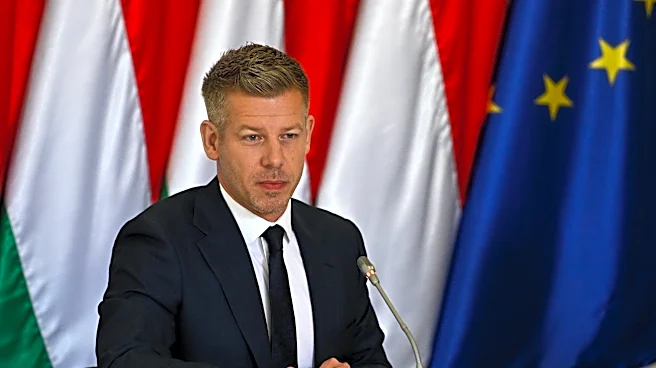
“The Hungarian government strongly condemns the Russian attack on Transcarpathia," Magyar said Wednesday during a news conference in Ópusztaszer in southern Hungary, when he announced that the ambassador would be summoned to protest the attack.
“She will tell him the same and ask for information on when Russia and Vladimir Putin plan to finally end this bloody war that began more than four years ago,” Magyar said.
The Russian government has not made any public statements on the summons.
When the ambassador left the Foreign Ministry building on the banks of the Danube, an activist yelled at him in Hungarian, “Comrade, it's over!”
Russia fired at least 800 drones in a massive daytime barrage Wednesday targeting about 20 regions of Ukraine including Transcarpathia, Ukrainian President Volodymyr Zelenskyy said. At least six people were killed and wounded dozens, including children. Lasting hours, it was one of the longest-lasting attacks by Moscow in the war now in its fifth year.
Zelenskyy called the summons in Budapest an “important message” and thanked Magyar for his comments.
“Moscow has once again shown itself to be a common threat not only to Ukraine, but also to neighbouring countries and Europe as a whole,” Zelenskyy said on social media.
After defeating Orbán in a historic vote in April, Magyar has vowed to undo much of the legacy built during Orbán’s 16 years in power, with a particular focus on alleged corruption.
The summons marks a stunning change after years of close relations between Hungary — both a member of the European Union and NATO — and Moscow, even following the 2022 full-scale invasion of Ukraine.
In March, Stanislavov, the ambassador, posted on Facebook an open letter to Magyar denying Moscow was involved in helping longtime Kremlin ally Orbán.
“It’s really not worth scaring Hungarians with imaginary Russian threats,” he wrote. “The embassy has clear objectives: to ensure the maintenance of normal bilateral relations, to develop mutually beneficial cooperation in the current situation where possible, and to protect the interests of citizens of Russia and Hungary.”
Magyar announced on Thursday that he was ending two crisis governing structures in Hungary, which were set up in response to the war in Ukraine and the COVID pandemic.
Orbán had declared a “ state of danger ” in 2022 in the wake of Russia's full-scale invasion of Ukraine, and his Fidesz party granted him extraordinary executive power during the COVID pandemic in 2020. Both enhanced his powers and led to widespread criticism over democratic backsliding. "We are returning to normality," Magyar said in a social media post. “As of today, after four years, the wartime state of emergency in Hungary is ending, and with it we are also putting an end to the decree-based emergency rule introduced by the Orbán government six years ago.”
___
McNeil contributed from Brussels.