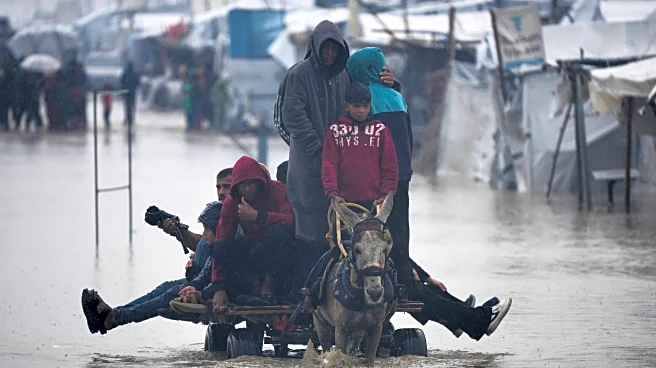

DEIR AL-BALAH, Gaza Strip (AP) — Rains drenched Gaza’s tent camps and dropping temperatures chilled Palestinians huddling inside them Thursday as storm Byron descended on the war-battered territory, showing
how two months of a ceasefire have failed to sufficiently address the spiraling humanitarian crisis there.
Children’s sandaled feet disappeared under opaque brown water that flooded the camps. Trucks moved slowly to avoid sending waves of mud toward the tents. Piles of garbage and sewage turned to waterfalls.
“We have been drowned. I don’t have clothes to wear and we have no mattresses left,” said Um Salman Abu Qenas, a mother displaced from east of Khan Younis to a tent camp in Deir al-Balah. She said her family could not sleep the night before because of the water in the tent.
Aid groups say not enough shelter aid is getting into Gaza during the truce. Figures recently released by Israel's military suggest it has not met the ceasefire stipulation of allowing 600 trucks of aid into Gaza a day, though Israel disputes that finding.
“Cold, overcrowded, and unsanitary environments heighten the risk of illness and infection,” said the U.N. agency for Palestinian refugees, UNRWA, in a terse statement posted on X. “This suffering could be prevented by unhindered humanitarian aid, including medical support and proper shelter."
Sabreen Qudeeh, also in the Deir al-Balah camp, said her family woke up to rain leaking from their tent's ceiling and water from the street soaking their mattresses. “My little daughters were screaming and got shocked when they saw water on the floor,” she said.
Ahmad Abu Taha, a Palestinian man in the camp, said there was not a tent that escaped the flooding. “Conditions are very bad, we have old people, displaced, and sick people inside this camp,” he said.
In Israel, heavy rains fell and flood warnings were in effect in several parts of the country — but no major weather-related emergencies were reported as of midday.
The contrasting scenes with Gaza made clear how profoundly the Israel-Hamas war had damaged the territory, destroying the majority of homes. Gaza’s population of around 2 million is almost entirely displaced and most people live in vast tent camps stretching for miles along the beach, exposed to the elements, without adequate flooding infrastructure and with cesspits dug near tents as toilets.
The Palestinian Civil Defense, part of the Hamas-run government, said that since the storm began they have received more than 2,500 distress calls from citizens whose tents and shelters were damaged in all parts of the Gaza Strip.
Aid groups say that Israel is not allowing enough aid into Gaza to begin rebuilding the territory after years of war.
Under the agreement, Israel agreed to comply with aid stipulations from an earlier January 2025 truce, which specified that it allow 600 trucks of aid each day into Gaza and an agreed-upon number of temporary homes and tents. It maintains it is doing so, though AP has found that some of its own figures call that into question.
COGAT said Dec. 9, without providing evidence, that it had “lately" let 260,000 tents and tarpaulins into Gaza and over 1,500 trucks of blankets and warm clothing. The Shelter Cluster, an international coalition of aid providers led by the Norwegian Refugee Council, sets the number lower.
It says UN and international NGOs have gotten 15,590 tents into Gaza since the truce began, and other countries have sent about 48,000. Many of the tents are not properly insulated, the Cluster says.
Amjad al-Shawa, Gaza chief of the Palestinian NGO Network, told Al Jazeera Thursday that only a fraction of the 300,000 tents needed had entered Gaza. He said that Palestinians were in dire need of warmer winter clothes and accused Israel of blocking the entry of water pumps helpful to clear flooded shelters.
"All international sides should take the responsibility regarding conditions in Gaza,” he said. “There is real danger for people in Gaza at all levels.”
Senior Hamas official Khaled Mashaal said that many people’s tents have become worn out after the two-year war, and people cannot find new places to shelter. He said Gaza also needs the rehabilitation of hospitals, the entry of heavy machinery to remove rubble, and the opening of the Rafah crossing — which remains closed after Israel said last week it would open in a few days.
COGAT did not immediately respond to a request for comment on the claims that Israel was not allowing water pumps or heavy machinery into Gaza.
Mashaal, the Hamas official, called for moving to the second, more complicated phase of the U.S.-brokered ceasefire.
“The reconstruction should start in the second phase as today there is suffering in terms of shelter and stability,” Mashaal said in comments released by Hamas on social media.
Regional leaders have said time is critical for the ceasefire agreement as mediators seek to move to phase 2. But obstacles to moving forward remain.
Prime Minister Benjamin Netanyahu’s office said Wednesday that the militants needed to return the body of a final hostage first.
Hamas has said Israel must open key border crossings and cease deadly strikes on the territory.
___
Mroue reported from Beirut and Frankel reported from Jerusalem. AP writer Natalie Melzer contributed to this report from Nahariya, Israel.