
U.S. Secretary of State Marco Rubio said he plans to meet with Danish officials next week after the Trump administration doubled down on its intention to take over Greenland, the strategic Arctic island
that is a self-governing territory of Denmark. Rubio told U.S. lawmakers that Trump wants to buy it, rather than use military force.
The U.S. is pulling out of 66 international organizations as Trump and his aides assert a new world order guided by military force and economic power. Trump is proposing a massive increase in military spending to $1.5 trillion next year, citing “dangerous times,” and said U.S. oversight of Venezuela could be lengthy.
And Minneapolis is on edge following the fatal shooting of a woman by an Immigration and Customs Enforcement officer taking part in the Trump administration’s latest immigration crackdown, with the governor calling for people to remain calm and schools canceling classes and activities as a safety precaution.
The Latest:
Many Greenlanders feel that remarks about their self-governing territory have been disrespectful, Aaja Chemnitz, one of the two Greenlandic politicians in the Danish parliament, told The Associated Press. Trump’s claim that Greenland is “covered with Russian and Chinese ships all over the place” is not accurate, she added.
“Many also experience that these conversations are being discussed over their heads. We have a firm saying in Greenland, ‘Nothing about Greenland, without Greenland,’” she said. “Most Greenlanders wish more self-determination including independence” but also want to “strengthen cooperation with our partners” in security and business development as long as it is based on “mutual respect and recognition of our right to self-determination.”
Greenland is “a longstanding ally and partner to the U.S. and we have a shared interest in stability, security, and responsible cooperation in the Arctic,” she said. “There is an agreement with the U.S. that gives them access to have bases in Greenland if needed.”
The Russian Foreign Ministry is calling the U.S. seizure of the Marinera oil tanker under the Russian flag was “a gross violation of the fundamental principles and norms of international maritime law” and warns that the incident could incite geopolitical tensions.
“Washington’s willingness to generate acute international crisis situations, including in relation to already extremely strained Russian-American relations, which are burdened by disagreements from past years, is a cause for regret and concern,” the ministry said in a statement Thursday.
U.S. actions lower the “threshold for the use of force” on the sea, and it’s “utterly cynical” for the U.S. to say the seizure is part of an effort to take over Venezuela’s oil production, it said. “We resolutely reject such neo-colonial ambitions.”
Emmanuel Macron said in a speech to French ambassadors at the Elysee presidential palace that the United States is “gradually turning away from some of its allies and freeing itself from the international rules.”
“It’s the greatest disorder, the law of the strongest, and everyday people wonder whether Greenland will be invaded, whether Canada will be under the threat of becoming the 51th state (of the United States) or whether Taiwan is to be further circled,” Macron said.
The French president pointed to an “increasingly dysfunctional” world where great powers, including the U.S and China, have “a real temptation to divide the world amongst themselves.”
Trump has boasted about the U.S. military operation to capture former Venezuelan President Nicolas Maduro. But the mission did involve a U.S. helicopter being hit by enemy fire.
In a New York Times interview published Thursday, Trump said he was thinking about a “Jimmy Carter disaster” as the Venezuela mission played out.
He was referring to a failed April 1980 mission Carter ordered to rescue 52 American hostages in Iran. U.S. helicopter mechanical failures and a crash with a C-130 killed eight servicemembers, deeply affecting Carter politically and personally.
“That destroyed his entire administration,” Trump told the Times. “I don’t know that he would have won” in 1980, Trump continued, “but he certainly had no chance after that disaster.”
Trump used Carter often in the 2024 campaign to mock then-President Joe Biden, saying Carter loved Biden “because he had a brilliant presidency compared to Biden.”
Troels Lund Poulsen made the remarks to Danish broadcaster DR on Thursday.
“Nothing about Greenland without Greenland. Of course we will be there. We are the ones who requested the meeting,” Greenland’s Foreign Minister Vivian Motzfeldt told DR.
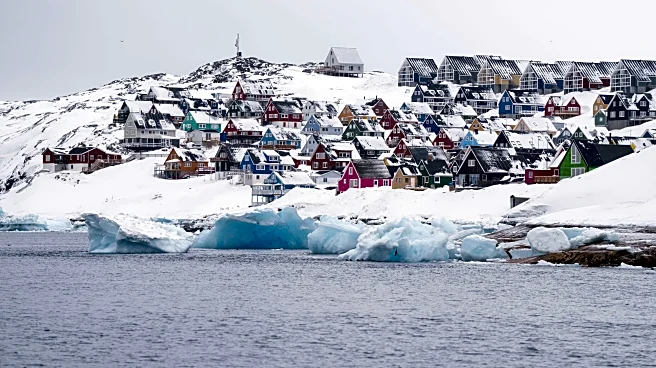
The island of Greenland, 80% of which lies above the Arctic Circle, is home to about 56,000 mostly Inuit people.
“Nothing can be decided about Denmark and about Greenland without Denmark, or without Greenland. They have the full solid support and solidarity of the European Union.”
The leaders of Canada, France, Germany, Italy, Poland, Spain and the U.K. joined Denmark’s Prime Minister Mette Frederiksen on Tuesday in defending Greenland’s sovereignty in the wake of Trump’s comments about Greenland, which is part of the NATO military alliance.
In an interview with Fox News, U.S. Vice President JD Vance said that Denmark “obviously” had not done a proper job in securing Greenland and that Trump “is willing to go as far as he has to” to defend American interests in the Arctic.
He also repeated Trump’s claim that Greenland is crucial to both the U.S. and the world’s national security because “the entire missile defense infrastructure is partially dependent on Greenland.”
Vance said the fact that Denmark has been a faithful military ally of the U.S. during World War Two and the more recent “war on terrorism” did not necessarily mean they were doing enough to secure Greenland today.
“Just because you did something smart 25 years ago doesn’t mean you can’t do something dumb now,” Vance said, adding that Trump “is saying very clearly, ‘you are not doing a good job with respect to Greenland.’”
“Only time will tell,” Trump told the New York Times, in a newly published interview, when asked how long the administration will demand direct oversight of the South American nation.
Trump did not give a precise timeline for how long he expected the oversight to last, The Times reported. He did say that the Venezuelan government, which is now being led by Delcy Rodriguez following Maduro’s weekend arrest by U.S. forces, is being cooperative despite some of its hostile public statements toward the U.S.
“They’re giving us everything that we feel is necessary,” Trump said.
Trump on Wednesday proposed setting U.S. military spending at $1.5 trillion in 2027, citing “troubled and dangerous times.”
The 2026 military budget is set at $901 billion.
“This will allow us to build the ‘Dream Military’ that we have long been entitled to and, more importantly, that will keep us SAFE and SECURE, regardless of foe,” Trump said in a posting on Truth Social announcing his proposal.
The military just received a large boost of some $175 billion in the GOP’s “big, beautiful bill” of tax breaks and spending reductions that Trump signed into law last year.
Insisting on more funding for the Pentagon is almost certain to run into resistance from Democrats who work to maintain parity between changes in defense and non-defense spending. But it’s also sure to draw objections from the GOP’s deficit hawks who have pushed back against larger military spending.
▶ Read more about Trump’s calls for increased military spending
Trump’s administration on Wednesday sought to assert its control over Venezuelan oil, seizing a pair of sanctioned tankers transporting petroleum and announcing plans to relax some sanctions so the U.S. can oversee the sale of Venezuela’s petroleum worldwide.
Besides the U.S. enforcing an existing oil embargo, the Energy Department says the “only oil transported in and out of Venezuela” will be through approved channels consistent with U.S. law and national security interests.
That level of control over the world’s largest proven reserves of crude oil could give the Trump administration a broader hold on oil supplies globally in ways that could enable it to influence prices. Both moves reflect the Republican administration’s determination to make good on its effort to control the next steps in Venezuela through its vast oil resources after Trump pledged the U.S. will “run” the country.
▶ Read more about the U.S.’s plan for Venezuelan oil
The White House said Tuesday that “U.S. military is always an option,” even as a series of European leaders rejected Trump’s comments about seeking an American takeover of the world’s largest island.
That’s notable since Trump’s newly appointed special envoy to Greenland, as well as deputy White House chief of staff Stephen Miller, had suggested that military action wouldn’t be necessary. And asked Tuesday if he felt comfortable taking military action in Greenland, Republican House Speaker Mike Johnson said, “No. I don’t think it’s appropriate.”
The comments also followed the leaders of France, Germany, Italy, Poland, Spain and the UK, joining Danish Prime Minister Mette Frederiksen in issuing a statement reaffirming that the strategic, mineral-rich Arctic island “belongs to its people.”
Canadian Prime Minister Mark Carney also expressed his support and announced a visit to Greenland early next month by Canada’s Governor General Mary Simon, who is of Inuit descent, and Foreign Minister Anita Anand.
▶ Read more about the White House’s comments
Location, location, location: Greenland’s position above the Arctic Circle makes the world’s largest island a key part of security strategy.
Increasing international tensions, global warming and the changing world economy have put Greenland at the heart of the debate over global trade and security.
Greenland sits off the northeastern coast of Canada, with more than two-thirds of its territory lying within the Arctic Circle. That has made it crucial to the defense of North America since World War II, when the U.S. occupied Greenland to ensure it didn’t fall into the hands of Nazi Germany and to protect crucial North Atlantic shipping lanes.
Following the Cold War, the Arctic was largely an area of international cooperation. But climate change is thinning the Arctic ice, promising to create a northwest passage for international trade and reigniting competition with Russia, China and other countries over access to the region’s mineral resources.
▶ Read more about why Greenland is strategically important to Arctic security
Trump’s renewed interest in acquiring Greenland from Denmark fits into a long, little-known pattern in U.S. history.
1. 1867–1868: Early US interest after the Alaska purchaseAfter the U.S. bought Alaska from Russia, officials under Secretary of State William Seward discussed acquiring Greenland as part of a broader push into the Arctic. But the idea never advanced to a formal offer, as Congress had little interest in pursuing another Arctic acquisition.
2. 1910: Proposed land swap involving GreenlandUnder President William Howard Taft, American diplomats floated a complex land-exchange plan that would have transferred Greenland to the United States in return for concessions elsewhere. Denmark rejected the proposal, and it quickly collapsed.
3. 1946: Formal post–World War II purchase offerAt the outset of the Cold War, President Harry Truman’s administration formally offered Denmark $100 million in gold to buy Greenland, citing its strategic importance. Denmark rejected Truman’s offer, though the U.S. retained military access. That presence continues today at the remote Pituffik Space Base, the U.S. Department of Defense’s northernmost installation.
▶ Read more about the U.S.’s history with Greenland
Rubio said he plans to meet with Danish officials next week after the Trump administration doubled down on its intention to take over Greenland, the strategic Arctic island that is a self-governing territory of Denmark.
Danish Foreign Minister Lars Løkke Rasmussen and his Greenland counterpart, Vivian Motzfeldt, had requested a meeting with Rubio, according to a statement posted Tuesday to Greenland’s government website. Previous requests for a meeting were not successful, the statement said.
Rubio told a select group of U.S. lawmakers that it was the Republican administration’s intention to eventually purchase Greenland, as opposed to using military force.
The remarks, first reported by The Wall Street Journal, were made in a classified briefing Monday evening on Capitol Hill, according to a person with knowledge of his comments who was granted anonymity because it was a private discussion.
On Wednesday, Rubio told reporters in Washington that Trump has been talking about acquiring Greenland since his first term.
▶ Read more about Rubio’s upcoming meeting