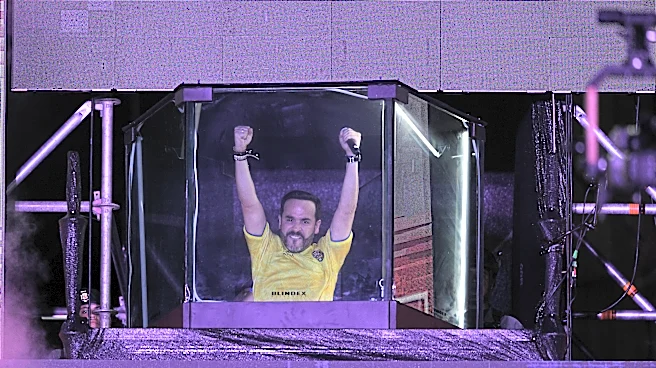









BOGOTA, Colombia (AP) — Trump-endorsed outsider Abelardo de la Espriella appears to have won Colombia's presidential election, making Colombia the latest country in Latin America to have chosen more conservative leadership.
De la Espriella was leading over rival Iván Cepeda by about one percentage point — about 251,000 votes — with nearly all votes counted Monday. Officials have not yet declared a winner. Cepeda has challenged the results, but that
review is unlikely to change the outcome.
De la Espriella campaigned on a tough-on-crime approach, which includes proposals like canceling peace talks with Colombian rebel groups and building mega prisons, like those in El Salvador. He was endorsed by U.S. President Donald Trump who described the lawyer and business owner, nicknamed “The Tiger,” as the candidate who could restore law and order in Colombia.
Here is a look at the Latin American countries that have elected conservative presidents in recent years:
Javier Milei, an economist and television commentator nicknamed “The Lion,” won Argentina’s presidential election in November 2023 by promising to slash government spending and tackle the South American nation’s decades-long inflation problem. The libertarian defeated the ruling Peronist movement.
During his tenure, Milei has stopped the nation’s central bank from printing money to finance the government deficit and has cut government spending by firing civil servants and halting investment in public infrastructure programs, while reducing subsidies for public utility bills.
Argentina's inflation has fallen from 211% in 2023 to 32% in 2025. However some have blamed Milei's austerity policies for decreasing the living standards of many Argentines, including public sector workers.
Daniel Noboa, a member of one of Ecuador’s wealthiest families, was reelected to a four- year term in April 2025, winning the election with 56% of the vote. The conservative leader has given the military a more prominent role in providing security in coastal cities overrun by drug gangs fighting over the control of ports and drug trafficking routes.
But the strategy has not substantially reduced homicide rates. The government also has been criticized for human rights abuses, such as extrajudicial executions.
Under Noboa’s watch, Ecuador’s military has started to conduct joint operations against drug traffickers with the U.S. Noboa also pushed for the reopening of a U.S. military base in Ecuador, but the proposal was struck down in a referendum last year.
Nasry Asfura, a real estate investor and former city mayor of the National Party narrowly won the presidential election in Honduras in November, defeating his closest rival by less than a percentage point.
Asfura, who belongs to the same party as former President Juan Orlando Hernández who was pardoned by Trump for a drug trafficking conviction, was endorsed by the U.S. president, who threatened to cut off aid to the small Central American country if Nasfura was not elected. Under Asfura’s administration, Honduras has received dozens of deportees from third countries through an agreement that was signed with the U.S. in early 2025, most of them Guatemalan nationals.
In December, José Antonio Kast, a conservative and a devout Catholic, won Chile’s presidential election with 58% of the vote, defeating a progressive government that had been in power for the previous four years.
In his campaigns, Kast capitalized on fears over increasing crime rates in Chile and said he would expel migrants from countries like Venezuela and Haiti that had been working in Chile without residency permits. One of his first moves after taking office has been to expand a trench along Chile’s borders with Peru and Bolivia in a bid, his government says, to stop drug trafficking and migration.
Kast’s government has recently faced protests over increasing unemployment and budget cuts that have affected public servants.
Laura Fernández, an economy minister under conservative ex-President Rodrigo Chaves, won Costa Rica’s election in February with 48% of the vote, defeating her closest rival by 15 percentage points and surpassing the 40% of votes needed to avoid a runoff election.
During her campaign, Fernández proposed tough-on-crime measures, including a state of exception that would enable police to arrest suspects without warrants, and said she would build a mega prison modeled after El Salvador’s notorious CECOT penitentiary.
Fernández’s government has received several flights with migrants from third countries deported by the U.S. as she complies with an agreement that was signed by her predecessor last year. In June, one of these flights had migrants from China, Vietnam, Colombia and Azerbaijan.
___
Follow AP’s Latin America coverage at https://apnews.com/hub/latin-america