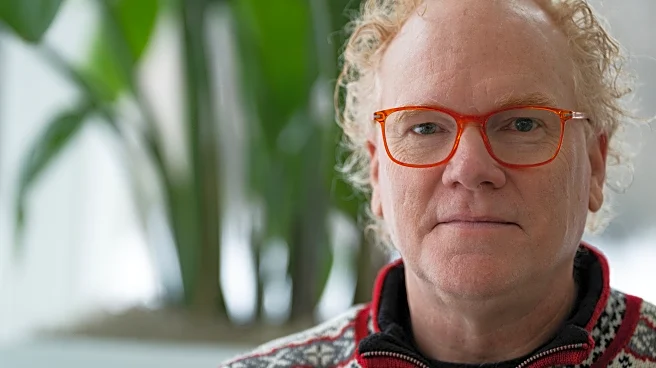



David Geeslin can still remember what it felt like to start learning American Sign Language as a toddler.
“My world became much clearer and more colorful,” Geeslin said through an ASL interpreter. “It wasn’t black and white anymore.”
Sign language opened up opportunities for Geeslin. When he was 3 years old, he enrolled at Indiana School for the Deaf. After earning his bachelor’s, master’s and doctorate degrees, Geeslin served as superintendent there
until retiring in 2025.
Now, though, Geeslin and other prominent members of the local Deaf community are concerned that a new master’s program at Butler University will result in fewer deaf kids learning to sign.
Butler’s new online master’s program in Deaf education will train future educators how to teach speaking and listening to deaf children, particularly kids who have cochlear implants or use other hearing technology. The new program is funded through a $1.25-million grant from the federal Department of Education.
But community members are upset that Butler’s curriculum only includes one ASL class, a one-credit course that teaches basic signs and “stories, poems and readings that exist in Deaf culture.”
Jenna Voss, director of the new Butler program, told Mirror Indy that the degree is designed to train teachers who can give children and families options, and that the curriculum’s focus on oral and spoken language does not prevent people from learning ASL separately.
“There will be deaf children who sign as their primary way of communicating and connecting with others, and there are deaf children who use hearing technology and use the spoken languages of their family’s homes and hearts,” Voss told Mirror Indy. “We need a workforce that can meet all of those needs.”
Research is split on the best way to educate deaf kids — whether that be through listening and spoken language, ASL or a mix of both. What is clear, though, is deaf children are far more likely than hearing children to experience language deprivation. That’s a communication disorder that develops when kids don’t have consistent access to a language — whether ASL or English — as babies and toddlers.
Many studies have found that teaching deaf children sign language helps them communicate naturally, even if they will eventually develop the ability to speak or hear using hearing aids or a cochlear implant.
Butler’s program, which launches this fall, comes amid changes to sign language programs at Indiana colleges. As part of an effort to cut degrees without a certain number of graduates, IU Indianapolis eliminated its bachelor’s degree in ASL interpreting and is no longer accepting new students. Ball State’s Deaf education program, similarly, is required to merge with other degrees before next school year.
After Butler announced the program in mid-January, community members started sending letters to Butler to ask that the university add more ASL classes to the curriculum. The letter campaign was organized by the Indiana Association of the Deaf.
“Some (deaf people) speak better than they sign, some sign better than they speak,” Geoffrey Bignell, director of advocacy for Indiana Association of the Deaf, said through an interpreter. “It’s very diverse, so providing everything is best, rather than limiting a professional who is going to be working in this environment.”
Christine Multra Kraft became deaf when she was 4 years old.
Because she had already learned to speak English, Kraft’s parents encouraged her to keep that skill as the family adjusted. But she struggled — until she started signing.
“I picked it up so quickly,” Kraft said through an ASL interpreter. “I was able to be back to myself.”
So when Kraft saw that Butler’s program would focus solely on spoken language, she was upset at what she saw as an attempt to force kids to speak rather than learn a language that comes more naturally to them.
“That perspective out there is that it’s like, oh, they need to be fixed,” Kraft said. “Sign language, there’s no failure there. It’s helping people grow as an individual, as a person.”
For many deaf people, though, there’s a fear that spoken language programs are repeating history. In the late 19th and early 20th centuries, sign language was banned in many Deaf schools, and children were required to attempt to speak and read lips.
This mindset started to shift in the 1960s, when scholars recognized ASL as a language. But an official decree that banned sign language was not officially redacted until 2010.
So, when Bonnie Conner heard about Butler’s new program, her thought was — “not again.” While she’s not against deaf people learning to speak, she’s upset that future teachers of the deaf wouldn’t be required to learn ASL.
“Why don’t hearing people listen to deaf people?” Bonnie Conner, who is chair of Vincennes’ ASL and Deaf culture program, asked through an interpreter. “Why don’t they listen to what they already know, their experiences? How can hearing people ever live in our shoes?
“They can’t. They never will, so at least they could understand our experiences and what we know from our experience.”
As with the research, parents too are often split on whether teaching sign or spoken language to their deaf children is the correct approach.
Perhaps that’s unsurprising, given that over 90% of deaf children are born to hearing parents. According to a 2013 survey from Gallaudet University, the nation’s preeminent Deaf college, less than a quarter of families with deaf children regularly use sign language at home.
Brooklyn Lowery, whose 7-year-old daughter Salem is deaf, is happy more future teachers will be trained to help kids listen and speak. While Lowery said she’d be supportive if her daughter wants to learn more ASL, she’s excelling at her IPS school now.
Giving families the option to choose, Lowery thinks, is important.
“Most people have no idea until they see her hearing aids that she has any difficulty at all hearing what’s going on around her,” Lowery said. “She just adapted beautifully to that situation.”
The new program at Butler is one of just five Deaf education programs in the country with a focus on spoken language, according to the program’s website. The program is a continuation of a long-running program at Fontbonne University near St. Louis, which closed last August.
In response to concerns from the Deaf community regarding sign language, Voss told Mirror Indy that Butler offers ASL as a foreign language for undergraduate students and is adding an ASL minor, which will also be launching in the fall. These classes won’t be part of the master’s program, though.
Rather, Voss said, the new degree curriculum will help students who want to pursue a career specifically in helping deaf kids learn listening and speaking skills.
“I think there are some people that would suggest every practitioner in our field needs to be able to do all the things,” she said. “I pragmatically and practically think that there is a space for specialization.”
___
Claire Rafford covers higher education for Mirror Indy in partnership with Open Campus
___
This story was originally published by Mirror Indy and distributed through a partnership with The Associated Press.