




President Donald Trump has signed an agreement with Iran that calls for Tehran to dilute its stockpile of highly enriched uranium and waives U.S.-backed sanctions on the country, immediately allowing Iran to sell its oil freely in a major concession from Washington, according to details released by both countries.
The White House had planned a signing ceremony on Friday in Switzerland, but its fate is now uncertain, with conflicting information from
the U.S., Iran and Pakistan.
Meanwhile, U.S. Defense Secretary Pete Hegseth lashed out at NATO allies Thursday, announcing a six-month Pentagon review of American forces in Europe whose outcome will depend on how fast the Europeans take responsibility for their own security.
Here's the latest:
U.S. Vice President JD Vance made the announcement Thursday at a White House news briefing, where he said more oil is now flowing through the Strait of Hormuz. The Republican vice president says more than 12.5 million barrels went through the shipping channel Wednesday night.
Vance says that’s the highest since the conflict began in late February. Vance says the U.S. is honoring its end of the early part of the agreement on the military side.
“So we’re also honoring our end of the early part of the agreement on the military side,” Vance said.
Vance cited it as an immediate benefit of the deal as he downplayed criticism that the agreement tilts in favor of Iran.
▶ Read more
Israeli Prime Minister Benjamin Netanyahu said Thursday that Israel’s military will stay in southern Lebanon, where it has occupied up to 10 kilometers (6 miles) from the border.
The remarks were his first comment since the U.S.-Iran deal was signed. Netanyahu said Israel must “maintain a security zone in southern Lebanon, and it requires that we must not leave there as long as Israel’s security needs require it.”
He’s made similar comments in the past about Israel’s refusal to withdraw from southern Lebanon.
The U.S.-Iran deal to end the war in the Middle East, signed overnight, also calls for an end to the war in Lebanon, where Israel has been fighting the militant Hezbollah group, but it’s unclear what that means in practice.
▶ Read more
Lawmakers on national security committees received the memorandum of understanding between Iran and the United States on Thursday morning after asking for it for several days.
The Trump administration still hasn’t briefed lawmakers though, even members of leadership — a highly unusual delay.
Senate Majority Leader John Thune said Thursday morning that he anticipates a briefing “early next week.”
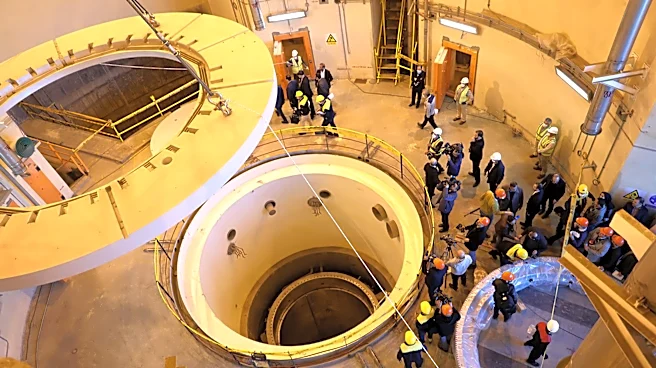
The draft agreement calls for Iran’s highly enriched uranium to be “downblended” — or diluted — under the supervision of the International Atomic Energy Agency. The two sides will work out the details during their negotiations as well as generally discuss Iran’s enrichment program, which it says it has a right to continue.
Iran developed the material in response to Trump’s scuttling of Tehran’s 2015 nuclear accord with world powers that prevented it from enriching uranium to high levels. He criticized the deal for giving Iran a huge windfall. But the interim deal outlines even more lucrative incentives if Iran reaches a new nuclear agreement.
One is the eventual lifting of all international sanctions, which would seem to go further than the 2015 accord. That agreement lifted sanctions related to Iran’s nuclear program but kept others in place over what the U.S. alleged were Tehran’s support for terrorism and rights abuses.
The interim pact also promises a $300 billion fund for postwar reconstruction. It’s not clear where that money will come from — but Trump said the U.S. would not contribute.
The deal immediately waives, but doesn’t eliminate, sanctions Trump imposed on Iran’s oil exports, allowing it once again to sell its crude on the world market and restoring a revenue stream worth billions.
Last year, Iran earned an estimated $45 billion from oil sales. But it had only one major buyer, China, and had to ship its crude through a shadow fleet of tankers to elude sanctions, eating into its profits. Under the blockade since April, its exports have nearly ground to a halt.
With the waiver, Iran will likely be able to find more customers and sell its oil for higher prices.
U.S. Defense Secretary Pete Hegseth said Thursday that the military will help “ensure Iran does the right thing at the table with this deal,” he said before boarding a plane.
“There’s not a lot of trust,” he said of the two sides, and Washington would be verifying that Tehran upholds its end of the peace.
“Iran’s going to have every opportunity to cut the kind of deal they should at the table, and if they don’t, the War Department will be right here ready to go,” he said after a meeting the NATO headquarters in Brussels where Hegseth lashed out at allies for not supporting the U.S. military to wage war on Iran.
“Whether it’s our military posture or it’s the carrots that exist to ensure Iran never has a nuclear weapon — all performance based,” Hegseth said. “We’re going to be the big stick behind the negotiations that never existed under President Obama.”
Phillip Belcher, marine director of Intertanko, a trade group for global independent tanker owners, said the main central route of the Strait of Hormuz is still closed and has an estimated 80 mines that need to be cleared.
But ships have been passing through the smaller Northern route, which goes through Iranian waters, and the Southern route, which goes through Omani waters.
“This is like a highway where the road in the middle is closed and you’re using that hard shoulder,” Belcher said. “That’s now being used as the main route. We need to get back to having the highway open.”
Major shipowners have begun moving vessels through the Strait of Hormuz since the memorandum of understanding was signed Wednesday, according to maritime data company Lloyd’s List Intelligence.
In a media briefing, Richard Meade, editor-in-chief of Lloyd’s List, said for the first time in 110 days, ships owned by major companies are transiting the strait after effectively being marooned there since February.
They did not give data on how many ships have passed through the strait as of Thursday. Tankers controlled by major ship owners Grimaldi Group, Cosco, Knutsen and NYK have passed through the strait. And two Iran-flagged, National Iranian Tanker Company-owned, sanctioned crude oil tankers have entered the strait, according to Lloyd’s List.
Pakistan has postponed a planned visit to Switzerland’s resort near Lucerne, where Islamabad was to host a ceremony for the signing of the Memorandum of Understanding between the United States and Iran, two senior officials said.
Prime Minister Shehbaz Sharif and top officials were expected to travel to Switzerland for the ceremony.
The officials said the visit was postponed because the Islamabad Memorandum of Understanding had already been signed electronically, entered into force, and moved into the implementation phase.
They spoke on condition of anonymity because of the sensitivity of the matter.
They said the next phase would proceed through separate technical-level tracks covering multiple issues under the comprehensive framework. Pakistan remains fully engaged in supporting the agreement’s implementation and ensuring sustained diplomatic follow-through, the officials added.
— Munir Ahmed
JD Vance was supposed to be spending the week promoting his new book, the kind of event a potential presidential candidate like the vice president typically uses to speak to a wide audience about his life and values ahead of a campaign.
Instead, the rollout of Vance’s second book, “Communion: Finding My Way Back to Faith,” has been largely crowded out by something else he’s put his name on: the tentative deal to end the Iran war.
The Republican vice president has embraced the role of chief defender of the agreement he and President Trump signed with Tehran, giving a series of interviews touting the memorandum of understanding as a success and releasing a video championing it.
It’s a striking emergence for a politician who was known for his skepticism of foreign military interventions and who seemed reluctant to speak on the conflict when Trump launched it in late February.
▶ Read more
For months, and sometimes longer, parents of kids with disabilities say they’ve waited for the Education Department to make progress on their complaints of bullying or other discrimination.
Now that the department is offloading civil rights enforcement and special education, some parents and advocates warn a process that’s largely been stalled since Trump took office will see only more chaos and roadblocks.
“It’s to the point I don’t even check in anymore with the attorney,” said Nicole May, an Ohio mother. May filed a complaint in spring 2024 with the department’s Office for Civil Rights, alleging her teenage daughter was bullied over her hearing aids and was getting in trouble in class because she couldn’t hear her teachers. More than two years later, the case lacks a resolution.
Under the changes announced Tuesday, the Department of Justice will take over civil rights enforcement in schools, and the Department of Health and Human Services will oversee special education. The moves help fulfill Trump’s campaign promise to dismantle the Education Department. Linda McMahon, the education secretary, pitched the changes as a way to get more help to families of kids with disabilities.
▶ Read more
Prices fell below $4 a gallon on average Thursday, but just barely.
It’s the first time since March that the average cost for a regular gallon has been that low. Prices fell overnight after President Trump signed an agreement with Iran that calls for Tehran to dilute its stockpile of highly enriched uranium and waives U.S.-backed sanctions on the country.
Gas prices are at $3.999 on average in the U.S., according to motor club AAA.
But fluctuations in gas prices remain across the country. In California, gas prices are averaging $5.64 per gallon, while in South Carolina it’s $3.58 per gallon.
▶ Read more
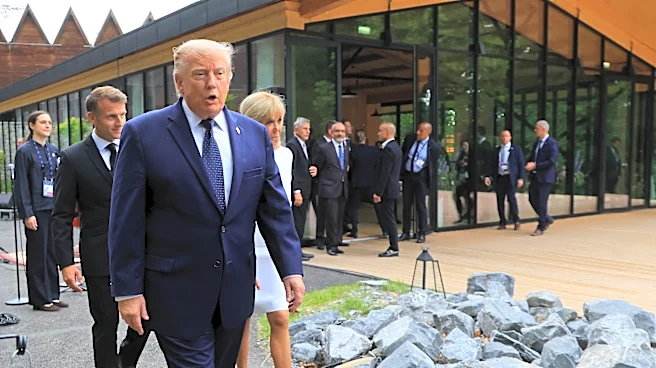
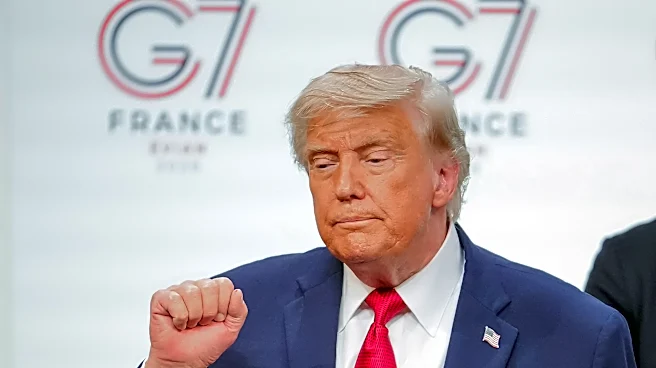
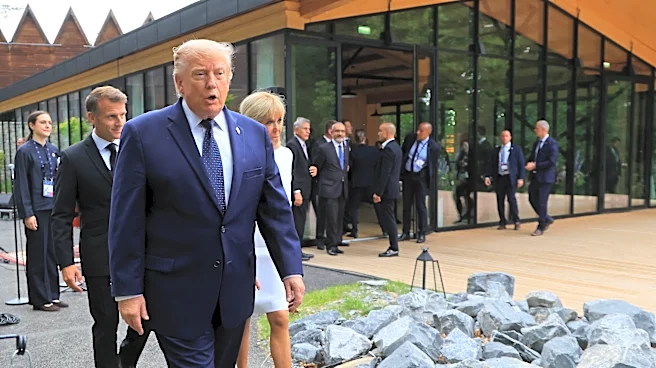
Trump, soon after returning to Washington early Thursday morning from the G7, took to social media to push back against critics of the Iran deal.
“These fools, who think I haven’t been tough enough on Iran, when the Stock Market Just Hit A RECORD HIGH, and Oil prices are ‘tumbling’ down, are either jealous, bad people, or stupid,” Trump posted on Truth Social.
Donald Trump explained the appeal in one sentence: “Versailles is not gold leaf — Versailles is the real deal.”
For Emmanuel Macron, that was precisely the point.
On Wednesday night, the French president threw open Louis XIV’s palace to his U.S. counterpart for a private reception, show and dinner marking America’s 250th birthday. At a turbulent moment for the trans-Atlantic alliance, it could help Macron keep a personal channel open as the two navigate differences over Iran, Ukraine and tariffs.
It already kept Trump from leaving a Group of Seven summit early, as he did last year in Canada.
“I’m a fan of beautiful places,” he told reporters, saying he had planned to leave earlier until “a very nice man” invited him to dinner.
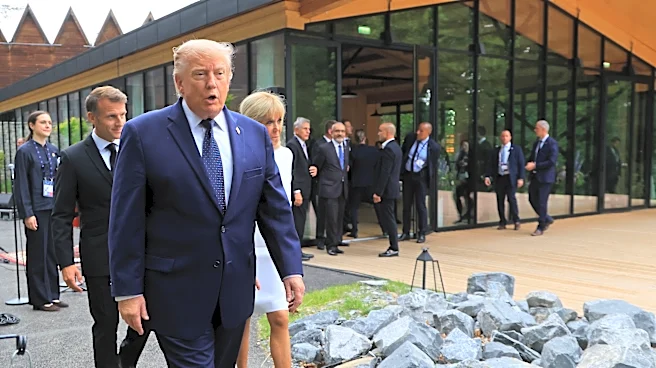
After posing in front of Versailles’ golden doors, Trump enjoyed a private tour of the chateau’s glittering interior. And in a surprise move over a dinner of lobster, caviar and vanilla ice cream, he signed a memorandum on ending the war in Iran at a venue steeped in historical symbolism.
▶ Read more
The Trump administration said Wednesday it’s buying back another energy company’s U.S. offshore wind leases for four more wind projects, as it seeks to discourage the expansion of wind energy in favor of fossil fuels.
The latest deal brings the total amount spent on these agreements to nearly $2.6 billion.
Chicago-based Invenergy has agreed to end its four offshore wind leases that were very early in development in exchange for reimbursements of lease fees totaling $765 million. The company had already canceled the largest of the four in November, Leading Light Wind off New Jersey’s coast. The others are off the coasts of Maine and California. It will invest that money in natural gas and geothermal ventures that can be built more quickly instead.
By buying back leases, the Republican administration is stopping offshore wind farms that Trump does not support and redirecting the money to fossil fuel projects that he does. It adopted this strategy after federal courts thwarted Trump’s efforts to stop offshore wind development through executive action. Trump has frequently talked about his hatred of wind power and calls turbines ugly.
▶ Read more
U.S. Defense Secretary Pete Hegseth lashed out at NATO allies on Thursday, announcing a six-month Pentagon review of American forces in Europe whose outcome will depend on how fast the Europeans take responsibility for their own security.
“This will be a real review. It will be designed to ensure that NATO is moving fast and irreversibly toward Europe leading, stepping up to take primary responsibility for the defense of Europe,” he told his NATO counterparts in Brussels.
Hegseth lambasted European allies for failing to provide U.S. forces access to bases in Europe to launch attacks on Iran, calling it “shameful.”
“These allies, they put America’s sons and daughters, our sons and daughters, at risk by denying them the predictable access, basing and overflight that never should have been in question at all,” he said.
Taking the microphone at the top of the meeting, Hegseth also railed against migration and gender equality policies in Europe, in remarks reminiscent to those of Vice President JD Vance in February last year that angered many Europeans.
▶ Read more
Senior U.S. officials on Wednesday read the memorandum of understanding with Iran to journalists after days of secrecy over what is in the document.
The officials spoke on condition of anonymity to read the deal before a formal signing ceremony set for Friday. Iranian state TV later released text that largely tracked what the U.S. put out.
Pakistani Prime Minister Shehbaz Sharif, whose country has been mediating between the sides, later said the leaders of the U.S. and Iran had signed the deal and it “shall enter into force with immediate effect.”
▶ Read what’s in the deal
President Donald Trump signed an agreement with Iran on Wednesday that calls for Tehran to dilute its stockpile of highly enriched uranium and waives U.S.-backed sanctions on the country, immediately allowing Iran to sell its oil freely in a major concession from Washington, according to details released by both countries.
The initial deal to end the war takes “immediate effect” after leaders from both countries signed it, Pakistani Prime Minister Shehbaz Sharif, who helped mediate the agreement, said online.
The agreement calls for a permanent end to hostilities and starts a 60-day negotiating clock to reach a final deal on the future of Iran’s nuclear program, though Trump left the door open to resume attacks. It appears to offer Iran several benefits up front while extracting little in return.
The deal has been shrouded in secrecy and confusion for days. The White House had planned a signing ceremony on Friday in Switzerland, but its fate is now uncertain, with conflicting information from the U.S., Iran and Pakistan.
▶ Read more