



In Noida’s Harijan Basti, a lot of doors are now locked, and the daily rhythm of cooks and cleaners rushing to work is no longer the same. The reason?
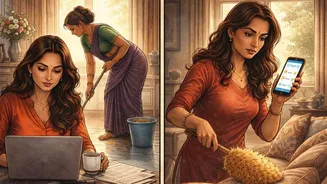
Many have left temporarily for 'Kal-katta' to vote, taking unpaid leave from the homes they work in for as long as a month. As a result, urban households from Noida to Delhi to Mumbai to Bengaluru are suddenly discovering how dependent they are on a workforce that moves between states. And right now, that workforce is on the move. As per estimates, a significant portion of domestic workers in metros come from states like West Bengal, Odisha, and Jharkhand. For many of them, elections are not civic duty, they are an economic strategy. Some domestic workers say that welfare schemes introduced by 'Mamata didi' such as the Lakshmir Bhandar initiative, which offers financial support to women from economically weaker sections, have become a crucial incentive. For some, the ₹1200 assistance is reason enough to make the journey home, even if it means losing their jobs and find replacements. The ripple effect is everywhere. A Mumbai resident’s video talking about her maid’s sudden departure quickly went viral, with comments pouring in from people across cities facing the same issue. Urban homes that are built on tightly scheduled routines are now juggling work calls with washing dishes and deadlines with daily chores. In many of these homes, where both partners work full-time, the absence of domestic help is not just inconvenient, it upsets entire systems. School tiffins, elder care and even basic meals suddenly become big challenges, revealing how much we depend on domestic workers. Many unable to find replacements are turning to app-based services like Snabbit and Meehelp, hoping to plug the gap. But reliability remains uncertain. “It’s luck if you find someone good on these apps. And now there’s this added anxiety, you cannot fully depend on anyone,” one resident says. The sudden spike in demand is also testing India’s domestic help platforms, raising questions about whether tech can truly formalise a sector built on trust and continuity. Behind the inconvenience lies a more complex story. Migration from eastern India to metro cities has long powered urban households, with generations of women moving for domestic work. But due to the war, for many domestic workers, city life is becoming increasingly difficult to sustain. The black market for LPG, which many of these women rely on, along with the constant negotiation of space, cost and dignity, is pushing them to reconsider their options. “Ever since the LPG price hikes in black market, we have been cooking on wood fire,” says Savita Haldar, a cook and cleaner. “But landlords don’t allow it here. Gas is too expensive. So where do we go?” “We also have families there, not just here,” says another worker who travels home during elections. “For you it is work but for us it is also our life.” For some, going back home where costs are lower and benefits more accessible feels like a smart choice. What urban India is experiencing as a ‘baai crisis’ is in reality a quiet power shift. It exposes the informal systems that keep cities functioning and how quickly they falter when those at the margins choose or are finally able, to step away. Because sometimes, it takes an election not just to change governments but to reveal who really runs the everyday machinery of urban life.