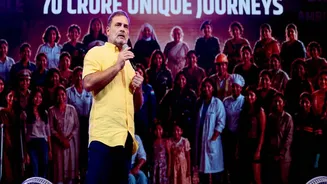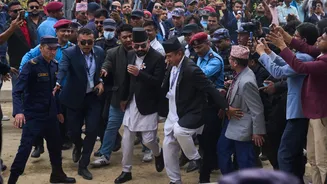

Nepal PM Balen Shah is facing growing pressure barely 150 days after the former rapper and Kathmandu mayor rode a wave of Gen Z anger into the country's
top political office. What began as a sweeping political honeymoon is now being tested on several fronts, with protests returning to the streets, opposition lawmakers demanding greater accountability and members of his own Rastriya Swatantra Party (RSP) questioning his style of governance. The pressure has built quickly. Shah took office on March 27 after the RSP won 182 of Nepal's 275 House seats, but barely two months later young protesters were back at Kathmandu's Maitighar Mandala demanding his resignation, signalling how quickly public expectations around the new government have shifted.
Protests Put Balen Shah Under Pressure
One of the early flashpoints came in April, when the government moved to strictly enforce customs rules on goods brought across Nepal's open border with India. The move affected people who rely on Indian markets for groceries, medicines and other household essentials, triggering protests in border towns.
Authorities subsequently relaxed the measures. But the episode offered an early indication of the difficulty Shah's government could face in translating an aggressive reform agenda into policies that do not immediately affect communities dependent on cross-border trade.
Public anger intensified in July following the death of 25-year-old ride-share driver Ganesh Nepali. Nepali died after self-immolating outside Kathmandu's passport office following a dispute involving municipal action against his vehicle.
His death fuelled demonstrations over municipal policing and revived criticism of government drives involving informal settlements and landless squatters. Critics argued that enforcement measures needed to be accompanied by adequate rehabilitation, adding another layer to the political pressure facing Shah.
The prime minister has also faced sustained criticism over Nepal's territorial dispute with India. His remarks concerning Nepal encroaching on Indian territory drew opposition criticism, while violent communal clashes in southern Nepal along the Indian border further complicated the government's position.
Parliament And RSP Unease Grow
The pressure is not limited to the streets. Shah's attendance record in Parliament has become a major point of contention, with opposition MPs attacking his repeated absence from House proceedings.
He attended only five of the first 39 sittings, according to the account provided, prompting Speaker Dol Prasad Aryal to direct him to appear before lawmakers and answer questions on August 26. The confrontation puts the prime minister in a position where he must now respond directly to criticism from Parliament while facing broader dissatisfaction outside it.
The strain has also begun to show inside the RSP. Lawmakers and senior party figures have questioned Shah's distance from the party organisation and what they view as a unilateral approach to governing. RSP MP Jagadish Kharel delivered a pointed criticism in Parliament, saying, “Govt will not survive if only the dignity of the PM is preserved. Our dignity must also be preserved.”
At barely 150 days into his tenure, the former mayor now faces the harder task of converting electoral momentum into political stability. The immediate tests will come from the streets, Parliament and within the RSP itself.