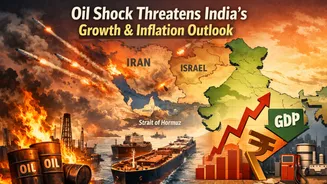










Amid the ongoing tensions in the Middle East, primarily led by the US and Israel joint attack on Iran, the economists have expected slower growth for India
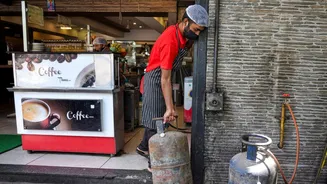
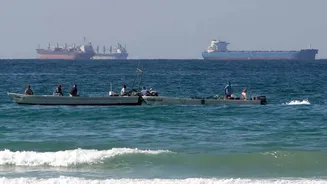
due to its reliance on the imported oil. Economists at banks including Goldman Sachs Group, ICICI Bank, IndusInd Bank have raised concerns with the heightened geo-political uncertainties. In a report on India’s trade, economists at the ICICI Bank have said that looking ahead, the Iran Israel war remain as a key risk for the Financial Year 2027 (FY27), with potential impacts on exports, remittances, and oil prices if tensions persist. Assuming average crude prices of USD 80 per barrel, the goods deficit could rise to USD 383 billion, with the current account deficit widening to 1.4% of GDP. Additionally, heightened global uncertainty is expected to keep foreign portfolio investment flows subdued, putting pressure on the rupee, which is projected to trade in the range of 91.5–93.5 per US dollar in the near term, they highlighted. Goldman Sachs has lowered India’s GDP growth forecast for FY26 to 6.5% from 7%. It has also estimated the inflation to rise to 4.2% from 3.9%. Further, the Fitch Ratings expected India’s economy to grow at 7.5% in FY26 but sees the pace moderating to 6.7% in FY27. It projected inflation to climb to 4.5% by December due to rising crude oil prices. Australia and New Zealand (ANZ) Banking Group also warned that India’s heavy reliance on imported energy will weigh on growth. ANZ sees expansion slowing to 6.5%–6.8% in the fiscal year starting April, down from around 7%. What government data said on growth forecast? Before the Middle East crisis due toIran Israel war, the Indian economy was appearing in a sweet spot. As per the first official data released by the government, Indian economy expanded by a strong 7.8% in the October–December quarter of the current financial year. The government had also revised the FY26 GDP growth estimate to 7.6%, up from the earlier projection of 7.4%. As per the Economic Survey, the growth projection for FY27 was revised upward to 7%–7.4% under the new series, compared with 6.8%–7.2% under the earlier series. As reported by the Economic Times, India imports about 90% of its crude oil and nearly half of its liquefied petroleum gas (LPG). With the Strait of Hormuz now effectively shut by Iran, roughly half of India’s crude and over three-fourths of its LPG imports have been disrupted, sending oil prices soaring past USD 100 a barrel.