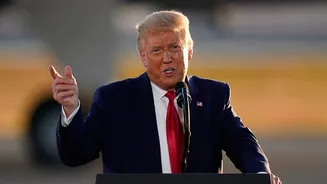








Fresh tariff threats from US President Donald Trump — this time linked to his push to secure Greenland — have unsettled global markets, reviving demand
for safe-haven assets such as gold and silver, while raising near-term volatility risks for equities, including in India. At the same time, analysts say the disruption could open up longer-term opportunities for India through faster trade negotiations and shifting global supply chains. On Saturday, Trump said the US would impose a 10% tariff from February 1, 2026, on imports from eight NATO-aligned European countries — Denmark, Norway, Sweden, France, Germany, the UK, the Netherlands and Finland — with the levy rising to 25% from June 1 if those nations refuse to negotiate the sale of Greenland, a Danish territory. The announcement, made via social media, marked Trump’s most aggressive effort yet to pressure Europe over the strategically important Arctic island, said an ET report. Trump said the tariffs would stay in place “until a Deal is reached for the Complete and Total purchase of Greenland,” arguing that US control of the island is critical to counter Chinese and Russian ambitions in the Arctic. Denmark and its European allies swiftly rejected the demand, triggering a rare show of unity across Europe and drawing criticism from both European leaders and some US lawmakers. Adding to the uncertainty, the US Supreme Court is currently weighing whether to overturn the legal authority Trump has previously used to threaten tariffs under the International Emergency Economic Powers Act. A ruling against the administration could complicate or delay the implementation of the proposed levies. If enacted, the new duties would likely be imposed on top of existing tariffs — currently 10% on UK imports and 15% on EU goods — raising the risk of retaliation and broader trade disruptions. While tariffs are formally paid by importers, the costs are often passed on to consumers, muddying the global inflation outlook. Safe-haven demand returns For investors, the immediate response has been renewed interest in safe-haven assets. Market participants say the Greenland tariff threat risks escalating geopolitical tensions, an environment that typically supports precious metals. Jateen Trivedi, VP–Research Analyst (Commodity & Currency) at LKP Securities, said gold has remained resilient amid multiple global flashpoints. “Gold traded in a flat-to-positive range, holding firm near Rs 1,43,150 on MCX and around $4,605 on Comex, comfortably sustaining above the $4,600 level,” he said. According to Trivedi, ongoing geopolitical uncertainty — including tensions involving the US, Iran and renewed strategic focus on Greenland — continues to underpin safe-haven demand. He added that gold is attracting a premium as an alternative to the dollar, with prices expected to remain volatile in a broad Rs 1,41,000–Rs 1,45,000 range in the near term ahead of the US Federal Reserve’s January policy meeting. Silver, which often tracks gold during periods of heightened uncertainty, is also likely to remain sensitive to geopolitical developments. Dalal Street: Volatility now, opportunity later For Indian equities, the impact is more nuanced. Experts expect short-term volatility if Trump’s tariff threats escalate into a wider trade conflict, but see potential longer-term positives emerging from the disruption. Analysts note that the standoff could accelerate negotiations on the long-pending India–EU Free Trade Agreement, with talks already in advanced stages. In the wake of Trump’s tariff threats against European economies, both India and the EU may push to finalise a deal. Over time, such an agreement could benefit India across sectors including pharmaceuticals, textiles, gems and jewellery, steel and metals, automobiles, solar equipment and leather. Indian markets ended the week cautiously higher despite global uncertainty. The Sensex rose 188 points, or 0.23%, to close at 83,570.35, while the Nifty gained 29 points, or 0.11%, to end at 25,694.35, snapping a two-session losing streak. IT and banking stocks led the recovery, with Infosys, TCS and Tech Mahindra among the top gainers. Key cues ahead Vinod Nair, Head of Research at Geojit Investments, said investor sentiment continues to swing between optimism and caution. “Indian equities ended the week with marginal gains, as sentiment oscillated between optimism over renewed India-US trade discussions and caution stemming from persistent geopolitical tensions,” he said, adding that prolonged global uncertainty has made foreign investors more risk-averse toward emerging markets and put upward pressure on bond yields. Going forward, Nair said market direction will be guided by global macro data — including US PCE inflation, GDP figures and jobless claims — which will shape expectations around the Federal Reserve’s interest-rate path. Domestically, PMI data, corporate earnings and management commentary will remain key triggers for Dalal Street.