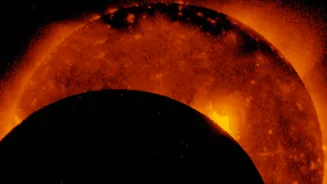

A rare total solar eclipse will occur on August 2, 2027, lasting 6 minutes and 23 seconds, the longest in a century, according to NASA. At the peak near
Luxor and Aswan in southern Egypt, daylight will dim significantly as the sun’s corona becomes visible around the moon. The eclipse path will begin over the Atlantic Ocean and move across southern Spain, Morocco, Algeria, Tunisia, Libya, Egypt, Saudi Arabia, Yemen, and end along the Somali coast. Areas outside this narrow path will see a partial eclipse.
Why This Eclipse Will Last So Long
The extended duration of the eclipse is caused by a favorable alignment of the Earth, moon, and sun. During this event, the moon will be relatively close to Earth, appearing slightly larger, while the Earth will be slightly farther from the sun, making the sun appear smaller.
This alignment allows the moon to cover the sun for a longer period than usual. For comparison, the April 2024 eclipse lasted about 4 minutes, 28 seconds, the August 2026 eclipse in Spain will last 1 minute, 43 seconds, and the last longer event occurred on July 11, 1991, with 6 minutes, 52 seconds of totality.
What Observers Should Do?
Observers should never look directly at the sun without certified solar filters, except during the brief phase of totality. Along the path of totality, people may experience sudden drops in temperature, rapid changes in light, and noticeable shifts in animal behavior as the sky darkens and daylight temporarily disappears.
Future long eclipses are predicted, including August 12, 2045, and May 22, 2096, both around 6 minutes, 6 seconds, but none are expected to exceed the July 1991 totality or reach the theoretical maximum of 7 minutes, 32 seconds.