






What is the story about?
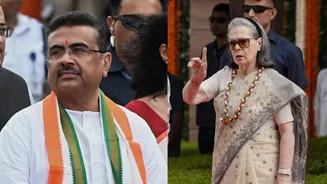
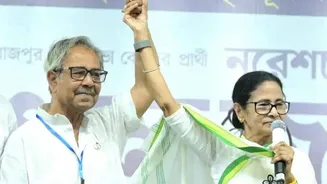
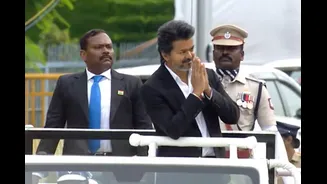
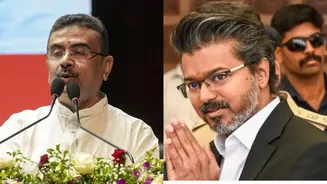
100 days in power, two states, two very different political playbooks. Tamil Nadu Chief Minister C Joseph Vijay and West Bengal Chief Minister Suvendu
Adhikari have completed their first 100 days in office — and both governments are using the milestone to showcase what they have changed. From welfare schemes, education and farmers' support in Tamil Nadu to welfare payouts, investments, administrative changes and a crackdown on extortion in Bengal, the first 100 days offer a glimpse into the priorities of the two new governments. Here's a closer look at what has changed in Tamil Nadu and West Bengal since Vijay and Adhikari took charge.
Vijay's Welfare Push In Tamil Nadu
Tamil Nadu Chief Minister Vijay marked the completion of 100 days with the theme "100 Days of Governance - A Government for Generations". According to the Tamil Nadu Chief Minister's Office (CMO), the government's focus has been on women's safety, farmers' welfare, youth skill development and transparent administration.
A dedicated Singapenn Special Task Force for Women Safety has been established to improve the safety and security of women.
Under the Thaaimaaman Thanga Mothiram Scheme, every newborn delivered in a government hospital will receive a 1-gram gold ring. The government has allocated Rs 560 crore for the scheme.
The Annan's Seer Scheme provides eligible women with an 8-gram gold coin and a silk saree for marriage. Rs 812 crore has been allocated for the scheme.
The Vettri Skill Training Scheme has provided skill development training to 12 lakh students and 1 lakh youth, according to the CMO.
The government has also expanded the Perunthalaivar Kamarajar Breakfast Scheme to cover an additional 15.14 lakh students in Classes 6 to 8 across 15,414 schools. Rs 710 crore has been allocated for the expansion.
Under the Vettri Laptop Scheme, Rs 2,000 crore has been earmarked to provide laptops to college students. Class XI students in government and government-aided schools are also being given branded bicycles with helmets and water bottles.
For farmers, the government has announced a Rs 6,000-crore crop loan waiver. It has also announced incentives of Rs 4,000 per tonne for sugarcane and Rs 2,750 per quintal for paddy.
The Vettri Housing Scheme has been allocated Rs 3,500 crore, while TN-VETTRI will receive Rs 6,000 crore annually to improve water supply, solid waste management, sanitation and rural connectivity.
The Vettri 150 Scheme guarantees 150 days of employment. The Vettri Magalir Goat Rearing Scheme provides five goats or sheep to disadvantaged women and transgender individuals.
On investment, the Vettri Tamil Nadu Investment Conclave 2026 secured Rs 1 lakh crore in investment commitments, according to the CMO.
The government has also formed 65 special task forces under STING - Special Task Force for Interdiction of Narcotics and Gangs - to tackle drug trafficking.
It also said 717 liquor shops located near educational institutions, temples and bus stands have been closed.
On governance, the CMO said steps have been taken towards "Honest and Transparent governance", including faster plan approvals and faceless property registration.
The government has also announced that domestic consumers using up to 500 units every two months will get 200 units of free electricity.
Vijay said the 100-day report reflects the government's commitment to a "Conscience of the People for an Era".
Suvendu's Bengal Reset
As West Bengal CM Suvendu Adhikari completes 100 days in office, the BJP government has highlighted welfare measures, Central schemes, investment plans, administrative changes and efforts to tackle extortion and syndicate activity as some of its key priorities.
Some of the government's first moves were symbolic. The blue-and-white signage associated with the previous Mamata Banerjee government has been repainted saffron in several places.
"Vande Mataram" has been made mandatory at school and madrasa assemblies, while the TMC's "Khela Hobe Diwas" has been replaced by "Ayushman Day", linked to the Centre's health scheme.
At the same time, Adhikari used his first Cabinet meeting to promise that no ongoing welfare scheme would be discontinued.
One of the government's main welfare initiatives is Annapurna Bhandar, which replaced Lakshmir Bhandar and doubled the monthly payout to women to Rs 3,000.
The first tranche reached more than 28 lakh women on June 3. By July 1, coverage had grown to around 1.1-1.3 crore beneficiaries, with the government eventually targeting close to two crore beneficiaries.
However, verification delays left several women without their August instalment, leading to criticism from the Opposition.
The government attributed the delay to verification and misinformation on social media.
"There is no reason for confusion. Eligible beneficiaries will certainly receive the money," Adhikari said, announcing that payments would resume from August 17 for applicants with error-free documents filed by July 10.
Municipal Affairs Minister Agnimitra Paul also acknowledged gaps in the beneficiary list.
"If any eligible woman has been left out, she should submit a written complaint," Paul said.
The government has also pushed Central schemes. According to the state government, 54 lakh farmers have received PM Kisan funds, 74 lakh toilets have been built and 40 lakh houses have been sanctioned under the PM Awas Yojana.
Ayushman Bharat has also been rolled out in the state, with 1.43 crore families identified for cards. The state has also signed a Rs 39,000-crore Jal Jeevan Mission agreement and is implementing the rooftop-solar Surya Ghar scheme.
Adhikari has described this as the tangible face of "double-engine" governance.
The Chief Minister has also identified unemployment as a major challenge in the state.
"There is a huge unemployment problem in West Bengal, but the state is rich in human resources, education, and a skilled workforce," Adhikari said.
Crackdown On Extortion
Tackling "cut money", extortion and syndicate activity has been another major focus of the Adhikari government.
Four toll-free helplines have been launched to receive complaints related to extortion, illegal tolls, syndicate activity and bootlegging.
The government has also taken action against its own party workers. Dozens have been suspended or expelled, while show-cause notices have been issued to more than 300 party leaders over extortion allegations.
State BJP president Samik Bhattacharya said: "Some people are trying to extort money using our party’s name. Chief Minister Suvendu Adhikari is taking strict administrative action. We are also taking action at the organisational level."
Agnimitra Paul acknowledged that the problem could not be eliminated overnight.
"The issue of extortion will continue to exist. We have not washed everyone clean in a detergent or a washing machine… They are human beings of flesh and blood," Paul said.
The government has also transferred senior IPS officers to the Anti-Corruption Branch for closer oversight.
Investment And Border Security
Adhikari has also made attracting investment a key priority.
He has announced a Rs 4,000-crore steel plant foundation in Purulia and highlighted Shyam Steel's proposed Rs 15,000-crore expansion in Bankura.
The Chief Minister has also cited interest from the Adani Group, RP-Sanjiv Goenka Group and Flipkart.
Adhikari has said Bengal will be "financially strong in the next one or two years".
He has also announced a push to revive the state's tea and textile sectors.
"One is the tea sector. We should do something for the tea garden workers. At least 25 tea gardens are closed. The other is textile… I have huge interest in these two sectors," Adhikari said, referring to a discussion with Union Finance Minister Nirmala Sitharaman.
Sitharaman is expected to visit West Bengal between August 24 and 28.
The state government is also finalising a single-window clearance system for investments above Rs 100 crore.
On national security, the BJP government has handed over 100 km of land to the BSF for border fencing along the Bangladesh border, including areas near the strategically important Chicken's Neck corridor.
The first 100 days of the two governments therefore show two distinct approaches. Vijay's Tamil Nadu government has put welfare, education, farmers and youth at the centre of its early agenda, while Adhikari's Bengal government has combined welfare with administrative changes, Central schemes, investment, border security and a crackdown on extortion.
The coming months will show how these announcements and initiatives translate into implementation on the ground.