








What is the story about?
Bengaluru may be renowned as India’s tech capital, but hidden amid its urban bustle lies a remarkable geological treasure, a rock formation that predates
almost all life on Earth. This ancient natural wonder, estimated to be about 3.4 billion years old, stands as one of the oldest exposed rocks on the planet, quietly towering above visitors inside the city’s most famous botanical garden.
An Ancient Witness Beneath Modern Bengaluru
Far older than the dinosaurs, the Himalayas and even Earth’s continents as we know them, the rock known as the Peninsular Gneiss offers a rare window into the deep geological history of our planet. According to many news reports like DH’s says that scientists estimate that this rock complex - formed during the Archaean Eon - is between 2.5 and 3.4 billion years old, meaning it solidified when the early Earth was still evolving.
The Peninsular Gneiss is a complex mix of metamorphic and igneous rocks created under intense heat and pressure deep within the Earth’s crust, the kind of conditions that existed long before life proliferated on land.
Where Is This Ancient Wonder?
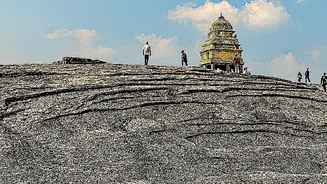
You don’t have to travel to remote hills or rugged terrain to see this geological marvel, it sits right in the heart of Lalbagh Botanical Garden in central Bengaluru. Within the sprawling 240-acre garden, the rock rises as a solid, striated hillock that visitors can climb and explore.Locally known as the Lalbagh Rock, the formation is recognised by the Geological Survey of India as a National Geological Monument, one of only a few such designated sites in the country. A Kempegowda watchtower atop the rock dates to the 16th century, marking the historical edge of the old city and offering panoramic views over Bengaluru.
Scientifically, the Peninsular Gneiss is hugely important. As one of the best exposed ancient rock masses in India, it helps geologists piece together how the Earth’s early crust formed and stabilised billions of years ago. Few places on Earth allow an ordinary visitor to literally walk on such primeval crustal fragments.