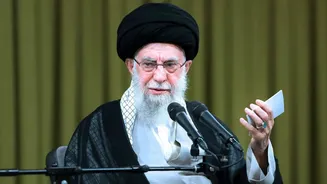

Iran's Supreme Leader Ayatollah Ali Khamenei has prepared a contingency plan to leave the country if nationwide protests intensify and security forces
fail to contain them, according to an intelligence report shared with The Times. The report says the 86-year-old leader would seek to leave Tehran with a small group of close aides and family members if he judged that the army or security services were deserting, defecting or refusing to follow orders. The group could include up to 20 people, among them his son Mojtaba, who is widely regarded as his heir apparent. "The 'plan B' is for Khamenei and his very close circle of associates and family," an intelligence source told The Times. Beni Sabti, a former Israeli intelligence officer who left Iran after the 1979 Islamic Revolution, said Khamenei's likely destination would be Moscow. "There is no other place for him," Sabti told the newspaper, adding that the Iranian leader "admires Putin" and that Iranian and Russian cultures are similar. The reported plan is said to be modelled on the escape of Syria's former president Bashar al-Assad, who fled to Russia in December 2024 as opposition forces closed in on Damascus. According to the intelligence source cited by The Times, preparations include "gathering assets, properties abroad and cash to facilitate their safe passage". Khamenei is known to control a vast network of assets through organisations such as Setad, part of Iran's system of semi-state foundations. A Reuters investigation in 2013 estimated the holdings at around $95bn, including properties and companies under his control. Many senior figures close to the supreme leader have family members living abroad, including in the United States, Canada and Dubai, the report said.
The claims come amid a wave of protests across Iran, triggered by economic hardship and reported in cities nationwide, including Qom. Demonstrators accuse security forces — including the Islamic Revolutionary Guard Corps (IRGC), the Basij militia, police and the army — of using live fire, tear gas and water cannons to disperse crowds.
Khamenei holds ultimate authority over Iran's political and security institutions and relies heavily on the IRGC to maintain control. According to a psychological assessment by a Western intelligence agency cited by The Times, desertion within the security forces would be a critical trigger for activating the escape plan.
The same report described Khamenei as "weaker, both mentally and physically" since last year's 12-day war with Israel. He has made few public appearances in recent days and was not seen during the latest protests. During the conflict with Israel, he reportedly remained in a bunker, reinforcing what the assessment described as an "obsession with survival".
Born in Mashhad in 1939, Khamenei rose through Iran's post-revolutionary system despite limited religious credentials. He survived an assassination attempt in 1981, which left him with permanent injuries. The intelligence assessment said the attempt reinforced his belief in a "divine mission" to lead Iran and protect the regime.
Recent setbacks suffered by Iran's regional allies — including Hezbollah and Hamas — have fuelled public anger at home, where inflation and living conditions have worsened. Protesters have been heard chanting: "No to Gaza, no to Lebanon, I'd give my life for Iran only."