







What is the story about?
DUBAI, United Arab Emirates (AP) — On Wednesday, Iran fired upon three ships in the Strait of Hormuz, heightening concerns over global energy security
and complicating ongoing efforts for dialogue between the United States and Iran to resolve the ongoing conflict. The Iranian paramilitary Revolutionary Guard reportedly executed the attacks following President Donald Trump's announcement of an indefinite extension of a ceasefire with Iran, which was set to expire on the same day.
Details of the Attacks
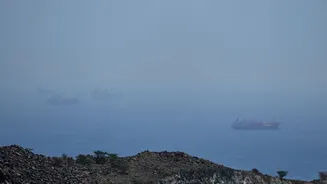
According to the United Kingdom Maritime Trade Operations Center, Iran targeted a container ship in the strait early Wednesday, followed by an assault on a second vessel shortly thereafter.Subsequent reports from Iranian state television indicated that the Revolutionary Guard had taken the vessels into custody, identifying them as the MSC Francesca and the Epaminondas. Efforts to reach the owners of the ships for comments were unsuccessful.
This escalation by Iranian leadership suggests a determination to negotiate from a position of strength after previous rounds of talks with the Trump administration resulted in increased hostilities.
Further reports from Nour News, Fars, and Mehr news agencies indicated that a third ship, named the Euphoria, was also attacked, with reports stating it had become stranded along the Iranian coast.
The UKMTO confirmed that the initial ship was attacked by a Revolutionary Guard gunboat that did not issue any warnings before firing, although there were no reported injuries from the incident.
Iran's Nour News claimed that fire was opened only after the ship allegedly ignored warnings from Iranian forces, while Fars described the action as Iran “lawfully enforcing” its jurisdiction over the Strait of Hormuz.
Since the onset of the conflict on February 28, which included U.S. and Israeli airstrikes on Iran, over 30 attacks on ships in the region have been documented.
Impact on Negotiations
The ability of Iran to control traffic through the Strait of Hormuz, a vital maritime corridor from the Persian Gulf to the ocean, has emerged as a significant strategic advantage.Despite the ceasefire halting American and Israeli airstrikes within Iran and preventing Tehran's missiles from targeting Israel and the broader Middle East, the maritime threat remains evident through the attacks in the strait and previous U.S. interceptions of Iranian vessels.
Without a diplomatic resolution, such maritime confrontations may persist, deterring vessels from traversing the strait and exacerbating global energy supply issues.
As of Wednesday, Brent crude oil prices were reported above $98 a barrel, reflecting a 35% increase since the conflict began.
Iran's Revolutionary Guard has issued statements promising to deliver severe consequences to its adversaries' remaining assets in the region.
On the eve of these attacks, hard-line supporters of Iran's regime held demonstrations showcasing missiles and launchers, signaling defiance towards both Israel and the United States, who have focused their airstrike campaigns on dismantling Iran's ballistic missile capabilities.
Uncertainty surrounds the timeline for the resumption of talks, with Pakistani officials indicating they await a response from Tehran regarding a potential delegation visit. Mojtaba Ferdousi Pour, head of the Iranian mission in Egypt, stated that no delegation would proceed to Pakistan until the U.S. lifts its blockade.
Casualties in Lebanon
In Lebanon, ongoing clashes between Israel and the Iran-backed Hezbollah have resulted in further violence. The state-run National News Agency reported that an Israeli drone strike in the village of Jabbour killed one individual and injured two others.Israel's military has denied conducting any attacks in that area.
Despite a 10-day ceasefire that commenced in Lebanon on Friday, multiple Israeli strikes have occurred, and Hezbollah claimed responsibility for its first attack on Tuesday.
Since the conflict's inception, Iranian authorities have reported at least 3,375 fatalities in Iran, over 2,290 in Lebanon, 23 in Israel, and more than a dozen in Gulf Arab states. Additionally, 15 Israeli soldiers in Lebanon and 13 U.S. service members in the region have also been killed.