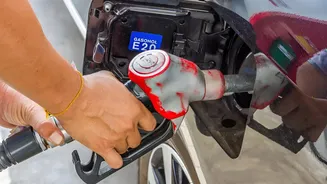









The Delhi Taxi and Tourist Transporters and Tour Operators Association has announced a protest march to Parliament on August 4, opposing the implementation
of ethanol-blended petrol. The E20 ethanol-blending policy has sparked a major controversy, centring on claims of reduced vehicle mileage, potential engine wear, and alleged conflicts of interest. The government has defended the programme, ruling out any immediate plan to increase blends beyond 20 per cent and asserting that the fuel is safe, clean, and helps farmers. At a press conference on Friday, association president Sanjay Samrat addressed concerns raised by transport operators and vehicle owners over the use of E20 fuel. Holding sugarcanes during the briefing, he said many transporters had reported issues related to fuel efficiency, maintenance expenses and vehicle performance. “Transport operators and vehicle owners from different parts of the country have reported reduced fuel efficiency, higher maintenance costs, and concerns regarding engine performance after the introduction of E20 fuel. Many vehicles manufactured before 2015 are not designed for 20 per cent ethanol blended petrol…This form of fuel is actually fit for new model vehicles…" Samrat said. The Ministry of Petroleum and Natural Gas has defended India's ethanol blending programme, rejecting claims that the country moved too quickly compared to nations like Brazil. The Ministry said India's transition towards ethanol-blended petrol has been a gradual, carefully planned process spanning more than two decades, backed by policy reforms, investment and expansion of production capacity. In an official response on why India appeared to accelerate its ethanol blending targets while Brazil took decades to build its ecosystem, the Ministry said ethanol as a fuel is not a recent innovation and has been used globally for over a century. The Ministry highlighted that ethanol blending initiatives in India predate the present government, with a pilot programme launched in 2001, formally announced in 2004, and E5 (5 per cent ethanol blending) introduced across several states by 2006. It added that the policy framework was notified in the Gazette of India in January 2013 during the previous UPA government. According to the Ministry, India had initially targeted 5 per cent ethanol blending across 10 states and Union Territories, but the programme struggled to progress, with blending levels remaining around 1.5 per cent until 2014. The Ministry said the primary challenge was not acceptance of ethanol as a fuel but the country's limited ability to produce sufficient quantities. "At the time, ethanol production depended largely on sugarcane, a seasonal crop, with annual production capacity of around 400 crore litres, which was insufficient to meet higher blending targets," it said.The government said the approach changed significantly after the launch of the National Policy on Biofuels in May 2018, which focused on creating an ecosystem for large-scale ethanol production.