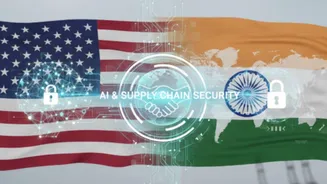

Washington DC: The United States sees India as a vital prospective partner in securing global AI and semiconductor supply chains, a senior American official
said, rejecting claims that political tensions kept India out of a recent Washington summit. Jacob Helberg, US Under Secretary of State for Economic Affairs, announced he will attend the India AI Impact Summit in February, as Washington aims to strengthen collaboration with New Delhi on “economic security matters.” Speaking to reporters virtually on Wednesday about the Pax Silica Summit in Washington, Helberg responded to questions regarding India’s absence from the event, which convened technologically advanced nations to coordinate strategies on AI infrastructure and semiconductor supply chains. "I want to be clear that the conversations between the United States and India pertaining to trade arrangements are a completely separate and parallel track to our discussions on supply chain security," Helberg said. "We are not conflating those two things." Helberg further emphasised that India was not "excluded" from the summit due to diplomatic friction, but is currently engaged through bilateral discussions rather than the multilateral framework. "We view India as a highly strategic potential partner on supply chain security-related efforts, and we welcome the opportunity to engage with them," he added. The Under Secretary stated that his participation in February's Delhi summit would offer a chance to set "tangible milestones" for US-India collaboration. Helberg said, "We are actively exploring ways to deepen that collaboration swiftly," adding that the summit would bring significant progress in bilateral economic security arrangements. Unveiled at the December summit, the Pax Silica initiative marks what organisers call a major shift in Washington’s economic policy, emphasising national security over traditional trade priorities. The framework is built on four pillars: rebalancing trade relationships, stabilising conflict zones through economic measures, revitalising American industry and safeguarding supply chains against vulnerabilities. Helberg described silicon and semiconductors as the "lifeblood" of modern technology, noting that the initiative aims to coordinate investment in fabrication plants, data centers and mineral refining among allied nations. The first summit brought together partners from Japan, South Korea, Singapore, the Netherlands, the UK, Israel, the UAE and Australia, along with participants from Taiwan, the EU, Canada and the OECD. (With inputs from ANI)